Copper Mining: Best Y Level and the Dripstone Trick
JavaCopper is never really rare. But one of our test seeds had 244,298 copper blocks in the chunks around spawn, two and a half times the others, and the reason was a giant dripstone cave sitting right underneath. Here's where copper actually sits, the tunnel height that pulls the most, and how to spot a seed that's secretly a copper mine.
Updated · 5 min read · Java up to 26.3
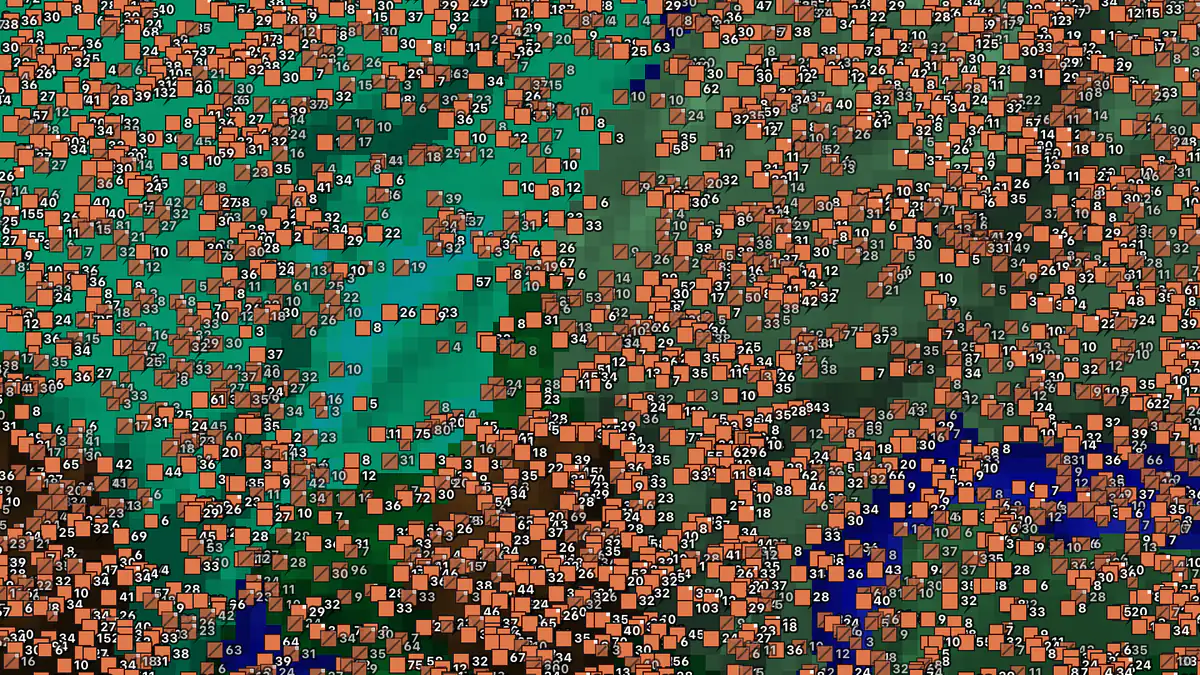
Feet at Y 45, done
If you want one number: tunnel with your feet around Y 45. Copper's spread peaks near Y 48, and a 2-high tunnel at Y 45 sees layers 44 to 47, right under that peak where the rock is still mostly solid.
We tested it the same way we did for debris. For the 32 by 32 chunks around spawn on three seeds, the engine placed every copper block the game would, with caves cut out, and we counted how many land in the four layers a tunnel touches (floor, feet, head, ceiling) at each height.
| Feet at | Seed 0 | Seed 123456789 | Seed −1234567890123 (dripstone) |
|---|---|---|---|
| Y 16 | 3,498 | 3,475 | 13,283 |
| Y 32 | 6,184 | 5,418 | 18,589 |
| Y 40 | 7,000 | 6,841 | 18,627 |
| Y 44 | 7,522 | 6,680 | 18,735 |
| Y 48 | 7,511 | 6,903 | 17,650 |
| Y 56 | 6,348 | 5,002 | 8,297 |
| Y 64 | 2,933 | 1,699 | 2,494 |
The best single height was Y 45 on seed 0 (7,589 blocks) and Y 47 on 123456789 (7,069). Anything from Y 40 to 48 came within 8% of the best. Above Y 56 it drops off a cliff, partly because the spread thins out and partly because that's where the ground runs out on a lot of terrain.
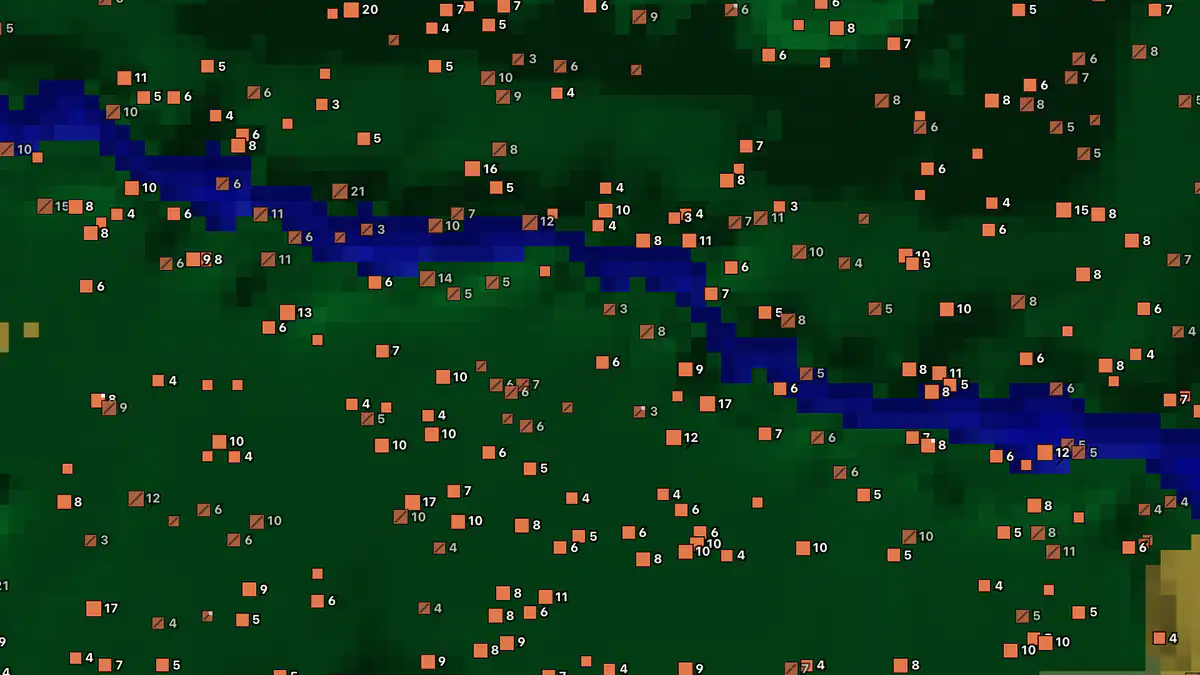
The dripstone trick
Now look at the last column again. Seed −1234567890123 had 244,298 copper blocks in its 1,024 chunks, against 95,256 on seed 0 and 84,680 on 123456789. That's 2.6 times as much copper, and the reason is under the floor.
Dripstone caves swap the normal copper ore for a bigger, denser version. On that seed, 214,577 of the copper blocks came from that large dripstone feature and only 29,721 from the regular one. The engine put 216,012 of them inside the dripstone caves biome. We sampled the biome at Y 0 across the 512 blocks around its spawn and it was dripstone caves at 99.8% of the points. The whole spawn area is sitting on one massive cave system.
It also flattens the best tunnel height. On the dripstone seed the best feet level was Y 36 (19,910 blocks), and everything from Y 28 to 48 came within 12% of it. When you're over a dripstone cave, the height barely matters. You're in copper either way.
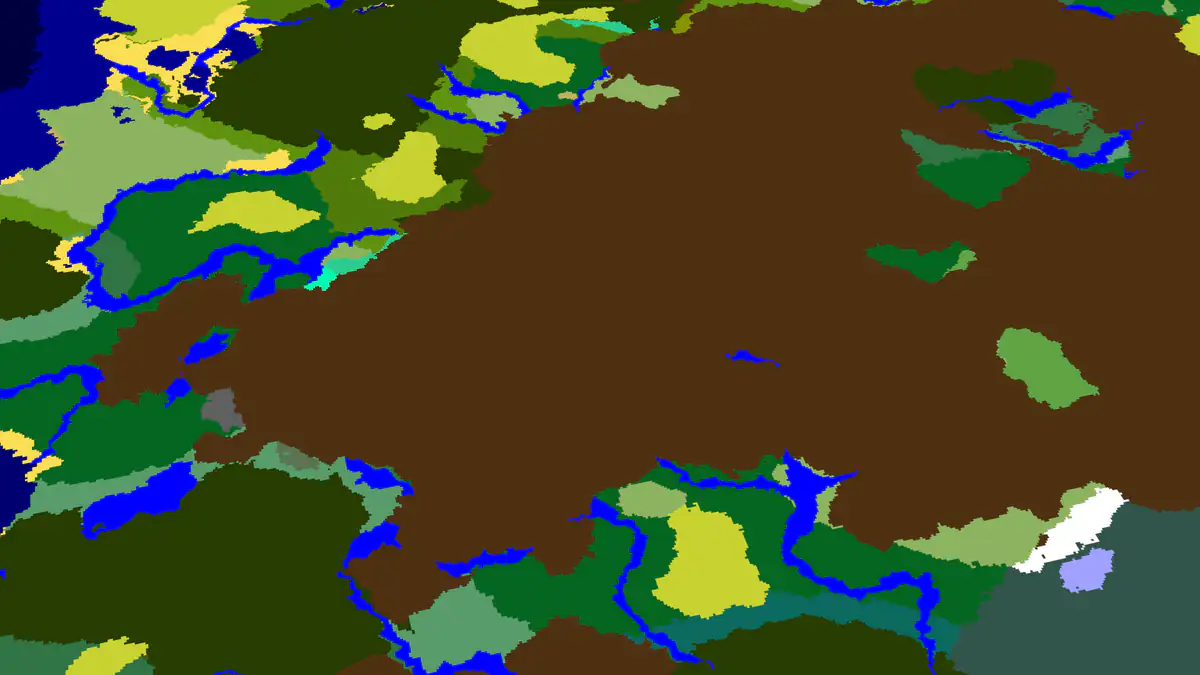
Compare seed 0, where the same sample found no dripstone at Y 0 at all, and 123456789 at 1.5%. Most seeds are like those. If yours has dripstone under spawn, that's your copper mine sorted for the whole world.
Don't count on caves to show it
Copper never gets deleted next to air, so you'd think caves would be plastered with it. They aren't. On seed 0 only 2,823 of the 95,256 copper blocks touched a cave, about 3%. The rest is behind the walls.
Caving still works because copper is so common, and every orange speck you pass is free. But if you want stacks, a tunnel at Y 45 or a dig through a dripstone cave's walls beats wandering. Copper ore drops 2 to 5 raw copper per block before Fortune, so even a short tunnel adds up fast.
Finding copper on your seed
- Open the ore finder, paste your seed, choose Java and your version, and switch the ore to Copper.
- Narrow the Y range to 44 to 47 to see what a Y 45 tunnel will hit, or leave it wide if you're caving.
- On the seed map, switch the biome layer to Caves (Y 0) and look for dripstone caves under your area. If you find them, set up shop above.
- Hover a deposit for its exact X, Y and Z, or open Nearest deposits in the side panel for the closest ones to spawn.
- Turn on large ore veins on the ore vein finder as well, in case a granite vein runs nearby.
The finder is Java only. Bedrock places ores with its own random generator, so we don't show Bedrock copper. Copper is common on Bedrock too, so a tunnel in the Y 40s is still a sensible start there.
What to do with a pile of copper
Smelt the raw copper into ingots and you'll find uses quickly. A spyglass is two copper and an amethyst shard. A brush for archaeology takes one copper ingot, a stick and a feather, and you'll want one for trail ruins. A lightning rod is three ingots and keeps your wooden base from burning down in storms.
Builders burn through copper the fastest. Blocks of copper oxidise over time from orange to green, and you can stop them at any stage with honeycomb or scrape them back with an axe. Copper bulbs are great redstone lamps. In 26.3 there are copper tools and armour too, a tier below iron, which makes an early copper mine worth more than it used to be.
Nine ingots per block of copper, so a single good afternoon at Y 45 turns into a few stacks of blocks. Over a dripstone cave, multiply that by two and a half.
Questions
What is the best Y level for copper in 26.3?
Feet at Y 45, which puts a 2-high tunnel in layers 44 to 47. Anything from Y 40 to 48 is nearly as good. Over a dripstone cave, anything from Y 28 to 48 works.
Do dripstone caves have more copper?
Yes. They use a larger copper ore feature. A seed with dripstone caves under spawn had 244,298 copper blocks in 1,024 chunks, against 84,680 to 95,256 on two seeds without.
How much raw copper does one ore drop?
2 to 5 raw copper without Fortune. Fortune raises that further, and nine ingots make a block of copper.
Can you see copper from caves?
Some. Copper isn't deleted next to air, but only about 3% of the copper blocks on our test seed touched a cave. Most of it is inside solid rock.
Does the ore finder show copper on Bedrock?
No, it's Java only. Bedrock uses a different random generator for ores, so Java coordinates won't match a Bedrock world.
Related guides
Finders and tools in this guide
- Ore FinderJavaDiamonds, iron, gold, redstone and every other ore, block by block with Y levels.
- Ore Vein FinderJavaHuge 1.18+ copper and iron veins with raw ore blocks, deep underground.
- Cave FinderJavaHuge cheese caves underground, sized and with the depth to dig to — mining, bases and caving.
- Ore LevelsBest Y levels for every ore, before and after the 1.18 world height change.
Written by the Minecraft Tools team from the same world-generation engine that runs the seed map. Coordinates quoted here were computed with it for the stated seed, edition and version, and the engine is tested against the real game.