Giant Ore Veins: Finding Raw Iron and Copper Blocks
JavaOne iron vein we mapped on seed 0 holds 6,557 ore blocks, 121 of them raw iron blocks. That's more iron than most survival worlds ever use, sitting in one tunnel under the deepslate. Veins are rare, though, and you can walk right past one. Here's what we measured and how to land on one first try.
Updated · 7 min read · Java up to 26.3
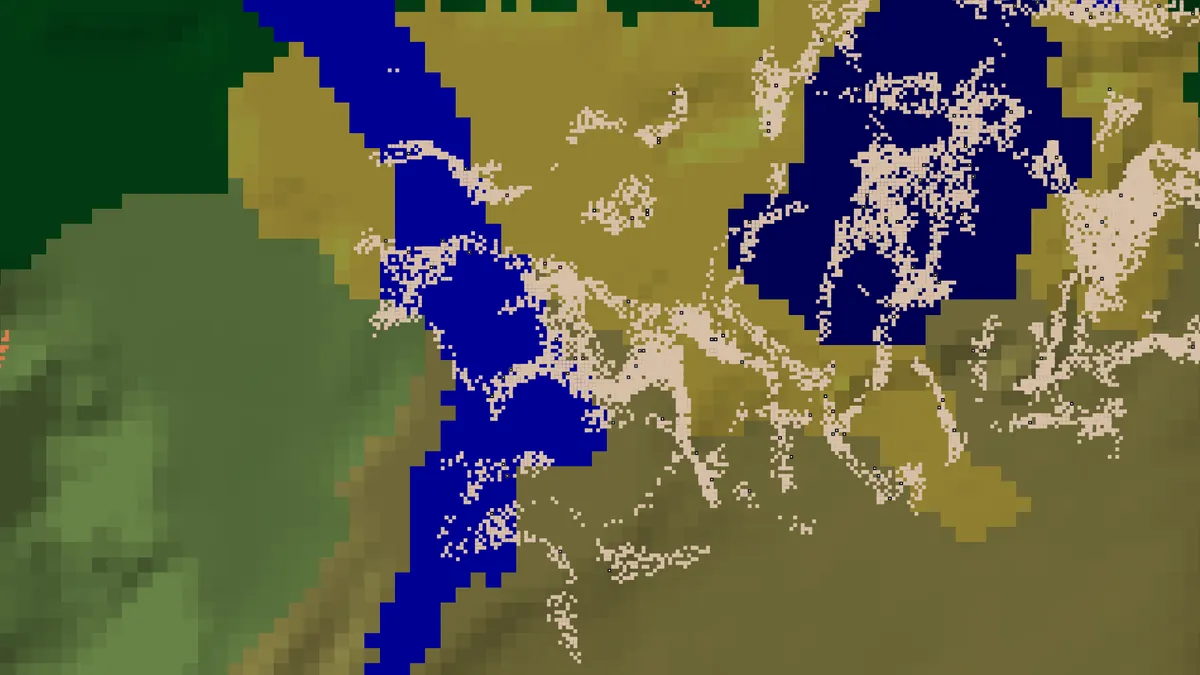
Not your normal ore blob
Normal ore comes in little blobs: a handful of iron here, a few copper there. Large ore veins are a different thing. They're long, twisting ribbons that run through the stone for a hundred blocks or more, packed with ore and wrapped in a filler block. Copper veins come in granite and sit between Y 0 and 50. Iron veins come in tuff and sit between Y −60 and −8, which means every iron ore block in them is deepslate iron ore.
The real prize is the raw ore block. Normal ore never generates as a raw block, only veins do. A block of raw iron is nine raw iron, it drops itself when mined, and Fortune doesn't touch it. In our counts raw blocks made up almost exactly 2% of every vein, on every seed: 627 raw iron blocks next to 31,256 iron ore on seed 0, and 495 raw copper blocks next to 25,131 copper ore on seed 123456789.
How much is down there
We had the engine generate every vein block in a 1,024 by 1,024 block square around spawn on three seeds, with caves cut out the way the game cuts them. Then we grouped blocks that sit within three blocks of each other into one vein body and counted the bodies with at least 100 blocks.
| Seed | Iron ore | Raw iron blocks | Copper ore | Raw copper blocks | Veins of 100+ blocks |
|---|---|---|---|---|---|
| 0 | 31,256 | 627 | 9,972 | 196 | 74 (49 iron, 25 copper) |
| 123456789 | 15,995 | 317 | 25,131 | 495 | 59 (18 iron, 41 copper) |
| 8675309123456789 | 22,403 | 415 | 22,375 | 497 | 90 (36 iron, 54 copper) |
So every seed had dozens of veins inside half a kilometre of spawn, but they only touched 7 to 15% of the chunks for each metal. Dig a random staircase down and you'll probably miss. Seeds also lean one way or the other: seed 0 is an iron seed, 123456789 is a copper seed. Nothing you can see on the surface tells you which.
The biggest body we hit was an iron vein on seed 0 centred near −376, −410: 6,557 blocks, 121 raw iron blocks, 184 blocks from end to end, running from Y −59 up to −8. Without Fortune that's around 7,500 raw iron. You'll need a few trips and a lot of shulker boxes.
Our favourite: seed 0, east of spawn
The one we'd actually go for on seed 0 is closer. An iron vein of 2,538 blocks with 53 raw iron blocks is centred around 210, 126, just 273 blocks from spawn. It spans about 119 blocks and sits between Y −57 and −8. Mine all of it without Fortune and you walk away with roughly 3,000 raw iron.
Its richest chunk is the one from X 208 to 223, Z 128 to 143. That single chunk holds 353 iron ore and 9 raw iron blocks between Y −57 and −14. If you only have one evening, dig straight down there.
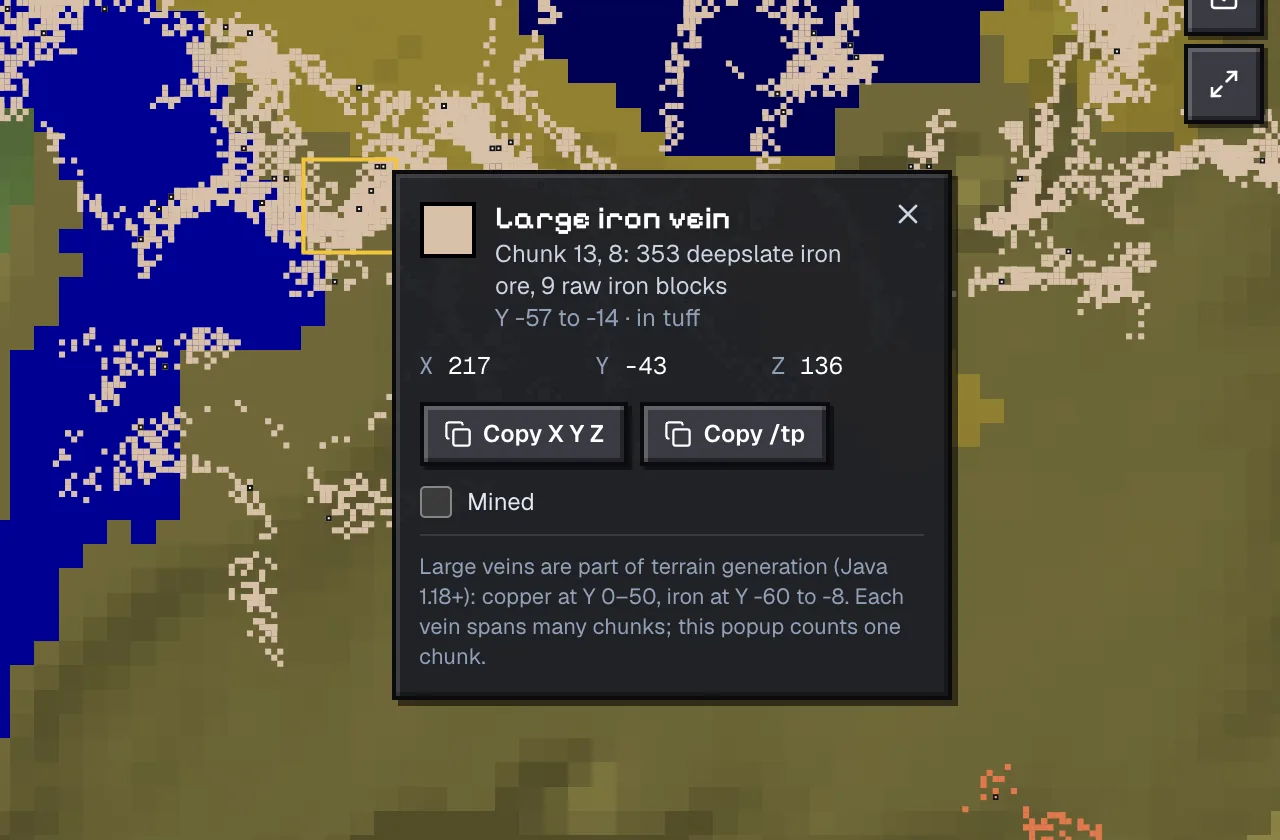
Reading the depths
Both kinds thin out towards the ends of their range, so the middle is where the volume is. In the square around spawn on seed 0, copper vein blocks were densest between Y 16 and 31 (1,493 of 3,071 blocks), and only 22 sat at Y 48 or above. Iron was fattest between Y −56 and −41, with 1,867 of 3,310 blocks there.
Seed 123456789 shifted a bit higher for iron (most of it between Y −40 and −16) but copper peaked in the same band. Close enough to make a rule: go to about Y 20 for copper and Y −45 for iron, and you're in the thick of it whichever seed you're on.
Caves are the catch. A vein only exists inside solid rock, so where a cave crosses one, those blocks are just air. The good side: a cave wall striped with tuff or granite at the right height is the vein telling you where it is. Tuff below Y 0 isn't proof on its own, since it shows up in plain blobs too, but tuff with deepslate iron ore stuck in it is worth following.
Finding one on your own seed
- Open the ore vein finder, paste your seed and pick your Java version (1.18 or newer).
- Zoom out a little: chunks a vein passes through are tinted, orange for copper and pale for iron, so the long bodies stand out.
- Check the Nearest large veins list in the side panel for the closest veins to spawn, or type your base's X and Z as the origin.
- Zoom in until single blocks show. Raw ore blocks are highlighted, so pick a spot where several sit close together.
- Click a chunk for its ore count and Y range, then copy the coordinates and dig a staircase down to the top of that range.
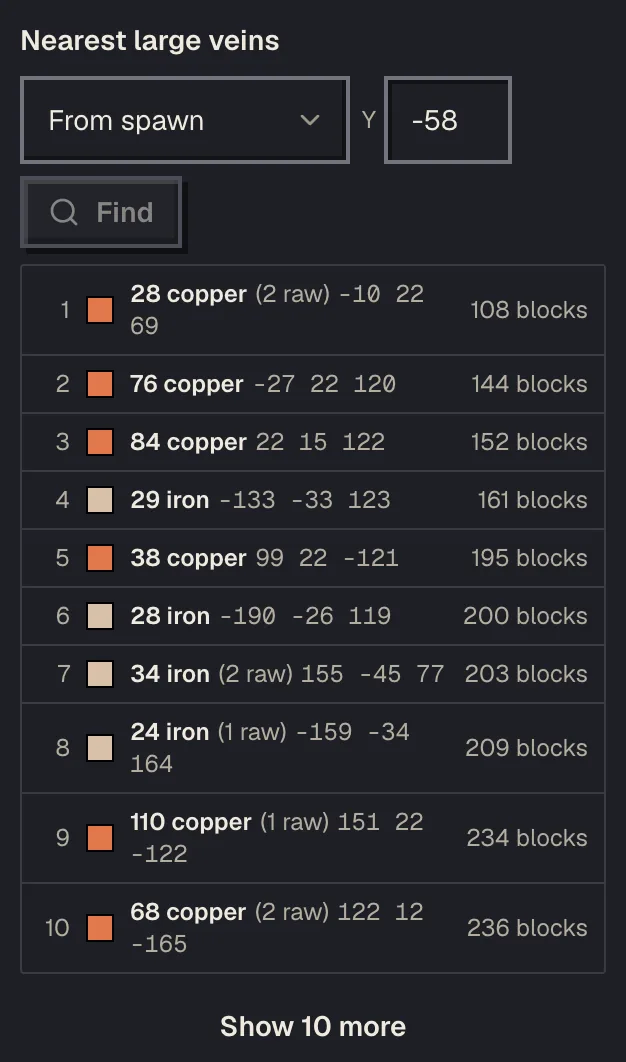
Copper is easier to stumble into because it's shallower and veins are common on some seeds. On 123456789 a raw copper block sits at 69, 19, −72, 25 blocks from spawn. The chunk from X 160 to 175, Z −80 to −65 holds 364 copper ore and 6 raw copper blocks between Y 10 and 49.
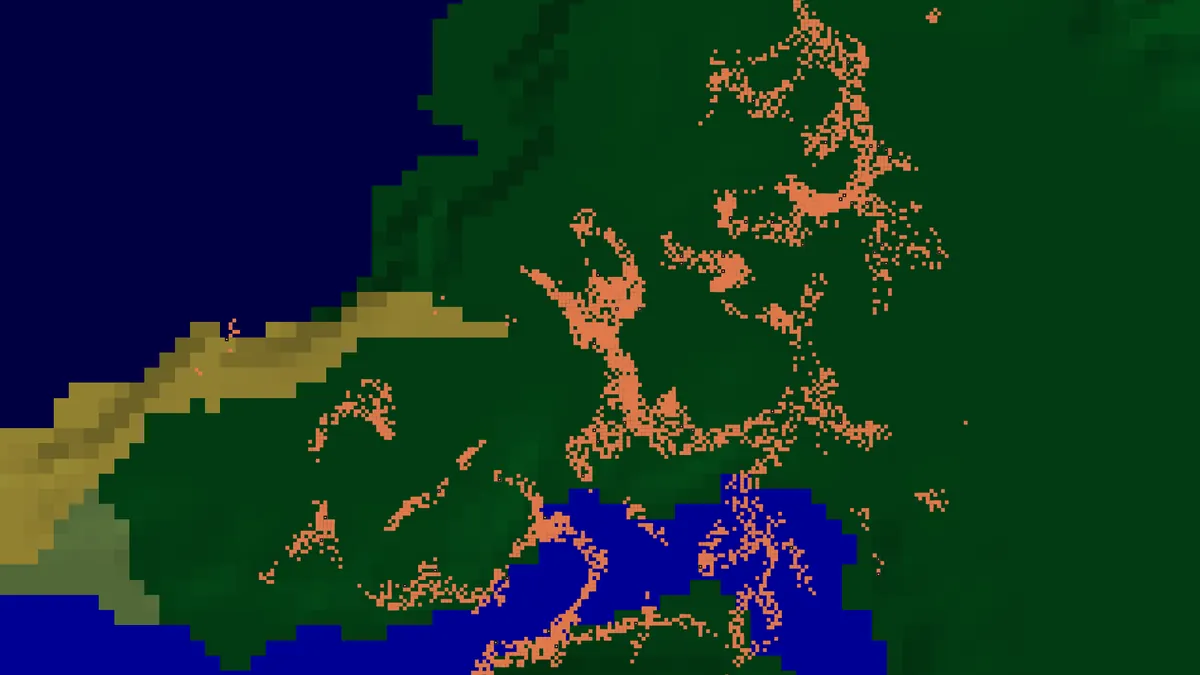
Veins versus normal mining
Here's the twist. Veins are a jackpot locally, but they aren't where most copper lives. In the 32 by 32 chunks around spawn on seed 0, normal copper blobs added up to 95,256 blocks against 3,071 vein copper blocks. On 123456789 it was 84,680 against 6,504. Normal copper is everywhere, and a cave dive at Y 48 fills your inventory fast. The copper guide covers that side.
Iron is where veins earn their spot. A good iron vein beats a week of strip mining at Y 16, and the raw blocks stack nine to one, so the trip home is light. Bring a stone pickaxe or better (wood won't drop anything), Fortune if you have it, and plenty of torches, because those tuff tunnels get dark and the deepslate layer spawns plenty of mobs.
Questions
At what Y level do iron and copper veins spawn?
Copper veins run from Y 0 to 50 in granite, iron veins from Y −60 to −8 in tuff. Both are thickest in the middle: on our test seeds copper peaked around Y 16 to 31, and iron sat between Y −56 and −16 depending on the seed.
How common are raw iron blocks?
About 2% of every vein's ore. Seed 0 had 627 raw iron blocks in a 1,024 by 1,024 block square around spawn, spread through 49 iron veins of 100 blocks or more.
Does Fortune work on raw ore blocks?
No. A raw iron or raw copper block always drops itself. Fortune only multiplies the normal ore blocks, which make up about 98% of a vein.
Can I find ore veins on Bedrock?
Bedrock has veins in game, but our ore vein finder is Java only (1.18 and newer). Bedrock generates terrain noise differently, so Java coordinates won't match a Bedrock world.
Why is half the vein missing when I get there?
Caves cut through veins. Wherever a cave crosses a vein, those blocks are air. The finder removes them the same way, so what it shows is what's left.
Related guides
Finders and tools in this guide
- Ore Vein FinderJavaHuge 1.18+ copper and iron veins with raw ore blocks, deep underground.
- Ore FinderJavaDiamonds, iron, gold, redstone and every other ore, block by block with Y levels.
- Cave FinderJavaHuge cheese caves underground, sized and with the depth to dig to — mining, bases and caving.
- Ore LevelsBest Y levels for every ore, before and after the 1.18 world height change.
Written by the Minecraft Tools team from the same world-generation engine that runs the seed map. Coordinates quoted here were computed with it for the stated seed, edition and version, and the engine is tested against the real game.