Ravine Finder Guide: Paths, Depth and Openings
JavaA ravine is the laziest mine in Minecraft: the game digs the hole, you just walk the walls. The catch is that most of them are buried. We traced 120 ravines around spawn on three seeds to see how many you can actually see from the surface, how deep they go and what's worth the trip.
Updated · 7 min read · Java up to 26.3
What we counted
We took the 1,024×1,024 blocks around spawn (4,096 chunks) on three seeds in Java 26.3 and had the engine trace every ravine the game would carve there: where it starts, its width, every step of its path, its highest and lowest point, and whether its cut reaches the top of the ground.
| Seed | Spawn | Ravines | Open to the sky | Buried |
|---|---|---|---|---|
0 | −32, 0 | 53 | 19 | 34 |
123456789 | 64, −48 | 35 | 3 | 32 |
8675309123456789 | 0, 0 | 32 | 3 | 29 |
That's 120 ravines in 12,288 chunks, or about one per 100 chunks, right where the 1-in-100 start chance says it should be. The open ones are the surprise. Seed 0 had 19, the other two had three each. Over all three seeds only 25 of 120 (about one in five) break through the ground. The rest sit under your feet and you'd never know.
Zero of the 120 opened into the sea floor. The game keeps a layer of stone between a ravine and any ocean, river or lake above it, so no flooded canyon will ever give itself away from a boat.
How big a ravine really is
On seeds 0 and 123456789 (88 ravines) the carved path was 60 to 88 blocks long, with the middle of the pack at about 74. That's shorter than most people picture. A ravine feels endless when you're inside it because it twists, but you can walk one end to end in under a minute.
- Width. The carver's width value ran from 0.28 to 5.79, median 2.89 on seed 0 and 3.34 on seed 123456789. A bit over half (44 of 88) were 3 or wider, which is the size that looks like a proper canyon instead of a crack.
- Height. From floor to top, the median ravine spans 27 blocks on seed 0 and 30 on seed 123456789. The tallest were 43 and 45.
- Start. Ravines start between Y 10 and Y 67, then wander up and down along the way.
- Floor. 47 of the 120 had a floor at Y 16 or lower, and 21 reached Y 0 or below, into deepslate. The deepest floor we saw was Y −10, on seed 0.
Seed 0: a ravine 14 blocks from spawn
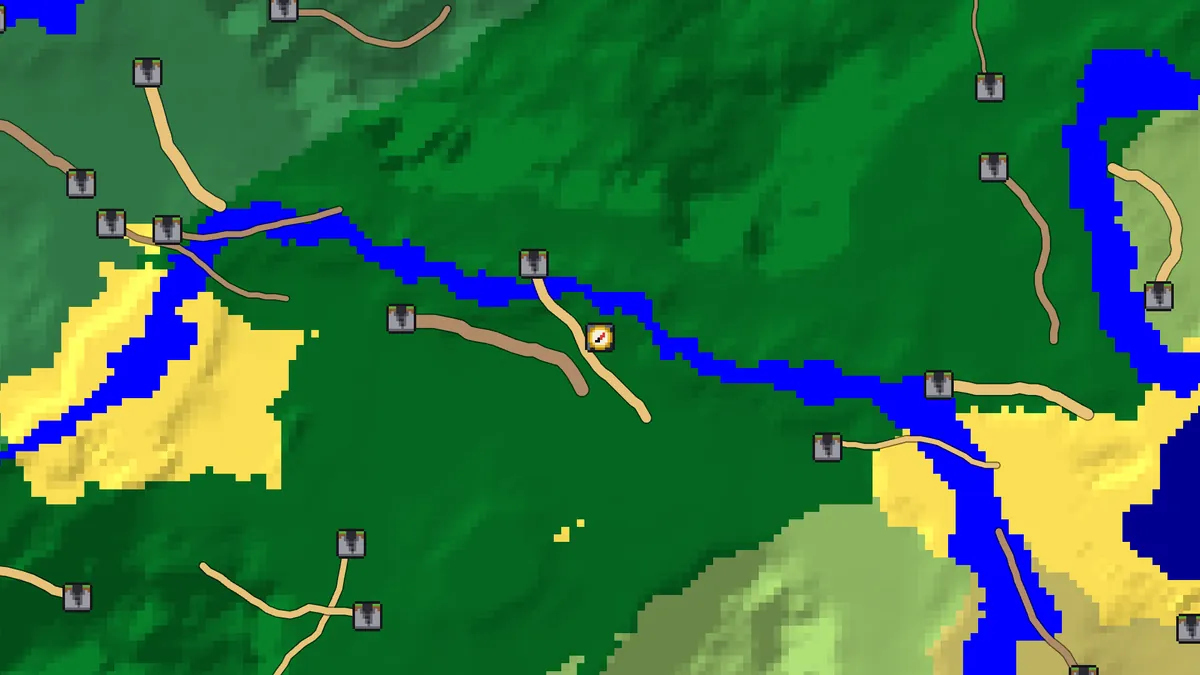
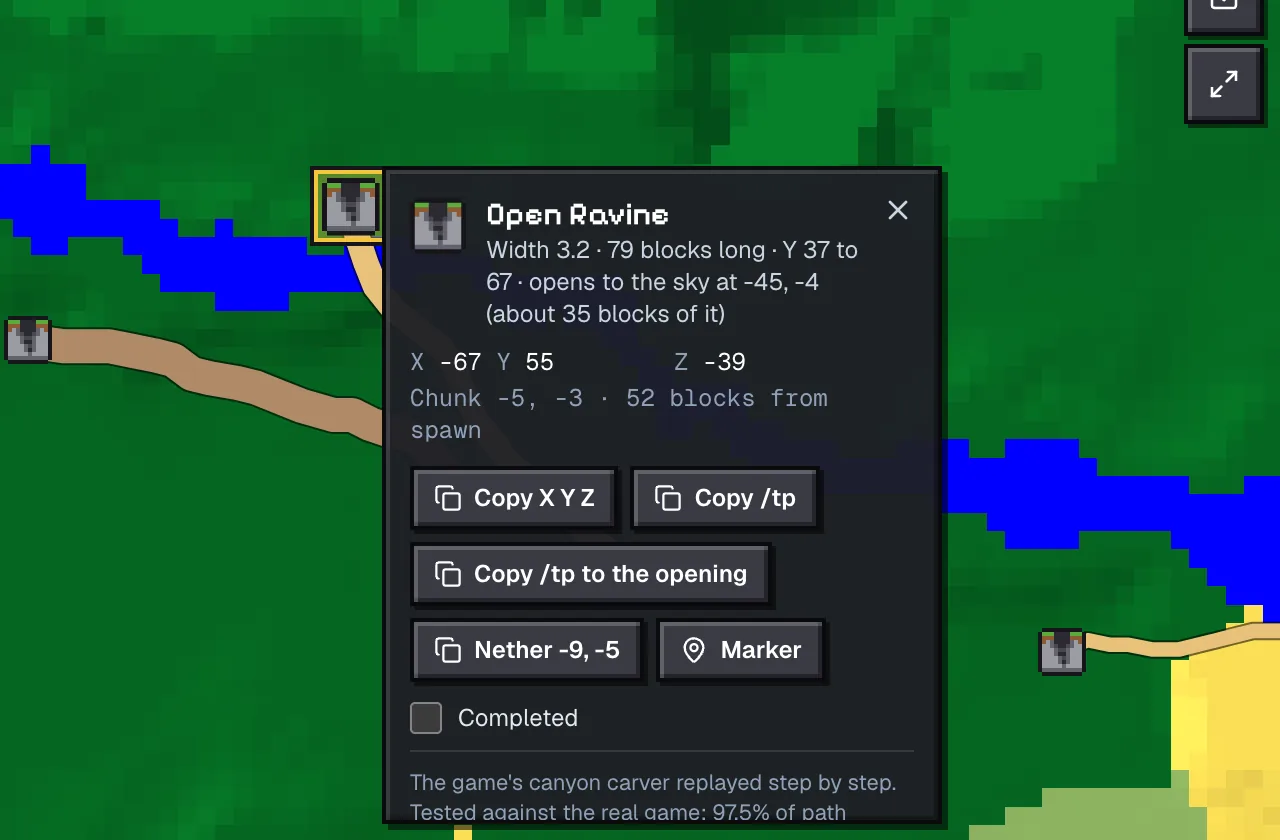
Seed 0 is a gift if you want one right away. The nearest ravine starts at −67, 55, −39, 52 blocks from spawn, and runs south-east right past the spawn point. Its path passes −43, 52, 0, eleven blocks west of where you appear, at a radius of four or five blocks.
It breaks the surface at −45, 63, −4, 14 blocks from spawn. 35 of its 79 carved blocks are open to the sky, its width value is 3.24 and it runs between Y 37 and Y 67. Not a deep one, but it's a free look at coal, copper and iron in the first five minutes of a world.
Seed 0's widest one starts at 315, 16, 77: width 5.69, from Y −3 up to 40, buried, 355 blocks from spawn. That's the kind of ravine you only find with a map, and it was nearly the biggest of all 120 (the record was 5.79, on seed 123456789).
Seed 123456789 is the opposite. Ten ravines start within 256 blocks of spawn and not one of them opens within that circle. The closest one starts at 166, 11, −115, buried between Y 0 and Y 23. The nearest opening is at 412, 69, 24, 355 blocks out, and the prettiest is further still: a ravine whose whole 84-block path is open, breaking the surface at −74, 71, 436.
Finding one on your own seed
- Open the ravine finder, type your seed and pick the Java version your world was made in (1.18 or newer).
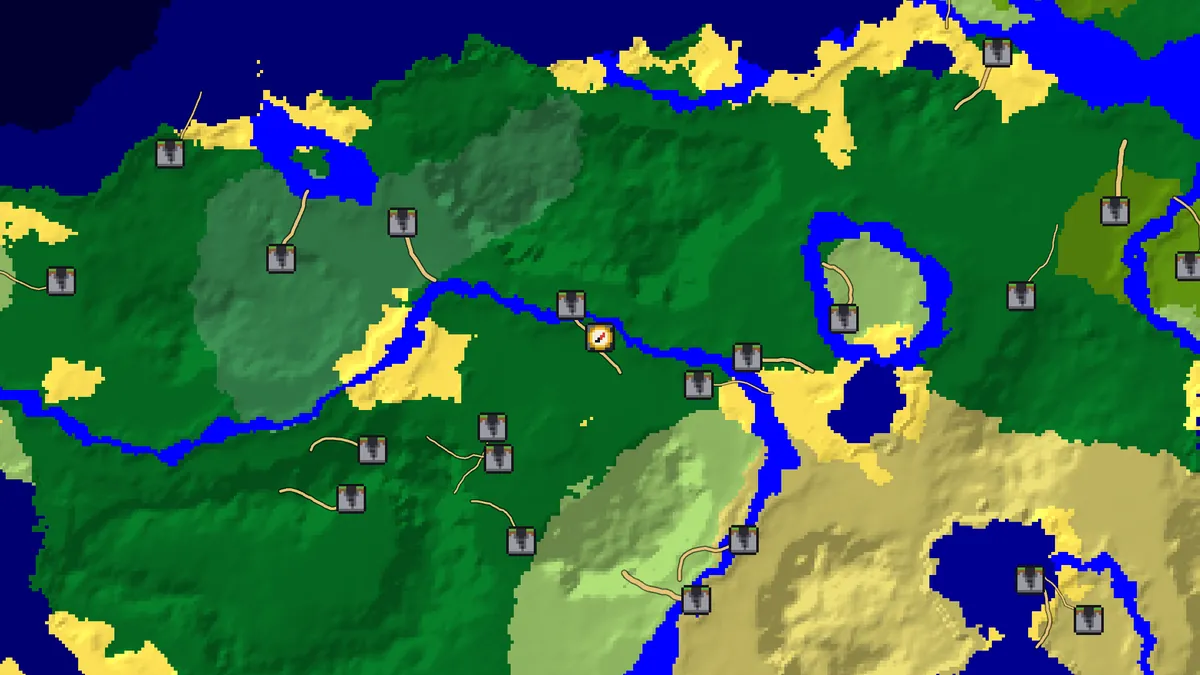
- Zoom out a step or two. Every ravine is drawn along its path, so the long thin bands are what you're looking for, not just the start marker.
- Switch on Ravines open to the sky only in the feature panel if you want one you can walk into. The Nearest list follows the switch.
- Click a ravine's start marker. The popup gives the width, the length, the lowest and highest Y and, for open ones, where it opens.
- Copy the /tp to the opening, or walk there with F3 open. For a buried one, pick a point on its band and dig a staircase down to the Y in the popup.
A buried ravine is often the better mine. It hasn't been lit by sunlight, so it's full of mobs, but nobody has walked it and the floor of a deep one sits in diamond range. Dig down onto the path at the low end of its Y range and you're standing at the bottom with the walls above you.
Mining a ravine without dying
The walls show a slice of every ore layer the ravine cuts through. A ravine from Y 40 to Y 60 is a copper and coal wall. One that bottoms out near Y 16 adds iron, and one under Y 0 can show diamonds, redstone and lapis in deepslate. The ore levels page has the exact ranges if you want to match a ravine to what you need.
- Torches and blocks. Ravines spawn mobs on every ledge. Light the floor first, then work the walls.
- A water bucket. For the drop in, for lava pockets in the walls, and for the floor if you fall.
- Scaffolding or a pillar of dirt to reach ore high on the walls. Don't parkour along the ledges.
- A shield. Skeletons on the far wall have a clear shot at you for the whole length of the ravine.
- A boat or a bucket for low floors. Ravines that dip below sea level often meet an aquifer, and the floor turns into a pool.
If you're after one ore in particular, the ore finder shows the actual veins around a ravine, including which ones are exposed in its walls. For the huge open caverns rather than canyons, use the cave finder.
How much to trust the paths
The finder doesn't guess. It runs the same canyon carver the game runs, with the same random numbers, so the start, the width and the path are the game's own. Where the ravine meets the terrain is the part that can be off by a little: the open-to-the-sky check compares every column of the cut with the engine's terrain model, and an overhang or a tree can change what you see on a block or two.
Two limits worth knowing. It's Java only: Bedrock carves ravines with its own generator and we haven't modelled it, so Bedrock coordinates would be wrong. And it needs a world generated in 1.18 or newer, the terrain the engine models. If your ravine isn't where the map says, check the version first, then read why the map and your world can disagree.
Questions
How common are ravines in Minecraft?
About one per 100 chunks. We counted 120 in 12,288 chunks around spawn on three Java 26.3 seeds. Only about one in five of them opens to the surface.
How deep do ravines go?
The median one we traced spans about 27 to 30 blocks from floor to top. Roughly four in ten have a floor at Y 16 or lower, and the deepest floor in our sample was Y −10.
Can a ravine open into the ocean?
No. The game leaves stone between a ravine and any water above it, so none of the 120 ravines we traced broke through a sea, river or lake floor.
Is there a ravine near spawn on seed 0?
Yes. On Java 26.3 a ravine opens at −45, 63, −4, 14 blocks from spawn, and its path passes 11 blocks west of the spawn point.
Does the ravine finder work on Bedrock?
No, it's Java only and needs a 1.18 or newer world. Bedrock generates ravines differently and that isn't modelled.
Related guides
Finders and tools in this guide
- Ravine FinderJavaEvery ravine with its path, width and depth, and whether it opens to the surface.
- Cave FinderJavaHuge cheese caves underground, sized and with the depth to dig to — mining, bases and caving.
- Ore FinderJavaDiamonds, iron, gold, redstone and every other ore, block by block with Y levels.
- Diamond FinderJavaEvery diamond in your Java seed with exact X Y Z, vein size and cave exposure.
- Ore LevelsBest Y levels for every ore, before and after the 1.18 world height change.
Written by the Minecraft Tools team from the same world-generation engine that runs the seed map. Coordinates quoted here were computed with it for the stated seed, edition and version, and the engine is tested against the real game.