Best Y Level for Ancient Debris and Netherite
JavaEveryone says Y 15. We wanted to know how much better Y 15 actually is, so we counted every ancient debris block in 1,024 Nether chunks on two seeds and ran a virtual tunnel through each layer. Short version: Y 15 wins, Y 16 is a tie, and a plain tunnel is a lot slower than people expect.
Updated · 8 min read · Java up to 26.3
The short answer: Y 15
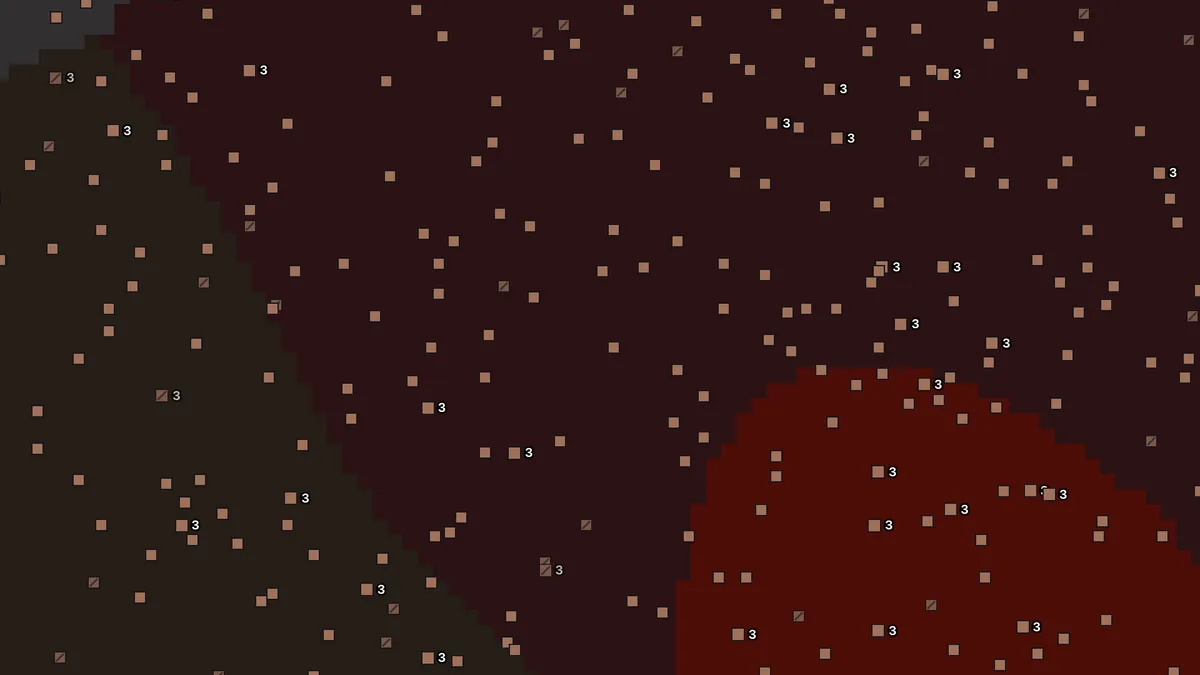
Stand with your feet on Y 15 and mine forward. That has been the answer since 1.16 and it still is in 26.3. The reason is simple: a 2-high tunnel lets you see four layers at once (the floor, your feet, your head and the ceiling), and with your feet at Y 15 those four layers are Y 14 to 17, right on top of the peak of the big debris batch.
We didn't want to just repeat it, so we checked. For seeds 0 and 123456789 on Java 26.3 we took the 32×32 chunks around the Nether origin (1,024 chunks, about 512×512 blocks), had the engine place every debris block the game would, and counted how many land in those four layers for each tunnel height.
| Feet at | Seed 0 | Seed 123456789 | vs Y 15 |
|---|---|---|---|
| Y 10 | 243 | 221 | about half |
| Y 12 | 356 | 343 | −24% to −34% |
| Y 14 | 451 | 475 | −4% to −9% |
| Y 15 | 469 | 522 | best |
| Y 16 | 468 | 505 | −0% to −3% |
| Y 18 | 423 | 399 | −10% to −24% |
| Y 22 | 158 | 163 | about a third |
So Y 15 and Y 16 are basically a coin flip, and anywhere from Y 14 to 17 is fine. What really costs you is drifting: a tunnel at Y 12 because you dodged some lava, or one at Y 22 because the floor looked nicer, quietly loses a quarter to two thirds of the debris.
Where the debris actually is
Those 1,024 chunks held 1,704 debris blocks on seed 0 and 1,568 on seed 123456789, so roughly 1.5 to 1.7 per chunk. About 70% came from the large batch, which piles up between Y 8 and 24. The rest came from the small batch that is spread evenly all the way up to Y 119, and that's the part people forget: 18 to 24% of all debris on these seeds sat above Y 24, where nobody tunnels for it.
Most finds are lonely. On seed 0, 650 of the 1,113 clusters were a single block, 335 were pairs and only 128 had three. Seed 123456789 looked the same (561 singles, 352 pairs, 101 triples). If you dig out one block, check the faces around it before moving on, because a pair or triple is about a 40% chance.

None of it was exposed. The engine marked zero blocks touching air on both seeds, which matches the rule the game has used since 1.18: a debris block that would sit next to air is not placed. Lava doesn't count as air, so debris happily hugs the lava ocean, but you'll never spot it in a cave wall. Every block has to be dug or blown out of solid netherrack.
Tunnelling is slower than you think
Here's the number that changed how we mine. Running a virtual 1×2 tunnel through every third row of those chunks, at feet Y 15, turned up 0.37 debris per 100 blocks of tunnel on seed 0 and 0.41 on seed 123456789. That counts everything in the tunnel itself, both walls, the floor and the ceiling.
Put another way: about 250 blocks of tunnel per debris, which is around 1,000 blocks of tunnel per netherite ingot (four debris give four scraps, four scraps plus four gold make one ingot). A full set of armour and tools is nine ingots, so roughly nine kilometres of tunnel. Nobody wants that, and that's why people bed-bomb.
- Beds explode when you try to sleep in the Nether, with more force than TNT. Mine a long 1×1 tunnel, place a bed at the end, step back around a corner and click it. Bring a stack of them.
- TNT works the same way in a branch, a bit weaker but you can chain it. Ancient debris has a blast resistance of 1,200, so explosions clear the netherrack and leave the debris standing.
- Plain pickaxe at Y 15 is fine when you don't have wool to spare. A diamond pick with Efficiency V breaks netherrack instantly, so the tunnel moves at walking speed and the real cost is the lava you keep opening.
Debris items don't burn, so a block that falls in lava after an explosion floats instead of disappearing. Fish it out with a pickaxe swing from the edge.
Skipping the search with the finder
The other option is to stop searching altogether. On seed 0, the spawn portal lands near Nether −4, 0, and within 64 blocks of that spot there are 56 debris blocks in 37 clusters below Y 24. On seed 123456789 it's 80 blocks in 47 clusters. That's 14 to 20 ingots' worth of debris you could walk to without leaving the area around your portal.
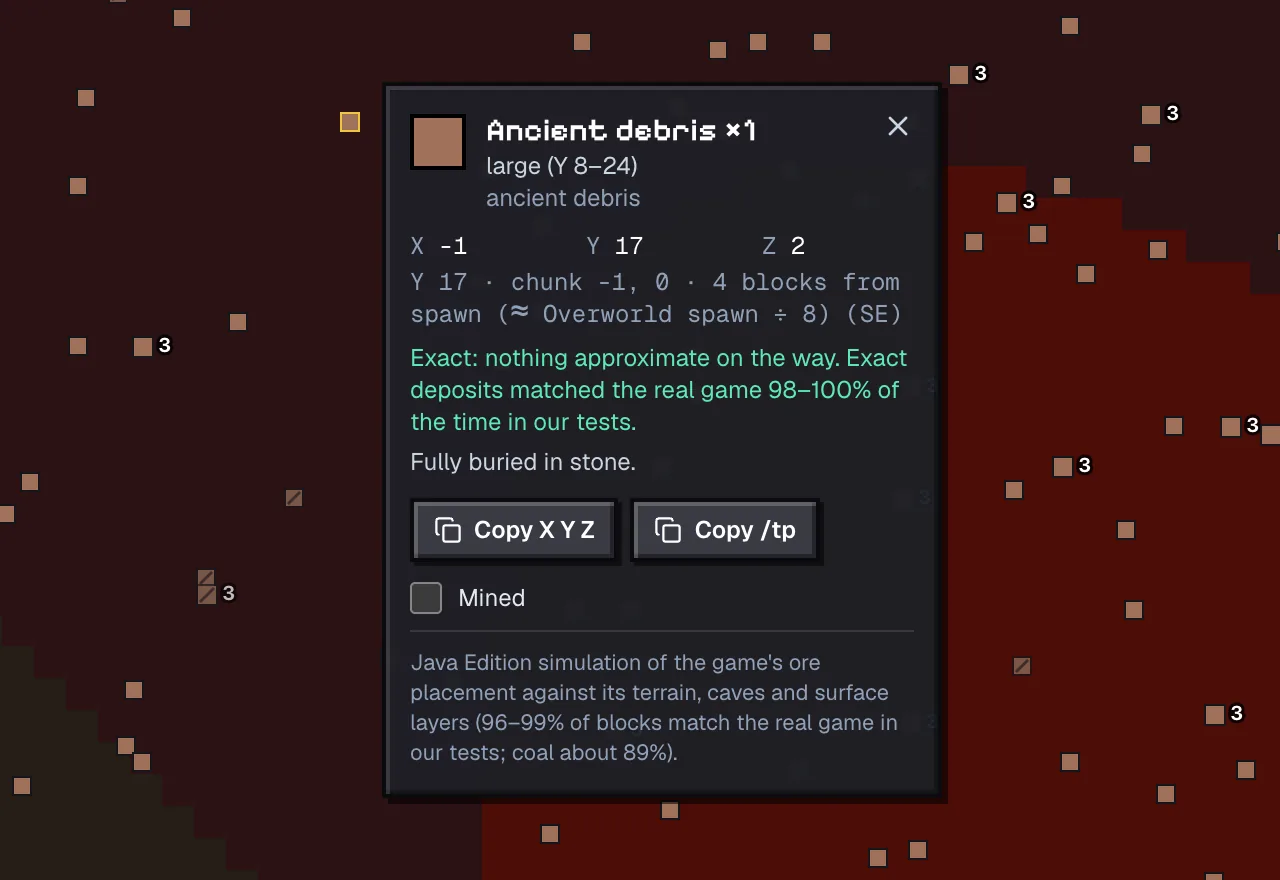
The closest one on seed 0 is a single block at −1, 17, 2, four blocks from the portal position. Seed 123456789 has a three-block cluster sitting right on the magic layer at 31, 15, −30 (plus 32, 15, −30 and 31, 16, −30), 33 blocks from its portal.
- Open the ancient debris finder, type your seed and pick your Java version.
- Convert your Overworld portal to Nether coordinates (divide X and Z by 8, or use the portal calculator) and put that in the Nearest deposits origin.
- Zoom in until single blocks are visible. Hover a square for its exact X, Y, Z.
- Narrow the Y range if you want to stay in one tunnel; 8 to 22 covers the large batch, 14 to 17 matches a Y 15 tunnel.
- Dig a 1×2 tunnel at the cluster's Y, walking the X first and then the Z with F3 open. Stop one block short and mine the debris from the side.
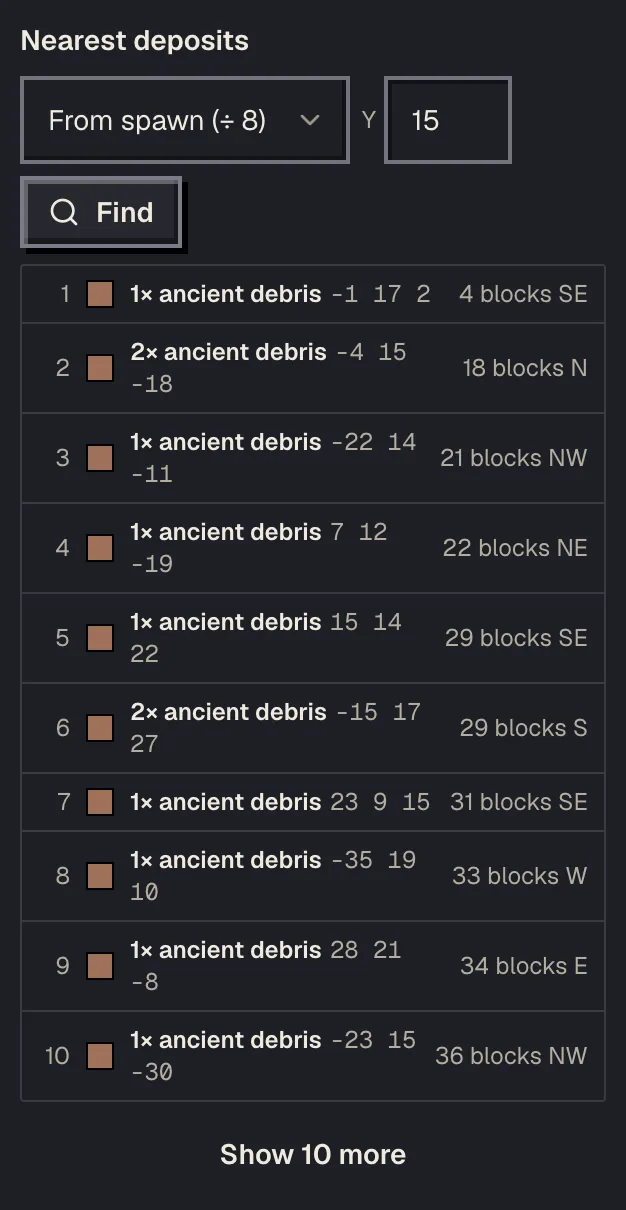
Is it exact? It replays both debris features for your seed and removes blocks that would touch air in its terrain model. Compared block by block against worlds made by the official Java server, it found every debris block and roughly 98% of what it shows was really there. The few misses sit right on cave edges, which the popup flags as uncertain.
What to bring
- Fire Resistance, at least two 8-minute potions. Y 15 is under the lava ocean, so every lava pocket you open is above or beside you.
- A diamond or netherite pickaxe. Iron can't mine debris at all.
- One piece of gold armour. Piglins wander the lower Nether too, and a gold helmet keeps them calm while you work.
- A stack of cobblestone or blackstone to plug lava, and a few gravel or sand blocks to drop into lava falls from above.
- Beds or TNT if you're blasting, and a shield. Bed explosions hurt, even around a corner.
- A portal of obsidian and a flint and steel, in case a ghast or a fall ends the trip a long way from your way out.
Bedrock and older worlds
The finder is Java only. Bedrock places ores with a different random generator, and we haven't modelled it, so we can't hand you Bedrock coordinates or Bedrock-specific numbers. Bedrock players generally mine at the same Y 15, and the bed method works the same there.
Debris arrived in 1.16. Worlds from 1.16 and 1.17 put the large batch's peak at Y 15 rather than 16, which changes nothing about where you should tunnel. Pick the version your Nether chunks were generated in and the finder switches rules. The ore levels page has every ore's range by version, and how ores generate covers the batch system in more depth.
Questions
What is the best Y level for netherite in 26.3?
Y 15 for your feet. A 2-high tunnel there sees Y 14 to 17, which held the most debris in our count of 1,024 Nether chunks. Y 16 is almost exactly as good.
Is Y 8 to 10 any good for ancient debris?
Not really. With feet at Y 10 a tunnel sees about half the debris it would at Y 15. The large batch thins out fast below Y 12.
How much debris do I need for full netherite?
One ingot per item, and each ingot takes four debris plus four gold. Four armour pieces plus sword, pickaxe, axe, shovel and hoe is nine ingots, so 36 debris, plus a netherite upgrade template per item.
How much does a tunnel at Y 15 find?
About 0.4 debris per 100 blocks of 1×2 tunnel on our test seeds, or roughly 1,000 blocks of tunnel per netherite ingot. Beds, TNT or the finder are much faster.
Does the ancient debris finder work on Bedrock?
No, it's Java only. Bedrock uses a different random generator for ores, so Java coordinates would be wrong in a Bedrock world.
Related guides
Finders and tools in this guide
- Ancient Debris FinderJavaEvery ancient debris block in the Nether for netherite, with exact Y levels.
- Ore FinderJavaDiamonds, iron, gold, redstone and every other ore, block by block with Y levels.
- Bastion Remnant FinderPiglin bastions: treasure rooms, bridges, hoglin stables and housing.
- Nether Fortress FinderFortresses with blazes, wither skeletons and nether wart.
- Ore LevelsBest Y levels for every ore, before and after the 1.18 world height change.
- Nether Portal CalculatorLink Overworld and Nether portals — coordinates ÷ 8 and search ranges.
Written by the Minecraft Tools team from the same world-generation engine that runs the seed map. Coordinates quoted here were computed with it for the stated seed, edition and version, and the engine is tested against the real game.