Nether Portal Linking Explained
JavaBedrockA Nether portal links to the nearest existing portal within a search area around its scaled position, which is simple until two portals share an area. The rule, the arithmetic and the fixes, with the portal calculator doing the sums.
Updated · 6 min read · Java & Bedrock up to 26.3
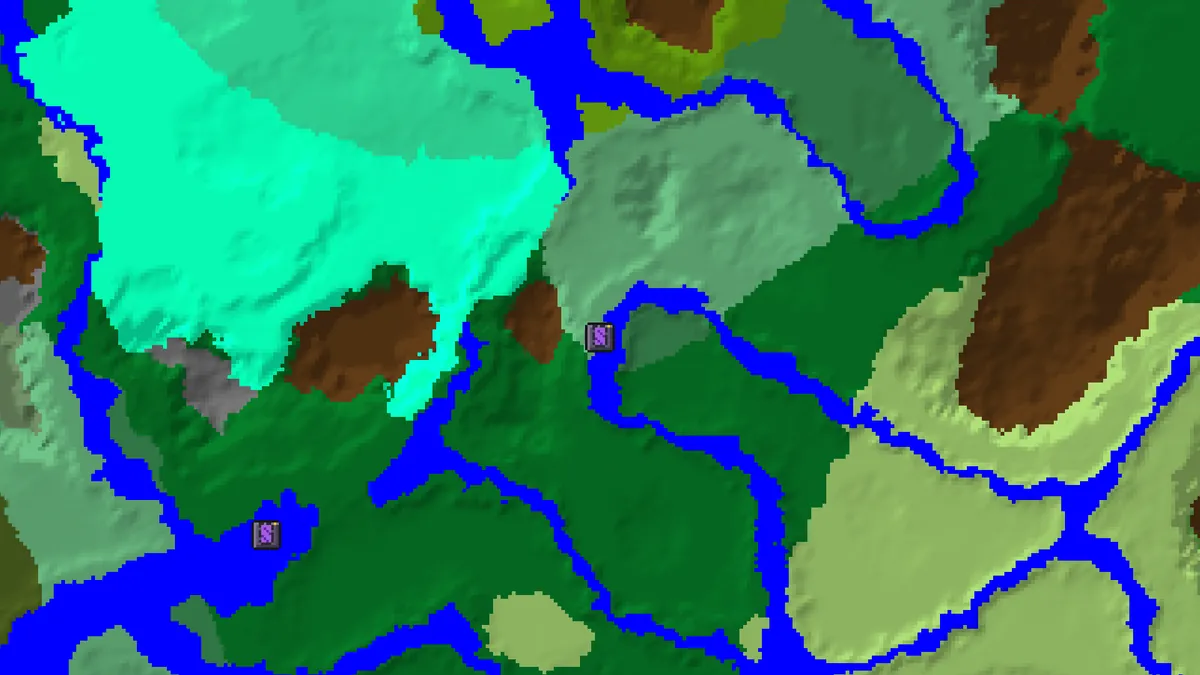
The 1:8 rule
One block of travel in the Nether equals eight blocks in the Overworld along X and Z; Y is not scaled. When you enter a portal at Overworld 1600, 70, -800, the game looks for a portal around Nether 200, 70, -100, and when you come back from Nether 200, 70, -100 it looks around Overworld 1600, 70, -800. The portal calculator does the division and multiplication for any coordinate and shows the search area described below.
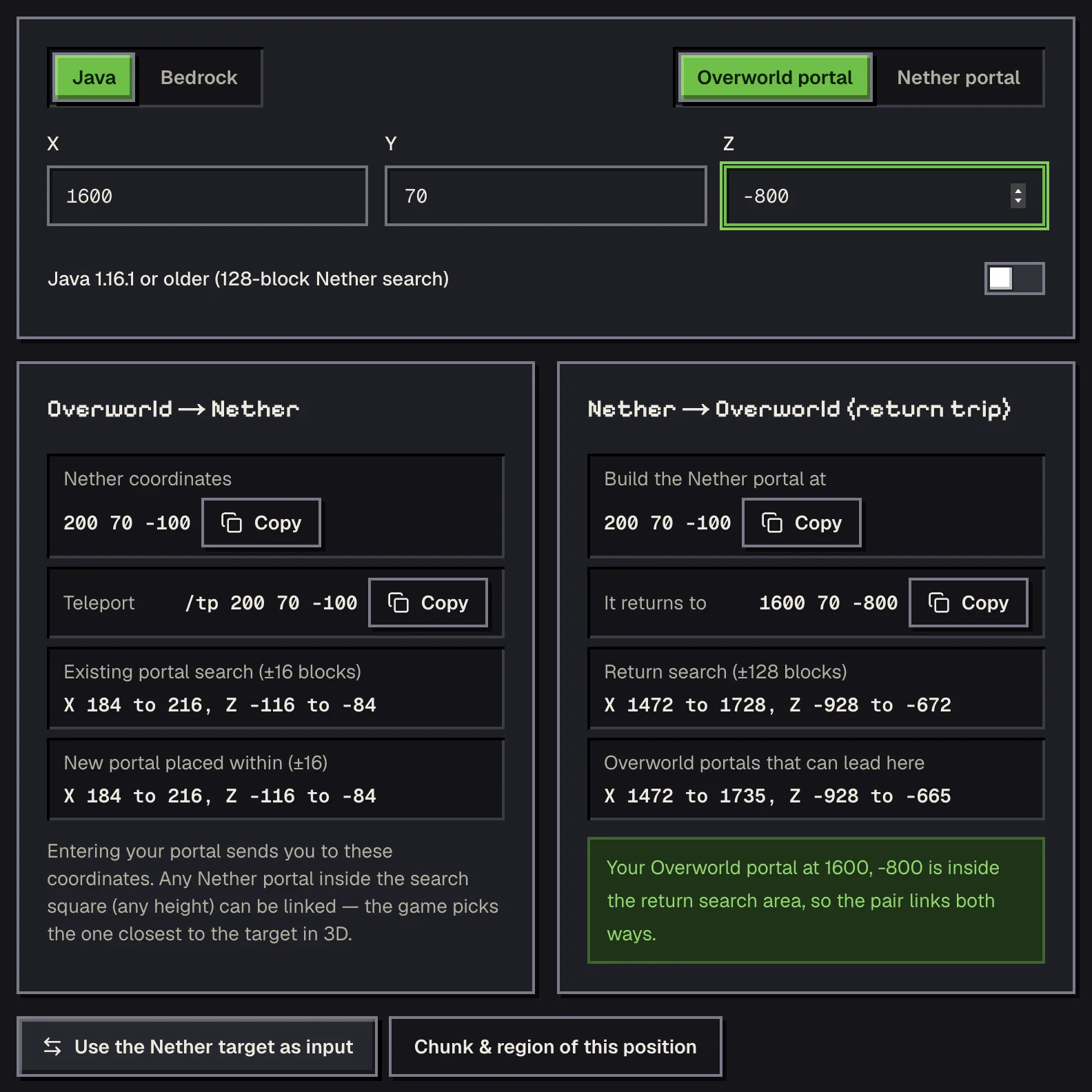
Because of the scale, the Nether is the fast way across the Overworld: a 2,000-block trip to a stronghold becomes 250 blocks, and an ice road or a flying machine in the Nether moves you across a whole continent in minutes. Most portal problems come from forgetting that the search area is also scaled: 128 blocks in the Overworld is only 16 in the Nether.
How the game picks a portal
When you step through a portal, the game scales your position to the other dimension and searches for an existing portal block within 128 blocks horizontally in the Overworld, or 16 blocks in the Nether, across the whole height of the dimension. If it finds one, you arrive there, at the closest portal if several qualify. If it finds none, it builds a new portal near the scaled position, preferring a spot with solid ground and space, and failing that, carving one out of the terrain.
The search uses straight-line distance including height, so a portal 100 blocks up on the Nether roof can lose to a portal at a lower Y that is slightly further away horizontally. Two Overworld portals less than about 128 blocks apart will usually share one Nether portal, because their scaled positions are within 16 Nether blocks of each other, inside the search area of whichever Nether portal was built first.
Why your portal links to the wrong place
- Two Overworld portals too close. Both map to nearly the same Nether spot and the first Nether portal captures both. Fix: build the Nether portals by hand at x ÷ 8 and z ÷ 8 for each, at least 16 blocks apart in the Nether, and remove the auto-generated one.
- Wrong height. An Overworld portal on a mountain at Y 150 looks for a Nether portal near Y 150, where the Nether roof is. The game will link to a lower portal if it is within range, but new portals end up in odd places. Build the Nether side at a sensible Y.
- A portal just outside range. If the Nether portal is 17 blocks from the scaled spot, the game builds a new one. Place portals within a few blocks of the calculated coordinates.
- Old portals you forgot. A ruined portal you repaired, or a portal from a previous base, can still be the nearest one. Mark every portal on the seed map; conflicts become obvious once they are all in one place.
Building a matched pair
- Build the Overworld portal and note its coordinates from F3 or the map. Say 1600, 70, -800.
- Divide X and Z by eight: 200, -100. Keep Y similar if you can, or choose a Y in the Nether that is convenient, between 30 and 120.
- Go through the portal once. The auto-generated Nether portal will be near 200, -100; if it is within a few blocks, keep it. If not, build a new portal at those coordinates and break the old one.
- Light the portal and go back. You should arrive at your original Overworld portal. If you arrive elsewhere, another Overworld portal within 128 blocks of 1600, -800 won the search.
- Drop markers on the seed map for both portals, in both dimensions. Future portals then go where the markers say they can.
The calculator shows both search areas as block ranges, and a planned portal that overlaps an existing one shows up before you spend the obsidian.
Ruined portals: free obsidian and a head start
Ruined portals have generated in the Overworld and the Nether since 1.16, on a 40×40-chunk grid in the Overworld and a 25-chunk grid in the Nether, so one is rarely more than 600 blocks away. Each has a partly built frame, often with a few obsidian blocks missing, and a chest with flint and steel, obsidian, gold items and sometimes an enchanted golden apple. Repairing one is the fastest way into the Nether on a fresh seed.
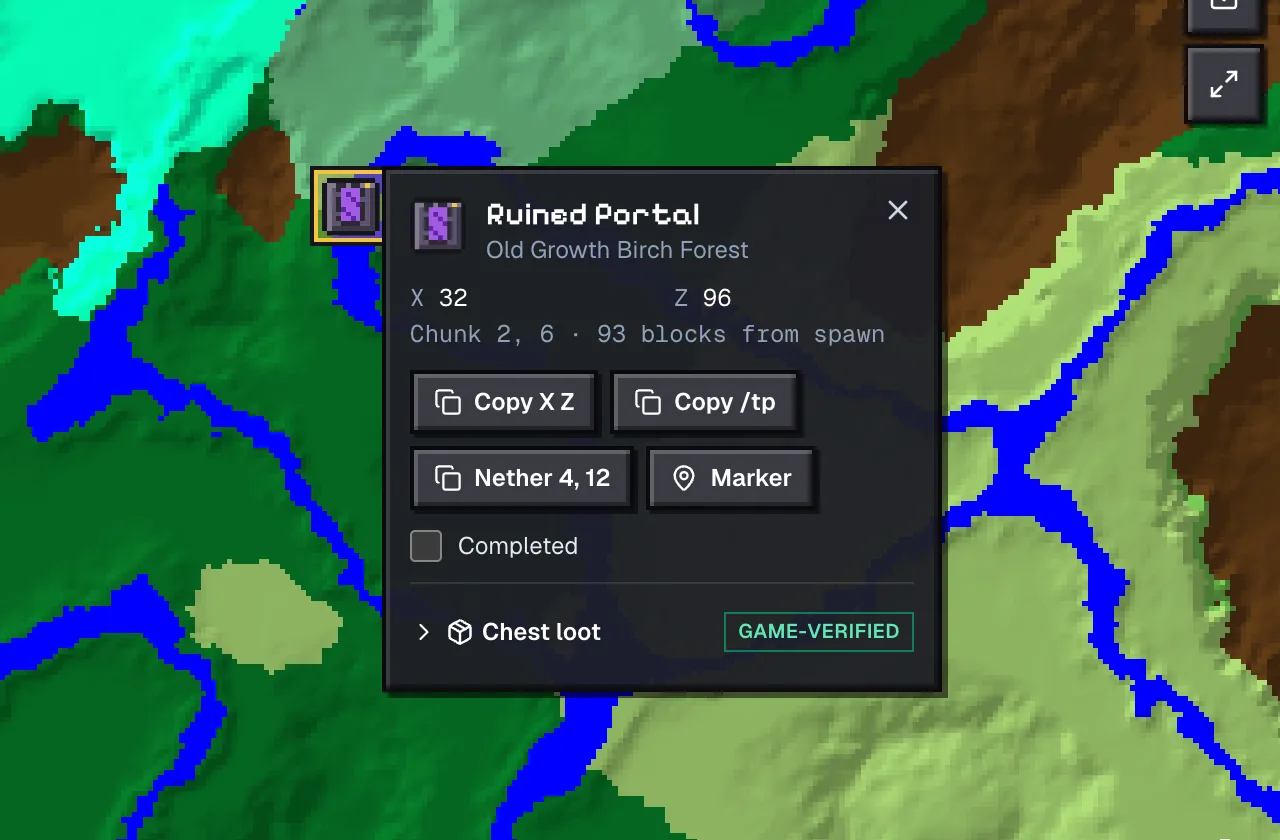
The ruined portal finder shows every ruined portal in both dimensions. Seed -1234567890123 has one 93 blocks from spawn at 32, 96; seed 0 has one at -352, 96. A ruined portal on the Nether side is also a landmark, since it is the only structure that generates at a known grid in the Nether besides fortresses and bastions.
A Nether hub that stays organised
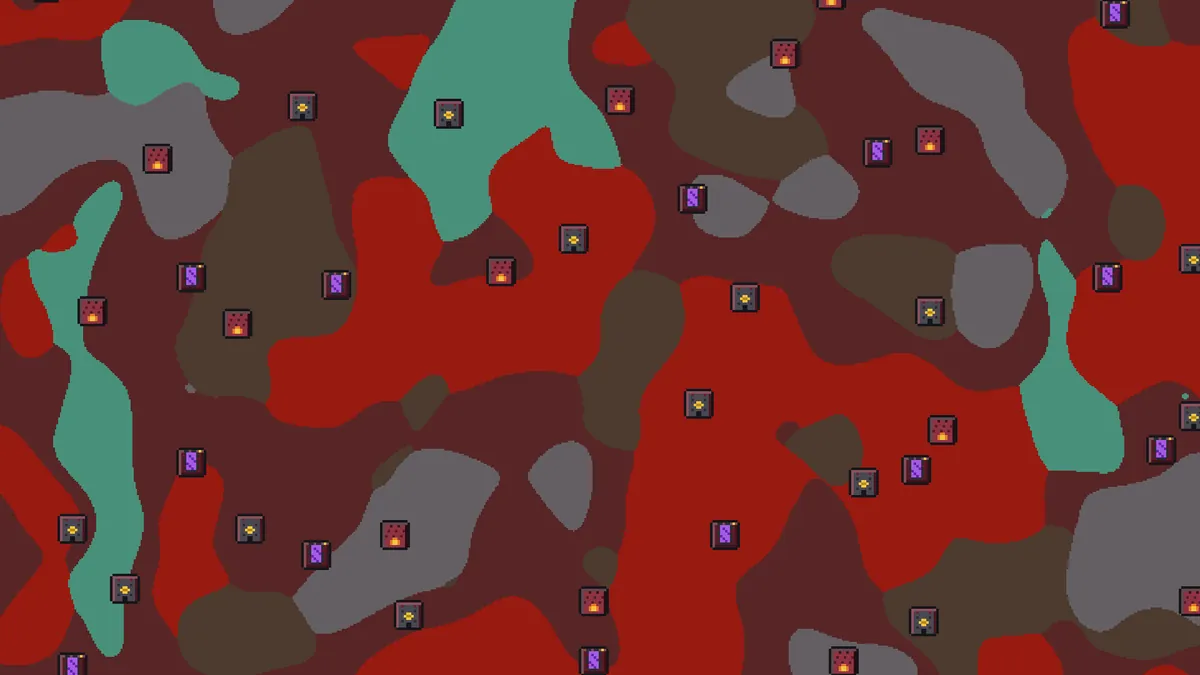
Once you have more than two portals, give the Nether side a hub: one central room near the spawn portal's Nether position with tunnels leading to each destination's scaled coordinates. Keep the tunnels at one Y, build portals at x ÷ 8 and z ÷ 8, and label them. Use the seed map's Nether view to check that no tunnel runs into a fortress or a bastion you would rather not meet: on seed 123456789 the fortress at -160, -304 and the bastion at 320, 16 are both within a few hundred blocks of spawn ÷ 8.
Bedrock follows the same 1:8 scale and search rules, with portals of any size between 4×5 and 23×23. The calculator applies to both editions; only the structure positions around your hub differ, and the map shows Bedrock's own fortress and bastion positions when you choose the edition.
Questions
How do I calculate Nether coordinates?
Divide the Overworld X and Z by eight; Y stays the same. The portal calculator does it and shows the area the game will search for an existing portal.
How far apart can two Overworld portals be before they share a Nether portal?
Their scaled positions must be more than 16 Nether blocks apart to be safe, which is 128 Overworld blocks, and in practice build Nether portals by hand when Overworld portals are closer than about 300 blocks.
Why did the game build a new portal instead of linking?
No portal block was within 128 blocks (Overworld) or 16 blocks (Nether) of the scaled position, in three dimensions. Build the Nether portal within a few blocks of the calculated coordinates.
Does the Y coordinate matter for linking?
Yes. The search measures straight-line distance including height, so portals far apart vertically can fail to link even if their X and Z match. Keep paired portals at similar heights when you can.
Can I use a ruined portal as my main portal?
Yes. Repair the frame with obsidian from its chest or your own, light it, and treat it like any portal. Its position decides where the Nether side appears, so check the calculator first.
Related guides
Finders and tools in this guide
- Ruined Portal FinderRuined portals in the Overworld and Nether, with obsidian and gold loot.
- Nether Fortress FinderFortresses with blazes, wither skeletons and nether wart.
- Bastion Remnant FinderPiglin bastions: treasure rooms, bridges, hoglin stables and housing.
- Nether Portal CalculatorLink Overworld and Nether portals — coordinates ÷ 8 and search ranges.
- Coordinate CalculatorConvert between block, chunk and region coordinates, and measure distance.
Written by the Minecraft Tools team from the same world-generation engine that runs the seed map. Coordinates quoted here were computed with it for the stated seed, edition and version, and the engine is tested against the real game.