How Ores Generate in Minecraft 1.18+
JavaBedrockEvery ore in Minecraft is placed by a handful of batches with fixed rules: how many tries per chunk, which Y range, whether the chance is flat or peaks in the middle, and whether blocks next to air survive. Those rules for every ore, and what they mean for where to dig.
Updated · 7 min read · Java & Bedrock up to 26.3
Batches, tries and shapes
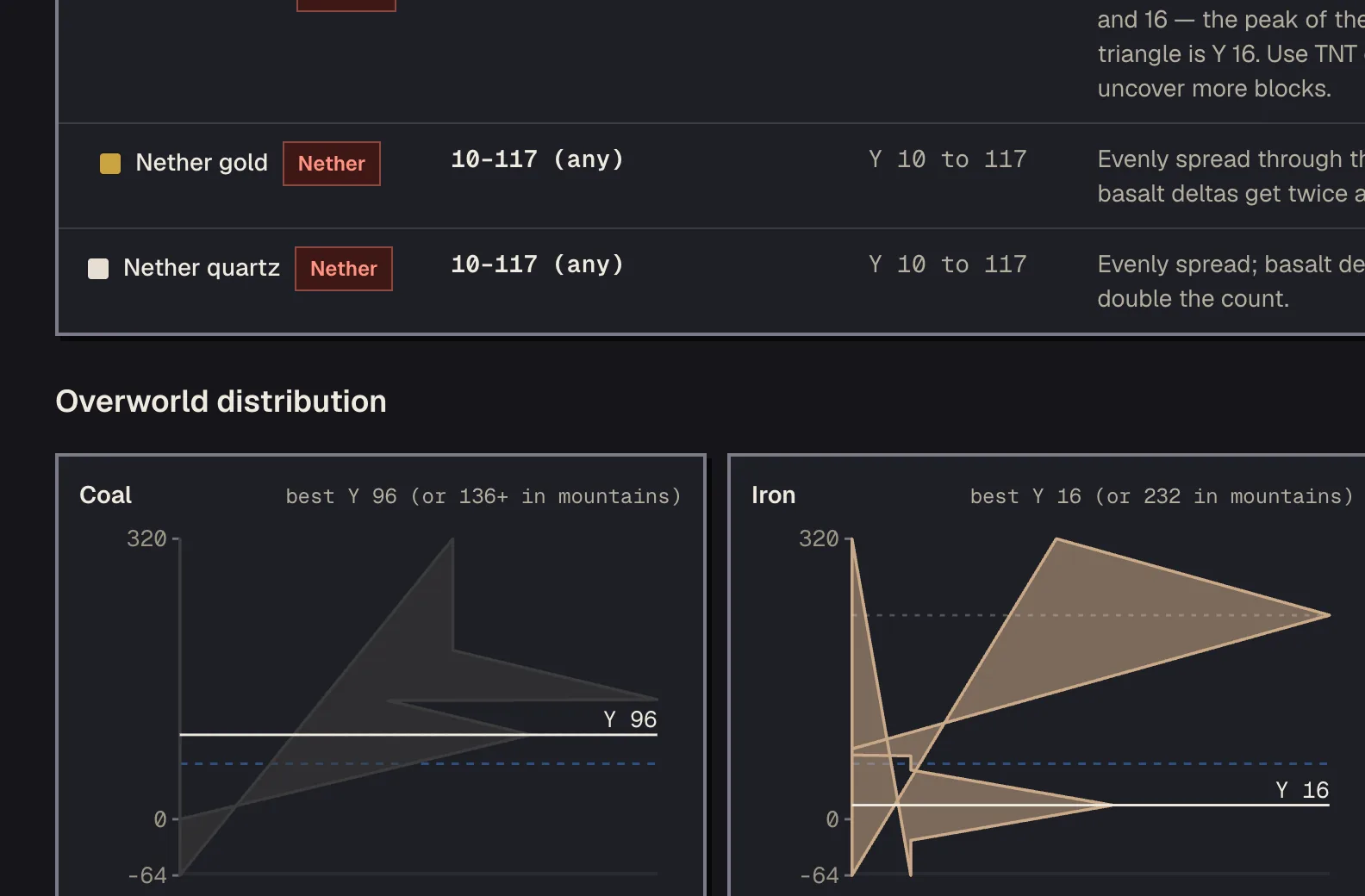
When a chunk generates, the game runs a list of ore features in a fixed order. Each feature is a batch: it tries to place a blob of one ore a set number of times per chunk, picking a random X and Z in the chunk and a Y from a range. Two kinds of range exist. A uniform range makes every level equally likely; a triangle range makes the middle of the range most likely and the ends rare, so the ore clusters around a peak.
The blob itself has a size parameter that sets how many blocks a vein can hold, and a chance to replace each candidate stone block, so veins come out irregular instead of as solid cubes. Most batches then apply a deletion rule: a share of the blocks that touch air is removed, from none for coal to all for buried diamonds and lapis. That rule, more than anything, decides what you see in caves.
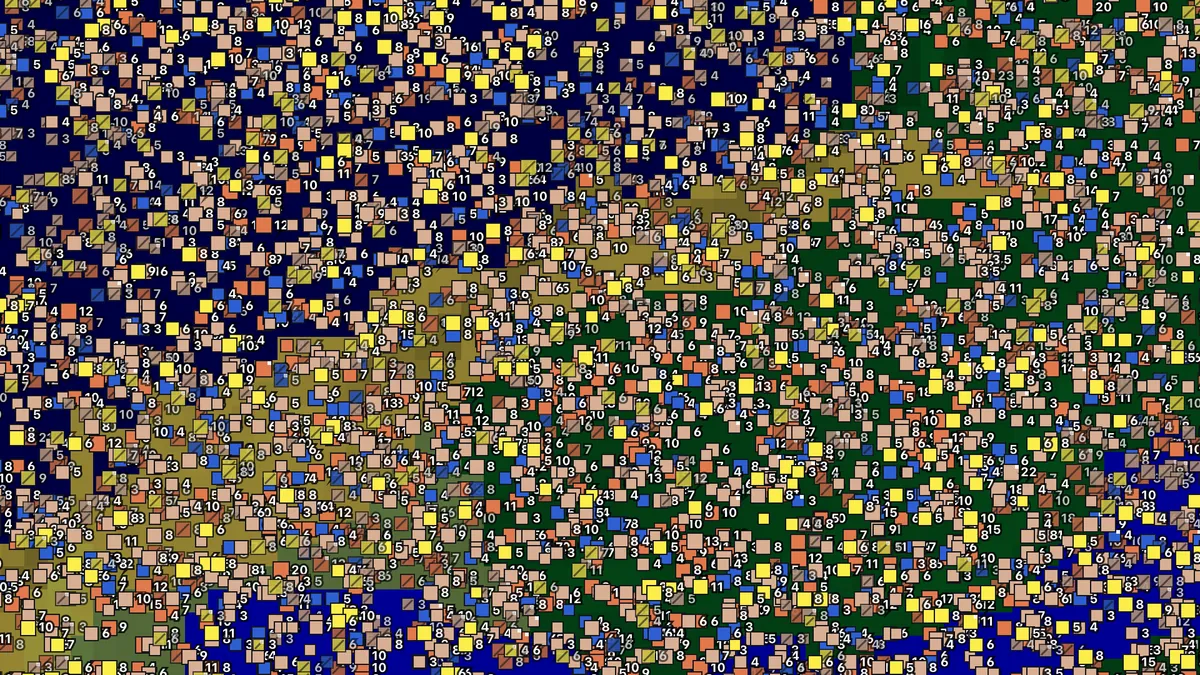
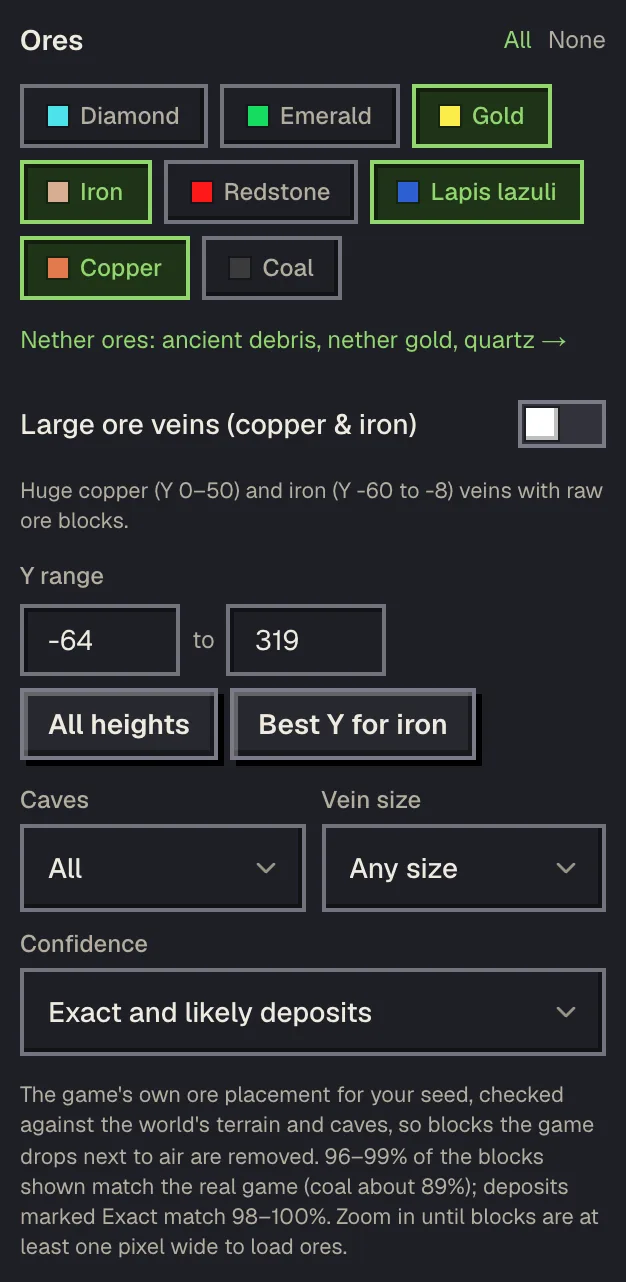
Because the random numbers come from the world seed, the chunk and the feature's position in the list, the result is fixed for a seed and version. The ore finder replays the list for Java seeds and draws every block; the ore levels page charts the batches for every version.
Every Overworld ore, 1.18 and later
| Ore | Main batches | Best Y |
|---|---|---|
| Coal | Y 0–192 triangle, peak 96; Y 136–320 uniform (mountains) | 96, or any mountain above 136 |
| Iron | Y -24–56 triangle, peak 16; Y 80–384 triangle, peak 232; small veins Y -64–72 uniform | 16 underground, 232 in tall peaks |
| Copper | Y -16–112 triangle, peak 48; large blobs in dripstone caves | 48 |
| Gold | Y -64–32 triangle, peak -16; Y -64 – -48 uniform; badlands Y 32–256 uniform | -16, or anywhere above 32 in badlands |
| Lapis lazuli | Y -32–32 triangle, peak 0; buried Y -64–64 uniform | 0 |
| Redstone | Y -63–15 uniform; Y -96 – -32 triangle, peak -64 | -58 or lower |
| Diamond | Y -144–16 triangle, peak -64, in four features | -58 or -59 |
| Emerald | Y -16–480 triangle, peak 232, mountain biomes only | 232 in peaks |
Ranges that extend past the world's limits are not mistakes: a triangle from Y -144 to 16 that peaks at -64 simply has its lower half cut off by bedrock, and that is the reason diamonds are densest right at the bottom. Emerald only generates in mountain biomes, such as meadows, groves, slopes, peaks, windswept hills and cherry groves, and it generates as single blocks, so an emerald vein is one block.
Air exposure: what survives next to caves
Each batch has an air-exposure deletion chance. Coal, copper, most iron and gold keep all of their exposed blocks, and cave walls are full of them as a result. The small and large diamond batches and the lower redstone batch delete half of their exposed blocks. The buried diamond and buried lapis batches delete all exposed blocks, so they exist only inside solid rock.
Two practical rules follow. First, caving is an excellent way to find coal, copper, iron and gold and a poor way to find diamonds, which hide a few blocks behind the walls. Second, any ore finder that treats the world as solid stone overcounts deep ores badly; the finder here models the noise caves, carver caves and ravines, the aquifers and the surface so that it can apply the deletion the way the game does, and marks blocks that sit on an approximation as Likely.
Large veins: copper and iron
1.18 added large ore veins, long snaking bodies that can run for dozens of blocks. Copper veins form between Y 0 and 50 and come wrapped in granite; iron veins form between Y -60 and -8 wrapped in tuff. Both contain blocks of raw ore, which only veins produce, alongside ordinary ore. Veins are rare, so hitting one is worth noticing: a few hundred raw copper or raw iron in one place.
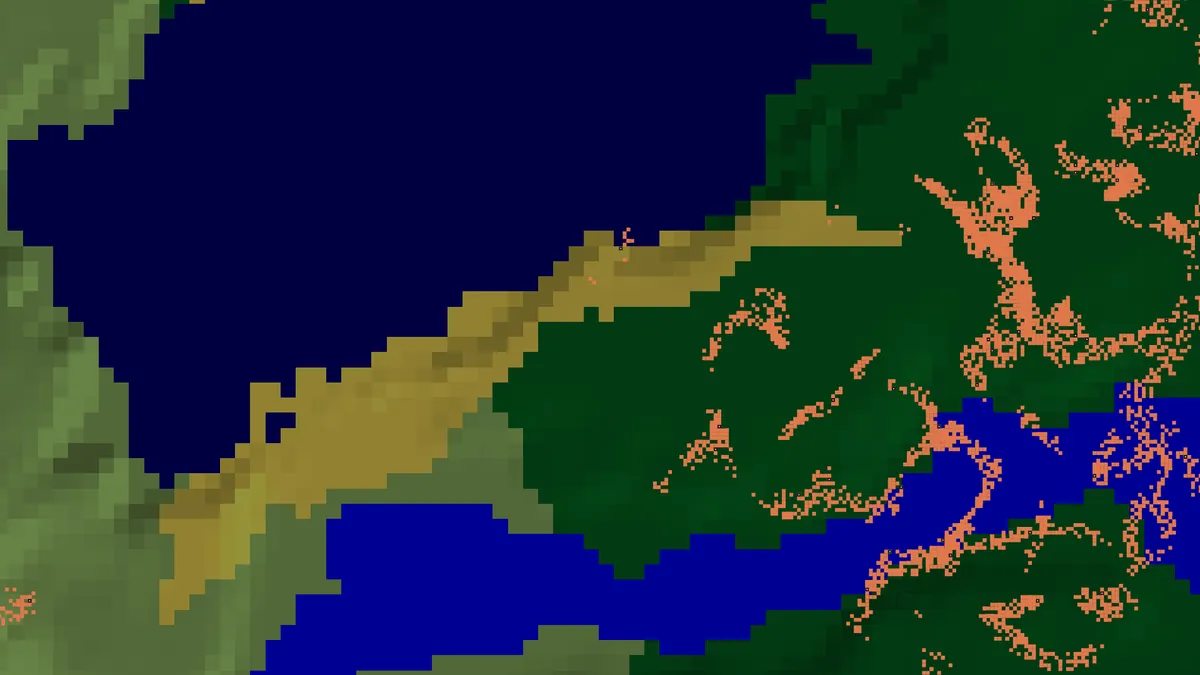
The ore vein finder draws veins as a separate layer because they come from a different mechanism than the batches: a noise function decides where a vein body runs, and a second noise decides where ore appears inside it. The finder's precision on vein ore was 98% in testing, and with veins and batches together it shows 99.6% of the game's copper and iron.
Nether ores and geodes
Nether gold and nether quartz generate uniformly from Y 10 to 117 in netherrack, with twice as many batches in basalt deltas. Ancient debris, the netherite ore, has a triangle batch from Y 8 to 24 peaking at Y 16 and a rare uniform batch from Y 8 to 119, and both are fully buried, never touching air, so you only find debris by tunnelling or by clearing netherrack with beds or TNT. Y 15 is the classic level because a tunnel there exposes Y 15 and 16, where the peak is. The ancient debris finder shows every block for Java seeds, and its precision in testing was 100%.
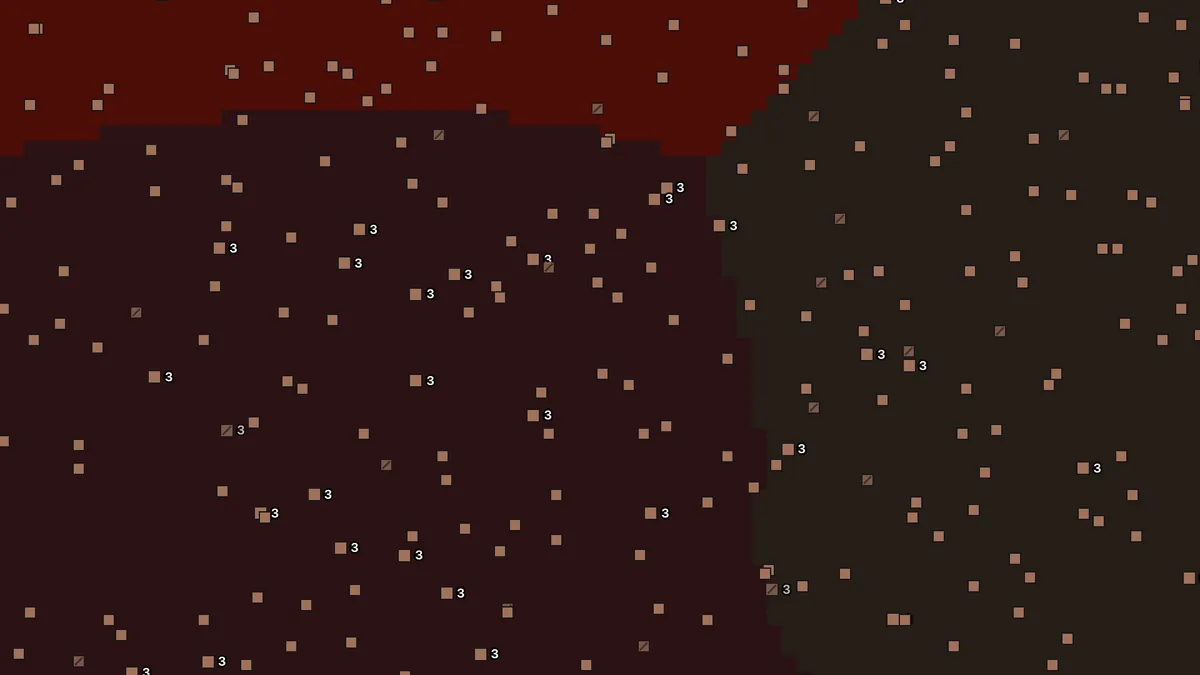
Amethyst geodes are not ores but behave like a batch: one attempt in roughly every 24 chunks between Y -58 and 30, which on seed 123456789 means 2,618 geode attempts within 2,000 blocks of spawn. Each is a hollow sphere of smooth basalt, calcite and amethyst with budding blocks that grow clusters. The geode finder marks the attempts as Approximate because caves and the surface can cut a geode open or remove it.
Before 1.18
Worlds created before Caves & Cliffs had a floor at Y 0 and used mostly uniform batches: diamonds and redstone at Y 0–15, gold at 0–31 with an extra badlands batch at 32–79, iron at 0–63, coal at 0–127, lapis in a triangle from 0 to 30 peaking at 15, emerald as single blocks at Y 4–31 in mountains, and copper, which only existed in 1.17, from 0 to 96 peaking at 48. Nether gold and quartz used the same Y 10–117 range, and ancient debris peaked at Y 15 exactly.
Chunks keep the rules they were generated with. In a world that has crossed the 1.18 line, the finders need the version of the area you are mining, and the ore levels page shows both tables; read whichever applies.
Questions
Why are diamonds densest at the bottom of the world?
Their main batch is a triangle from Y -144 to 16 peaking at Y -64. The lower half is cut off by bedrock, so the visible part is densest at Y -64 and thins out toward Y 16.
Why do I see so much iron in caves but few diamonds?
Iron, coal, copper and gold keep all of their blocks that touch air; diamonds lose half of theirs and buried diamonds all. Caves show what survived.
Do ores generate the same way on Bedrock?
Bedrock uses the same batches and Y ranges from 1.18 on, so the table and the best levels apply, but its random placement differs and the ore finders only draw Java seeds.
What is a large ore vein?
A long body of copper (Y 0–50, with granite) or iron (Y -60 to -8, with tuff) added in 1.18, containing raw ore blocks that nothing else produces. The ore vein finder shows them as a separate layer.
Where is ancient debris?
Mostly from Y 8 to 24, peaking at Y 16, with a rare scattering up to Y 119. It never touches air, so tunnel at Y 15 or clear netherrack with beds or TNT.
Related guides
Finders and tools in this guide
- Ore FinderJavaDiamonds, iron, gold, redstone and every other ore, block by block with Y levels.
- Ore Vein FinderJavaHuge 1.18+ copper and iron veins with raw ore blocks, deep underground.
- Amethyst Geode FinderUnderground geodes full of amethyst clusters and budding blocks.
- Diamond FinderJavaEvery diamond in your Java seed with exact X Y Z, vein size and cave exposure.
- Ancient Debris FinderJavaEvery ancient debris block in the Nether for netherite, with exact Y levels.
- Ore LevelsBest Y levels for every ore, before and after the 1.18 world height change.
Written by the Minecraft Tools team from the same world-generation engine that runs the seed map. Coordinates quoted here were computed with it for the stated seed, edition and version, and the engine is tested against the real game.