Best Y Level for Iron in Minecraft 26.3
JavaEveryone tells you to go climb a mountain for iron. We counted every iron ore block the game places in 1,024 chunks on two seeds, then did the same for two mountain ranges, and ran a virtual tunnel at every height. Mountains do have more iron. A tunnel at Y 12 still finds three to four times as much of it per block you dig.
Updated · 7 min read · Java up to 26.3
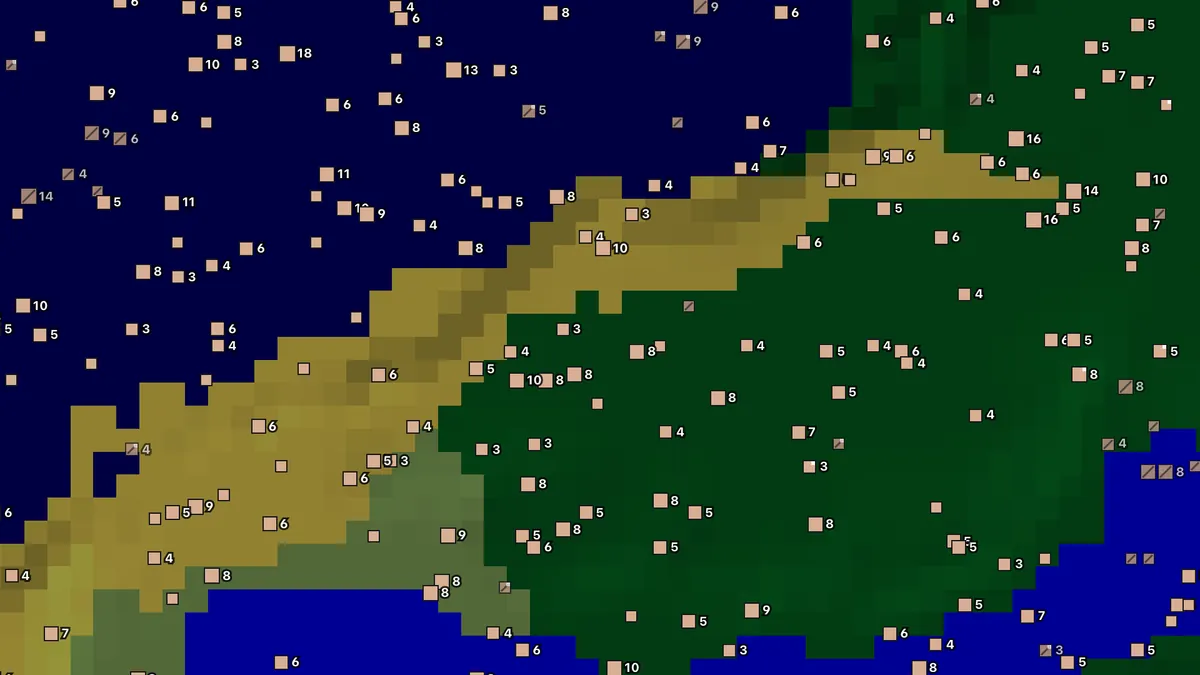
Y 12, give or take a few
Put your feet on Y 12 and dig. Anywhere from Y 10 to 16 is basically the same, so don't stress if a lava pocket bumps you up a couple of blocks. That's the short version and it holds on every seed we tried.
Here's how we got there. For seeds 0 and 123456789 on Java 26.3 we took the 32×32 chunks around 0, 0 (1,024 chunks, roughly 512×512 blocks), let the engine place every iron ore the game would, and counted how many land in the four layers a 2-high tunnel lets you see: floor, feet, head and ceiling.
| Feet at | Seed 0 | Seed 123456789 |
|---|---|---|
| Y −58 | 594 | 480 |
| Y −16 | 2,219 | 2,139 |
| Y −2 | 4,431 | 4,135 |
| Y 12 | 5,901 | 5,873 |
| Y 16 | 5,597 | 5,263 |
The top spot was feet at Y 12 on seed 0 and Y 13 on seed 123456789, within a percent of each other. Y 16, the number most charts quote, comes in 5 to 10% lower. Close enough that it doesn't matter. What does matter: going deep for diamonds costs you a lot of iron. A diamond tunnel at Y −58 sees about a tenth of the iron a Y 12 tunnel does.
But what about mountains?
Mountains get a third iron batch that only exists above Y 80, so the advice to go mining in the peaks isn't made up. We wanted numbers, so we found two big ranges near spawn: jagged peaks around −480, −384 on seed 123456789 (about 600 blocks from spawn) and stony peaks around 608, 128 on seed 8675309123456789. Then we counted a 16×16 chunk patch of each.
| Area | Iron blocks | Per chunk | From the mountain batch |
|---|---|---|---|
| Seed 0, flat land at 0, 0 (1,024 chunks) | 77,083 | 75 | 334 |
| Seed 123456789 at 0, 0 (1,024 chunks) | 72,811 | 71 | 414 |
| Seed 123456789, jagged peaks (256 chunks) | 24,248 | 95 | 4,567 |
| Seed 8675309123456789, stony peaks (256 chunks) | 25,870 | 101 | 6,083 |
So a mountain chunk holds about a third more iron than a lowland chunk. The catch is where that extra iron sits. In both ranges it was spread from Y 80 up to around Y 160, thickest between Y 96 and 111, wherever there happened to be stone. A tunnel only sees four layers of that.
We ran the same virtual tunnel through the mountain patches: a 1×2 tunnel down every third row, counting ore in the tunnel, both walls, the floor and the ceiling. At feet Y 100, the best mountain height, it found 1.1 to 1.5 iron per 100 blocks. At feet Y 12 under the very same mountains it found 4.1 to 4.6. Back on flat land at Y 12, seeds 0 and 123456789 gave 4.5 and 4.6.
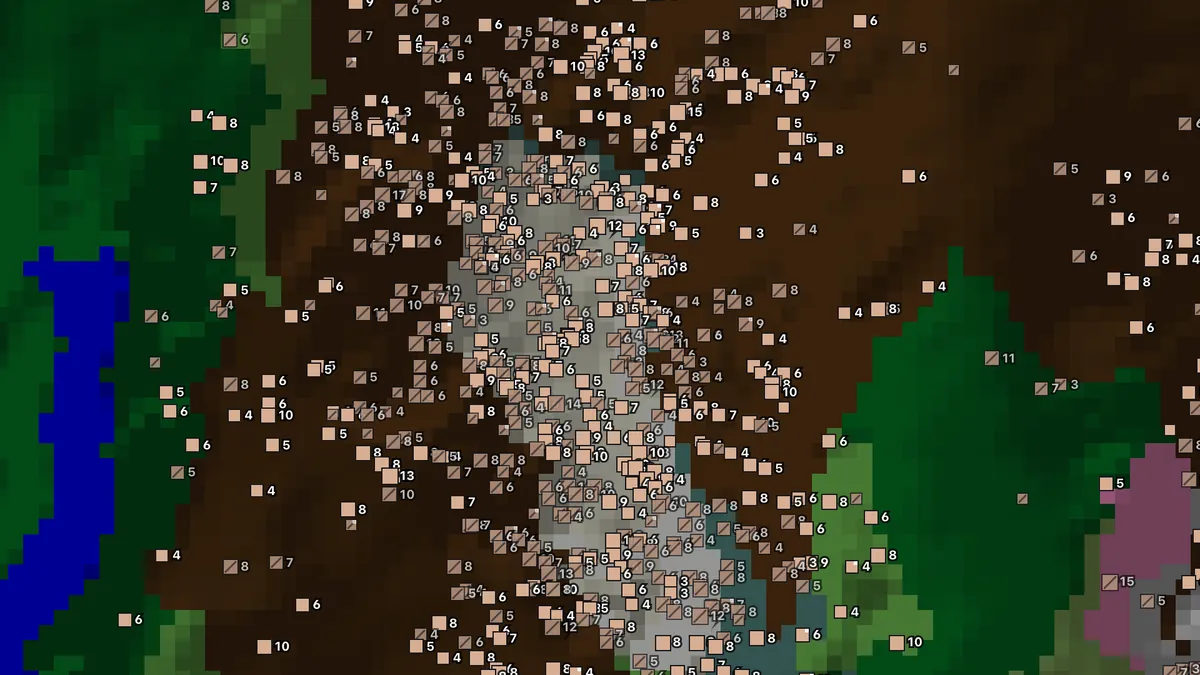
Where mountains do win is the stuff you can see. 3 to 5% of the mountain iron touched air on a cliff or in a cave, so if you're already up there for emeralds or goats, cut along the exposed faces and you'll pick up plenty. Just don't tunnel through a peak expecting a jackpot.
How long a tunnel takes
4.5 iron ore per 100 blocks at Y 12 works out to one ore every 22 blocks. Each ore drops one raw iron without Fortune, and a single 64-block run down a chunk row gets you roughly three ingots. A full set of iron armour is 24 ingots, so about 530 blocks of tunnel. An anvil is 31 ingots. A stack of hoppers for a sorting system is 320, which is where you stop mining and go build an iron farm.
The tunnel at Y 12 isn't just iron, either. On seed 0 the same tunnel ran into lapis at 0.9 per 100 blocks and gold at 0.5. On seed 123456789 there was redstone at 0.8 per 100 too, because redstone's upper batch reaches Y 15. It's a decent all-rounder layer when you need a bit of everything early on.
- Stone pickaxe is enough. Iron ore only needs stone tier. Start this tunnel on day one.
- Fortune III averages a bit over two raw iron per ore. Save your fortune pick for the deposits you find, not for the netherrack-style tunnel itself.
- Mind Y 0 to 8. That's where stone fades into deepslate. Deepslate takes about twice as long to mine, so staying above Y 8 keeps the tunnel quick.
Large iron veins: the jackpot
Since 1.18 the game also makes giant ore veins: long snakes of tuff mixed with deepslate iron ore and the odd block of raw iron, between Y −60 and −8. They're nothing like normal deposits. One vein on seed 0, under roughly X 320 to 367 and Z 64 to 127, had 1,990 iron blocks in it, 26 of them raw iron blocks (nine raw iron each). Count the raw blocks as nine and that is about 2,200 raw iron, which would take you something like 49,000 blocks of tunnel at Y 12.
They're not rare either. In a 64×64 chunk area around 0, 0, seed 0 had iron vein blocks in 591 chunks and seed 123456789 in 321. The ore vein finder draws them on the map. Dig straight down to one instead of hoping to cross one.
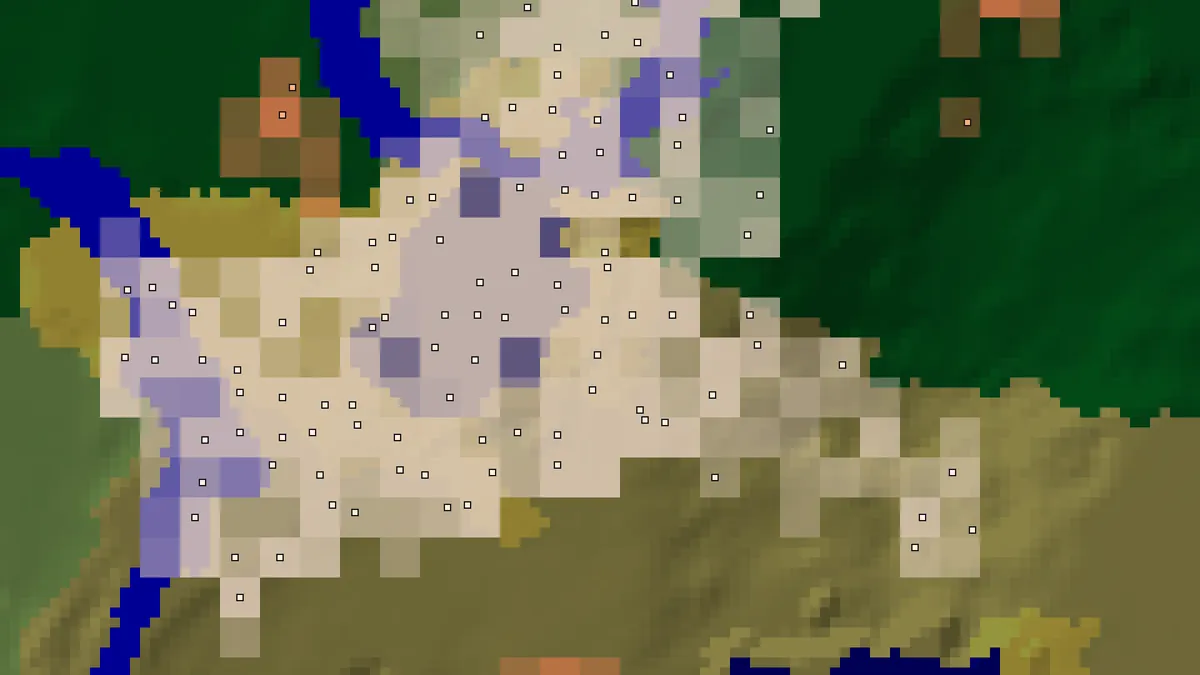
Using the finder for iron
On seed 123456789 there's an eight-block iron deposit at 70, 13, −46 (blocks from Y 12 to 14), six blocks from spawn, fully buried. Seed 0 has a six-block one at −31, 16, −1, two blocks from its spawn. Every seed has stuff like this sitting right under your feet; you just can't see it.
- Open the ore finder, type your seed, pick Java and your version, and switch the ore to iron.
- Set the Y range to 10–15 if you want to stay in one tunnel, or leave it open and use the Nearest deposits list.
- Zoom in until single blocks show. Hover a square for its X, Y and Z, or click it for the full deposit.
- Walk there with F3 open and dig down to one block above the deposit's top Y.
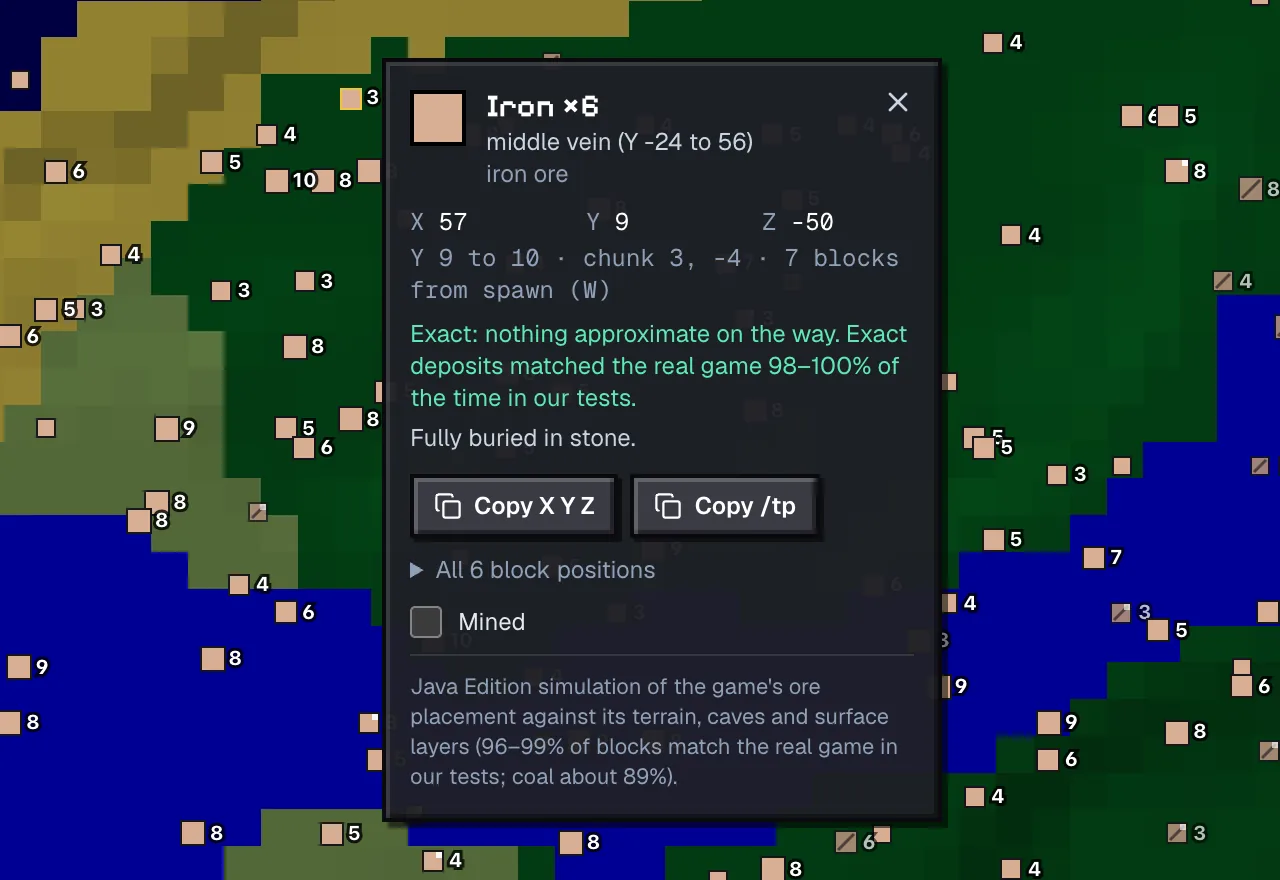
How far to trust it: checked block by block against worlds the official Java server generated, 99.4% of the iron blocks the finder showed were really there. Deposits sitting on a cave edge are marked Likely instead of Exact, and those are the ones to double-check.
Older versions and Bedrock
Everything above is 1.18 and newer. Before 1.18, iron was spread evenly from the bottom of the world up to Y 63 or so, and any height in that range worked about the same. If your world was made in 1.17 or earlier, its old chunks still follow those rules, and the finder switches to them when you pick the version. The ore levels page lists every ore's range for each version.
The ore finder is Java only. Bedrock uses a different random generator for ore placement and we haven't modelled it, so there are no Bedrock deposits or Bedrock counts in this article. Bedrock's iron heights are the same idea since 1.18, so Y 12 to 16 is a fine place to start there too.
Questions
What is the best Y level for iron in 1.21 and 26.3?
Feet at Y 12. In our count of 1,024 chunks per seed it saw the most iron of any tunnel height, and anything from Y 10 to 16 was within about 10%.
Is mining in mountains better for iron?
Mountain chunks hold about a third more iron, but it's spread from Y 80 up to the peaks. A tunnel at Y 100 found 1.1 to 1.5 iron per 100 blocks; at Y 12 under the same mountain it found 4.1 to 4.6.
How much iron does a tunnel at Y 12 find?
About 4.5 iron ore per 100 blocks of 1×2 tunnel on our test seeds, counting both walls, the floor and the ceiling. That's roughly 530 blocks of tunnel for a full set of iron armour.
Where are the big iron veins?
Large iron veins sit between Y −60 and −8 and are made of tuff, deepslate iron ore and raw iron blocks. The ore vein finder shows them for your seed on Java 1.18 and newer.
Does the ore finder show iron on Bedrock?
No. The ore finder is Java only, because Bedrock places ores with a different random generator.
Related guides
Finders and tools in this guide
- Ore FinderJavaDiamonds, iron, gold, redstone and every other ore, block by block with Y levels.
- Ore Vein FinderJavaHuge 1.18+ copper and iron veins with raw ore blocks, deep underground.
- Biome FinderSearch for any biome, from cherry groves to mushroom fields and deep dark.
- Ore LevelsBest Y levels for every ore, before and after the 1.18 world height change.
Written by the Minecraft Tools team from the same world-generation engine that runs the seed map. Coordinates quoted here were computed with it for the stated seed, edition and version, and the engine is tested against the real game.