Iron Farms: Picking the Village and the Spot
JavaBedrockAn iron farm needs villagers, a spot that stays loaded, and a way to get the first villagers there. All three are questions about your seed, and the map answers them before you place a block: the nearest village, the spawn chunks, the river between them.
Updated · 7 min read · Java & Bedrock up to 26.3
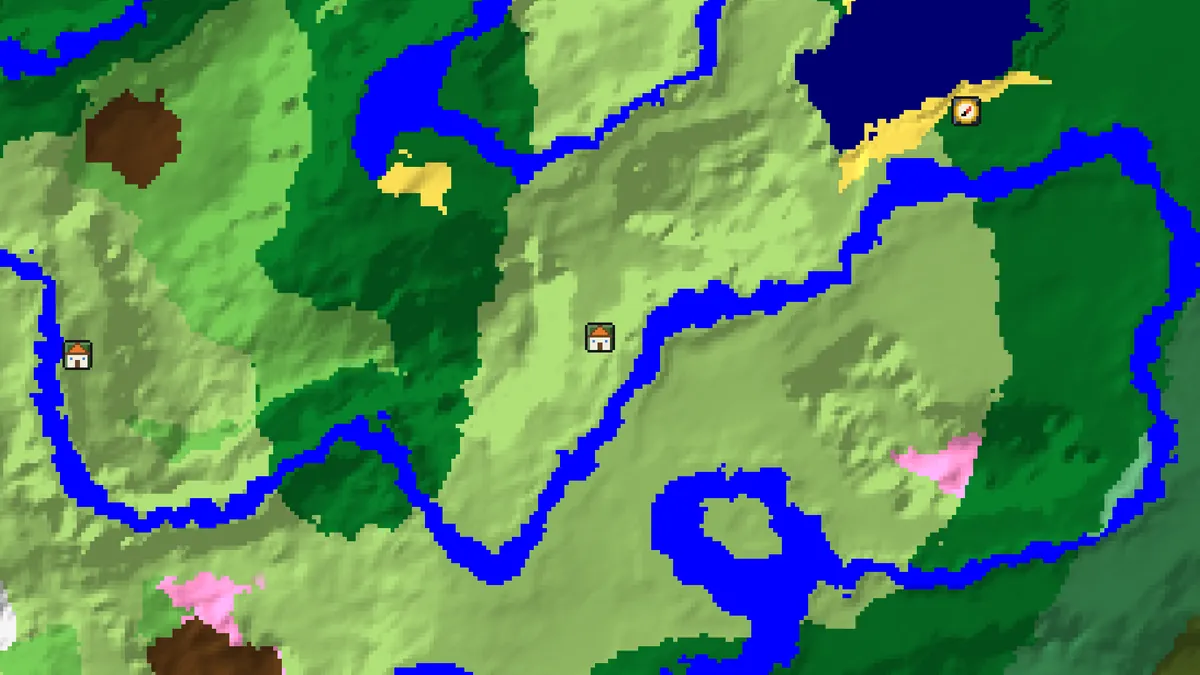
What actually spawns a golem on Java
Since 1.14, iron golems are summoned by villagers, not by villages. A villager who has a bed, has slept and worked recently and cannot see a golem nearby will try to summon one, and a villager who is frightened by a hostile mob tries harder and sooner. The golem appears on a solid block with room above it, within about eight blocks horizontally and six vertically of the villager. Light does not matter and neither does the time of day.
Every popular farm design is built on that one paragraph. Three villagers, their three beds, and a zombie they can see but that cannot reach them, standing behind glass or across a gap. The scared villagers summon a golem every half-minute or so, the golem lands on a platform that is the only valid spawning surface within reach, water pushes it into lava or a drop, and the iron and poppies arrive at a hopper. Nothing about the farm needs to be inside a natural village.
That is also why the design is cheap to scale: a second cell with its own three villagers and its own zombie is a second farm, as long as the two groups of villagers cannot see each other's golems. Spacing the cells by more than about sixteen blocks keeps them independent.
So why does the seed matter?
Because the villagers have to come from somewhere, the farm has to run while you are elsewhere, and the first trip between the two is the slowest hour of the project. All three are things the seed decides.
- Villagers. The nearest natural village is your supply of the first three. Breeding at the farm takes care of the rest, but the first three have to be moved, and the distance and terrain between the village and the farm site set how painful that is. Zombie villages are a second source: cure the zombie villagers and they are yours, with discounted trades thrown in.
- The site. Farms only produce while the chunks they stand in are loaded. The chunks around the world spawn are loaded all the time on Java, which makes the spawn chunks the one place where an iron farm works while you are at the other end of the map. Anywhere else, it runs only when a player is within render distance.
- The route. Villagers travel badly on foot. A river from the village to the site means boats; a flat path means a minecart track or a boat dragged over land; a long distance means a Nether tunnel. The map shows all three before you commit.
Reading the map for a farm
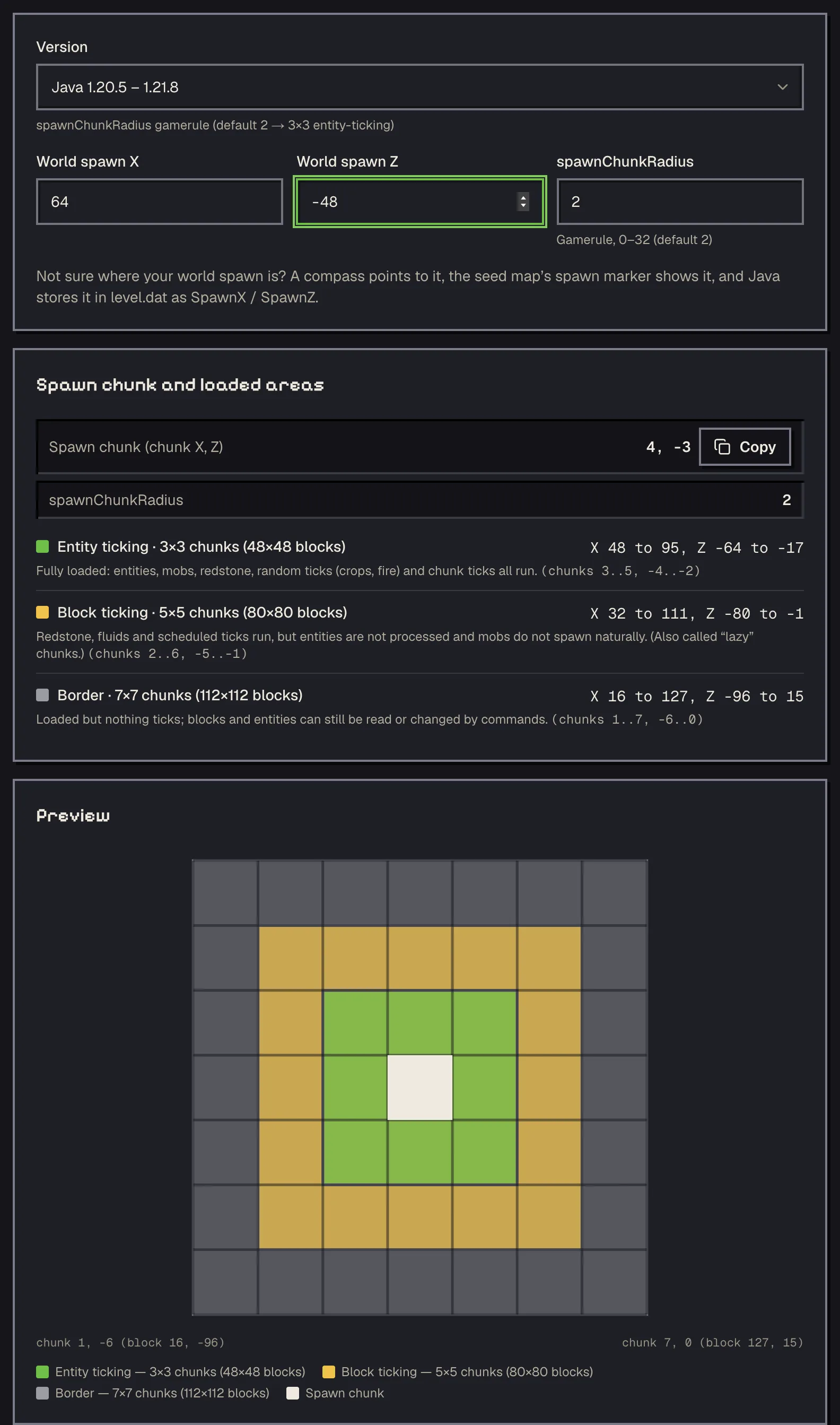
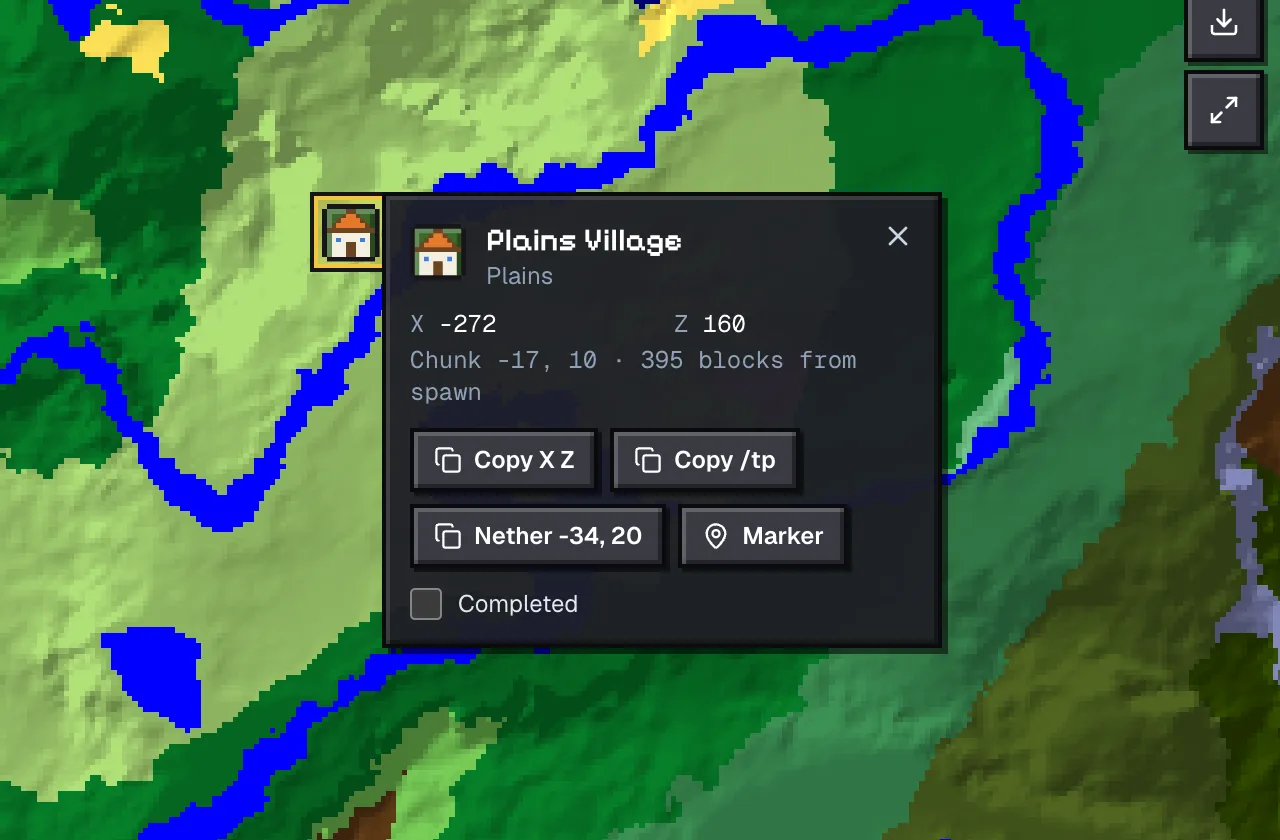
Take seed 123456789 on Java 26.3. Spawn is at 64, -48 in a forest, so the spawn chunks are there, and the spawn chunk calculator draws exactly which chunks stay loaded for your version. The village finder puts the nearest village, a plains one, at -272, 160, about 395 blocks south-west. That is a short boat trip or a few minutes of walking a villager in a boat on land. Two more plains villages sit at -752, 176 and -816, -992 if the first has too few villagers.
The text seed chunkscout is the awkward case: its nearest villages are a snowy one at 880, 576 and a taiga one at -816, 672, both over a thousand blocks from spawn, and there is a pillager outpost at 256, -448 in between. A farm in those spawn chunks means a long villager transport or a cure of two zombie villagers found on the way. Knowing that on day one changes what you build first.
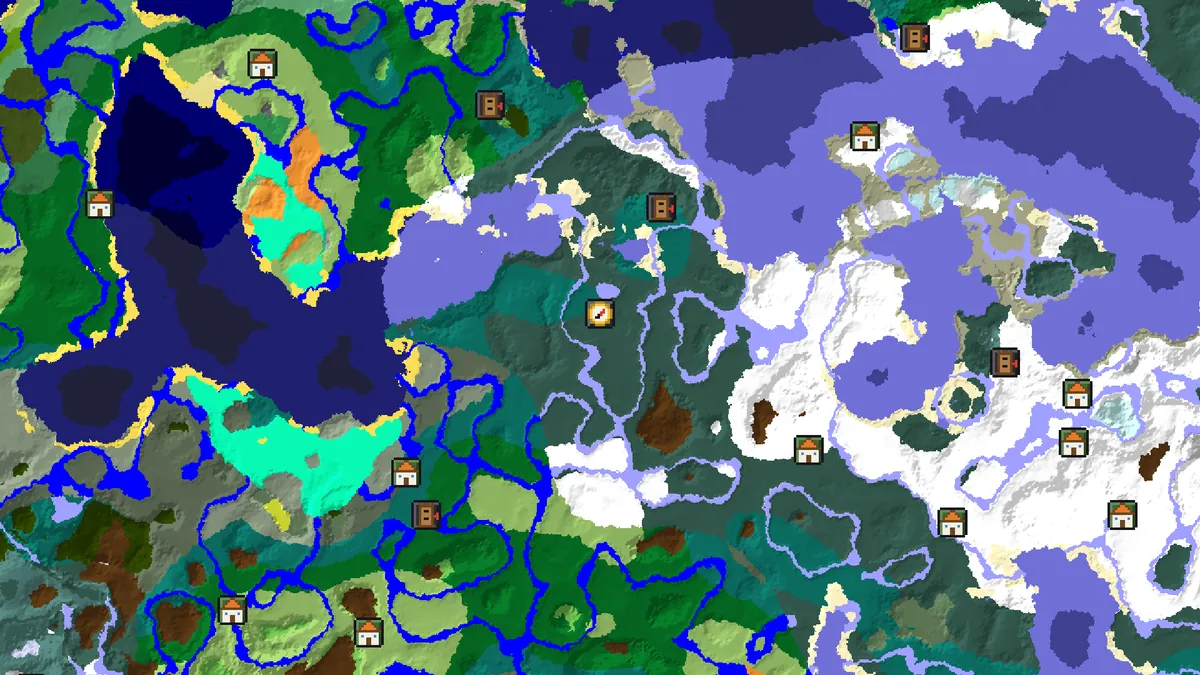
Also look at what else is around the site. Terrain shading tells you how flat the ground is, which decides how much you dig; a nearby cave system is a source of zombies for the scare cell but also of stray mobs that distract villagers; and a pillager outpost within a few hundred blocks sends patrols, which scare villagers in a way that spawns golems you did not plan for, usually on top of your farm.
Moving the first villagers
- Boats are the honest answer for anything under a thousand blocks. Push a boat against a villager, it climbs in; then row, or on land drag the boat a block at a time, which is slow but reliable.
- Minecarts need a track, so they pay off when you will use the line again, for instance between a village and a trading hall.
- Nether portals move villagers too. Build a portal at the village and one at the farm site, push the villager through in a boat or a minecart, and the 1:8 scale makes a long trip short. Read the portal linking guide first so the two portals link where you expect.
- Curing beats transporting when the distance is large. Trap a zombie villager, splash weakness, feed a golden apple, wait a few minutes. Two cured villagers plus a bed and bread breed a third on the spot.
Bedrock plays by other rules
On Bedrock, golems spawn into a village based on how many villagers and beds it has rather than on frightened individuals, so Bedrock iron farms are built on a real village, often by enlarging it with beds and villagers until the game's counts tick over. The scare-cell designs from Java do not work there, and Bedrock rates are generally lower.
The seed questions are the same, though. The village finder is exact for Bedrock, so you know which village is closest and what type it is, and the spawn chunk logic differs on Bedrock, where only a small area around spawn stays loaded, so a Bedrock farm usually needs a player nearby in any case.
What a farm gives you
A single three-villager cell on Java produces a golem roughly every thirty to forty seconds while loaded, each worth three to five iron ingots and a few poppies: hundreds of ingots an hour from one cell, several times that from three or four cells. That covers rails, hoppers, anvils and armour for a whole server and leaves iron blocks for beacons. The farm in the spawn chunks is the one that quietly fills a chest while you are off hunting an ancient city.
Questions
Does an iron farm need a natural village?
Not on Java since 1.14: villagers summon golems wherever they are, so three villagers with beds and a zombie to scare them are enough. The natural village is where the first villagers come from.
Where should I build an iron farm?
In the spawn chunks if you want it to run while you are away, since those stay loaded on Java. The spawn chunk calculator shows the exact chunks for your version and spawn.
How do I get villagers to the farm?
Boats for short distances, including over land; minecart tracks for routes you will reuse; Nether portals for long ones. Or cure two zombie villagers near the site and breed from them.
Why do golems spawn in odd places near my village?
Villagers frightened by zombies, pillagers or raids summon golems within a few blocks of themselves. A pillager outpost nearby sends patrols that trigger this.
Do Java iron farm designs work on Bedrock?
No. Bedrock spawns golems into villages based on villager and bed counts, so Bedrock farms are built around a real village with many beds. Rates are lower than on Java.
Related guides
Finders and tools in this guide
- Village FinderLocate villages by biome type — plains, desert, savanna, taiga and snowy.
- Spawn Point FinderSee the exact world spawn and the surrounding spawn chunks.
- Seed MapInteractive biome map with every structure, slime chunk and spawn point on one canvas.
- Spawn Chunk CalculatorWhich chunks stay loaded around world spawn, by version.
Written by the Minecraft Tools team from the same world-generation engine that runs the seed map. Coordinates quoted here were computed with it for the stated seed, edition and version, and the engine is tested against the real game.