Lush Caves and Axolotls: Where to Dig
JavaLush caves are not random holes with moss in them. We checked what sits above 83,205 sample points on five seeds, and the pattern is brutal: zero lush caves under plains, forests or savannas, and 85% of old growth pine taiga has one underneath. Here's where to dig, how deep, and what to do with the axolotls once you're down there.
Updated · 7 min read · Java up to 26.3
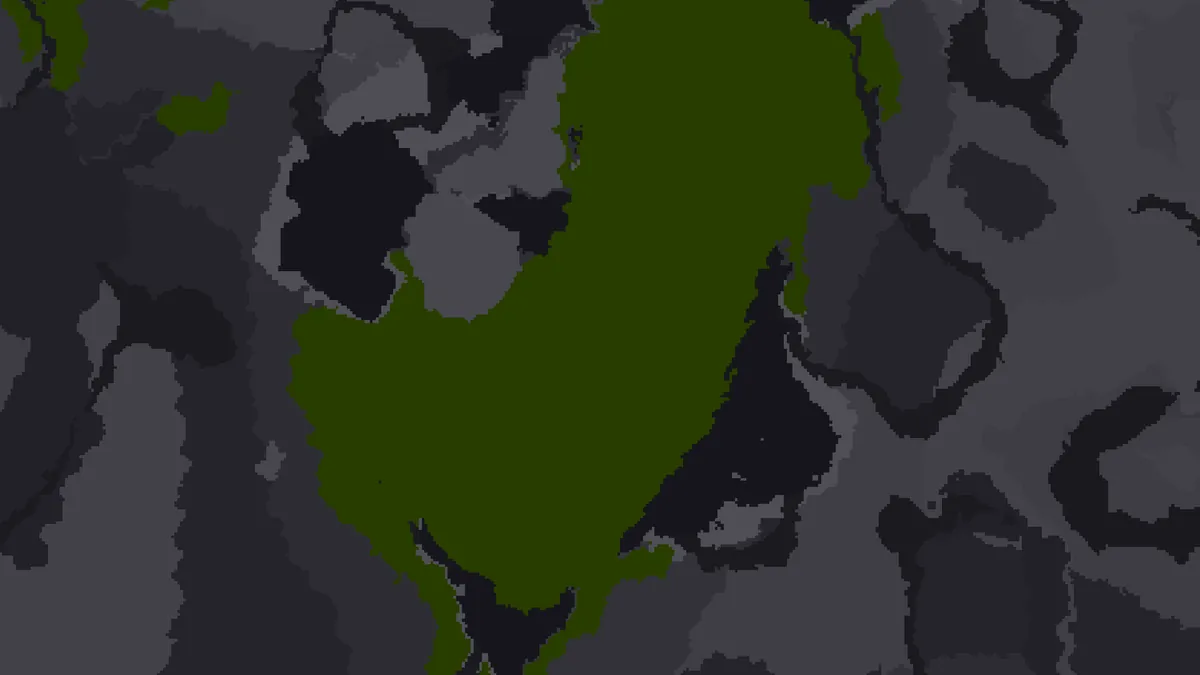
What you're looking for
A lush cave is an underground biome, not a structure. Moss carpets the floor and walls, clay pools sit in the low spots, big dripleaf grows out of the water, spore blossoms hang off the ceiling and cave vines with glow berries light the whole thing up. It's the one place underground that feels nice to be in, and it's the only place axolotls spawn.
Because it's a biome, the game decides it the same way it decides jungles and deserts: from climate noise. Since 1.18 every block of the world has its own biome in three dimensions, so a forest on the surface can sit on top of a lush cave at Y 0 and plain stone again at Y 40. That's what makes them annoying to find by wandering, and easy to find with a map that can look underground.
The surface gives it away
We sampled five seeds (0, 123456789, 8675309123456789, chunkscout and -1234567890123) every 32 blocks over a 4,096 block square around spawn, which is 83,205 points. At each one we asked the engine two things: what biome is at Y 0, and what biome is on the surface above it. Overall, 11.2% of those points were lush caves. But the split by surface biome is wild.
| Surface biome | Points | Lush cave below |
|---|---|---|
| Old growth pine taiga | 587 | 85% |
| Old growth spruce taiga | 627 | 77% |
| Dark forest | 1,884 | 74% |
| Swamp | 1,076 | 30% |
| Taiga | 2,993 | 29% |
| Jungle | 1,826 | 28% |
| Desert | 1,112 | 21% |
| Ocean | 6,694 | 11% |
| Forest, plains, savanna, meadow, badlands, snowy plains | 26,475 | 0% |
Read that last row again. Not a single lush cave under any of those 26,475 points. The reason is humidity: lush caves need wet climate, and plains, forests and savannas are the dry-ish end of the scale. Dark forests and the old growth taigas are the wettest land biomes in the game, so they almost always have lush caves under them.
Jungles surprised us. Everyone says "lush caves are under jungles", and sure, 28% is well above average, but a dark forest is more than twice as reliable. Deserts at 21% were the other surprise. The cave climate isn't a perfect copy of the surface one, so you get the odd lush cave under sand.
How deep to dig
Lush caves are not a layer at one height. We checked nine heights on the same grid (one point every 32 blocks over a 2,048 block square) and the share of lush cave peaks right around Y −8 to Y 8, then fades out both ways.
| Y | 123456789 | 8675309123456789 | chunkscout |
|---|---|---|---|
| 40 | 2% | 4% | 1% |
| 24 | 5% | 6% | 6% |
| 8 | 10% | 11% | 14% |
| 0 | 11% | 12% | 16% |
| −8 | 9% | 11% | 14% |
| −24 | 3% | 7% | 6% |
| −40 | 0% | 3% | 1% |
So if you strip mine at diamond level, you'll almost never cut into one. Mine a staircase down to about Y 0 under a dark forest or an old growth taiga and you've got the best odds there are. Deeper down it's the deep dark's turn: on two of these seeds 30% of the points at Y −56 were deep dark, and lush caves had vanished completely by then.
How far is the nearest one?
Here's the nearest lush cave point to spawn at Y 0 on each seed, on that same 32 block grid. A real cave can start a few blocks closer than the grid point.
| Seed | Spawn | Nearest lush cave | Distance | Lush at Y 0 |
|---|---|---|---|---|
| chunkscout | 0, 0 | 0, 0 | right under you | 14.5% |
| 8675309123456789 | 0, 0 | −64, −64 | 91 blocks | 10.2% |
| 123456789 | 64, −48 | 448, 48 | 396 blocks | 12.8% |
| -1234567890123 | −16, 16 | −144, −432 | 466 blocks | 13.5% |
| 0 | −32, 0 | −320, 736 | 790 blocks | 5.1% |
On chunkscout you spawn in a snowy taiga with a lush cave at Y 0 directly below your feet. Dig straight down a few dozen blocks and you're in it. Seed 0 is the stingy one: only 5% lush, and the first sizeable patch is about 860 blocks out.
Seed 8675309123456789 has the biggest one near spawn: a lush region of roughly 408,000 square metres centred around 0, −576, sitting under a lukewarm ocean and the jungle and bamboo jungle on its shore. At 0, −576 the column is lush cave from Y −40 to Y 0, with ocean above Y 20. Under an ocean like that, expect a lot of the cave to be flooded. Good news if you came for axolotls.
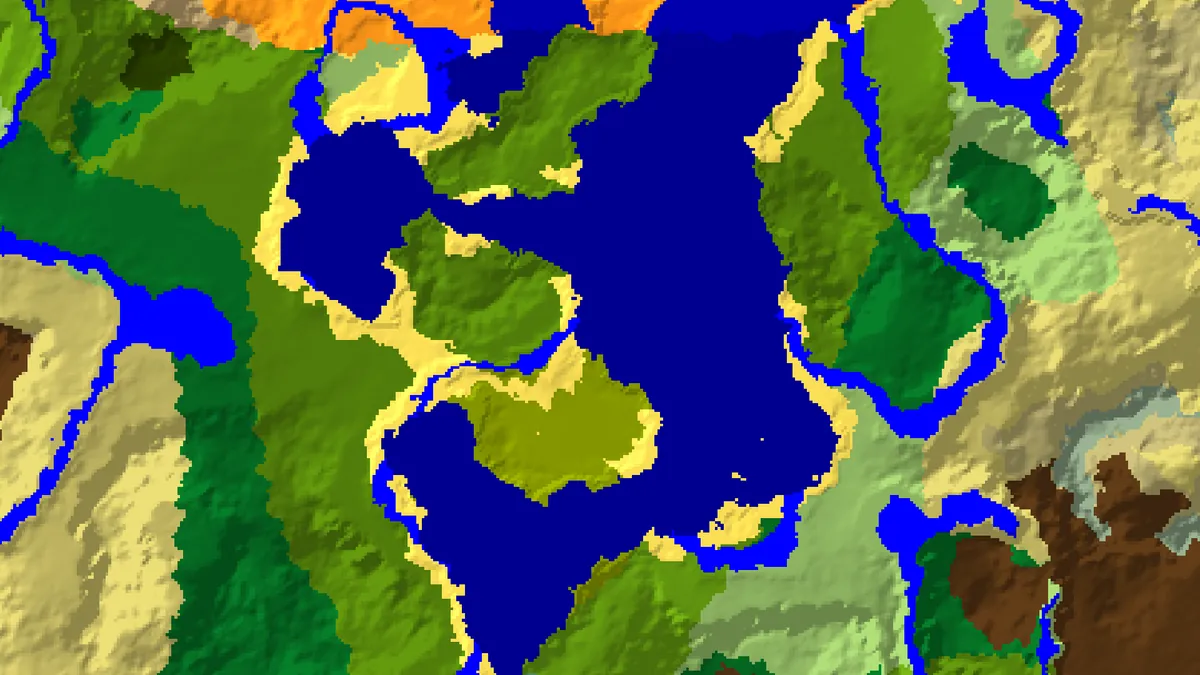
Finding one on your seed
- Open the Biome Finder, enter your seed and a Java version from 1.18 up.
- In the side panel, set Biome layer to Caves (Y 0). The map now shows what's at Y 0 instead of the surface.
- Set Highlight to Lush Caves. Everything else dims, so the green patches jump out.
- Hover a patch for its coordinates, then flip back to the surface layer to see what you'll be walking over. A dark forest or old growth taiga on top is a good sign it goes deep.
- Walk there and dig a staircase down to around Y 0. Don't dig straight down: lush caves love water and clay pools, and you don't want to fall into a flooded room.
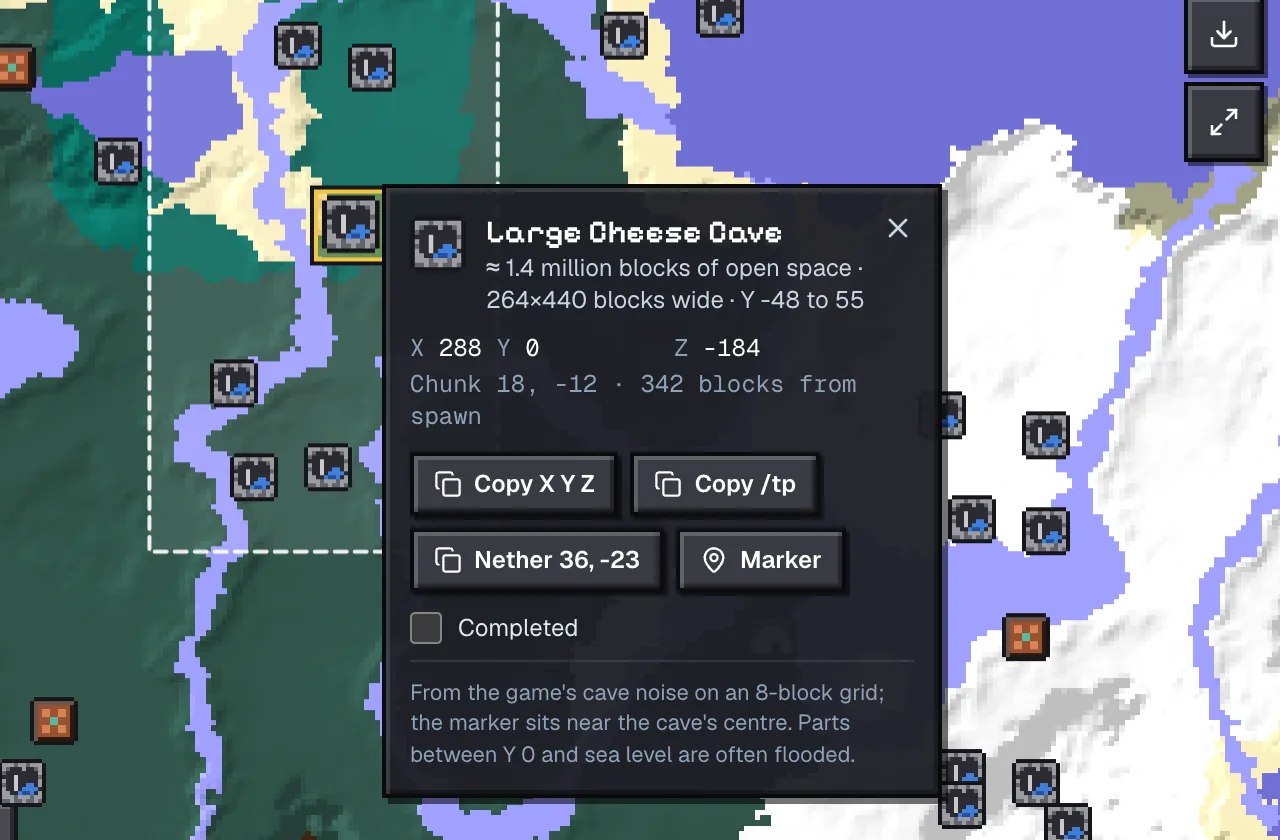
The Cave Finder helps too. It marks the big cheese caverns, and some of them are lush inside. On chunkscout, the biggest cave within 1,000 blocks of spawn is a lush one: about 1.39 million blocks of open space centred at 288, 0, −184, 342 blocks from spawn, under a taiga. The engine has it lush at Y 0 and Y 20, so a good chunk of the cavern is moss.
Axolotls and glow berries
Axolotls spawn in water inside lush caves, and nowhere else. Bring a water bucket: right-click one with it and you've got a bucket of axolotl to carry home. They need water to live, so dump them in a pond or a tank as soon as you're back.
- Breeding takes a bucket of tropical fish. Catch tropical fish in a warm ocean with a water bucket, then feed it to two axolotls.
- The blue one only comes from breeding, at a 1 in 1,200 chance per baby. Wild axolotls are pink, brown, gold or cyan. If you want blue, set up a breeding pen and be patient.
- In fights they attack drowned, guardians and most other water mobs. Finish off a mob they are fighting and you get Regeneration. Take a couple to an ocean monument and they genuinely help.
- Playing dead: when an axolotl gets hurt it sometimes lies still and heals. It's not glitching, leave it alone.
Glow berries grow on the cave vines hanging from the ceiling. Right-click a vine with berries to pick them. They're food, they breed foxes, and you can plant them on the underside of any block for a light source that looks way better than a torch. Grab a stack of moss blocks and some azalea while you're down there too. A bone meal on moss spreads it over stone, which is a great way to make the cave your own.
Questions
What biome are lush caves under?
Wet ones. On five seeds, 85% of old growth pine taiga, 77% of old growth spruce taiga and 74% of dark forest had a lush cave at Y 0 below. Plains, forest, savanna, meadow and badlands had none at all.
What Y level are lush caves at?
Mostly between Y −24 and Y 24, peaking around Y 0. Below Y −40 they're almost gone and the deep dark takes over.
Are lush caves always under jungles?
No. In our sample only 28% of jungle points had a lush cave below. Dark forests and old growth taigas are far better bets.
Where do axolotls spawn?
In water inside lush caves. Scoop one up with a water bucket. The rare blue variant only comes from breeding, 1 in 1,200 babies.
Can the seed map show lush caves?
Yes. On the Biome Finder or the seed map, set the biome layer to Caves (Y 0) and highlight Lush Caves. It works for Java 1.18 and newer.
Related guides
Finders and tools in this guide
Written by the Minecraft Tools team from the same world-generation engine that runs the seed map. Coordinates quoted here were computed with it for the stated seed, edition and version, and the engine is tested against the real game.