Java vs Bedrock: Structure Placement
JavaBedrockSince 1.18 Java and Bedrock generate the same Overworld biomes from the same seed, but they place structures with two unrelated random number generators. The difference is worth understanding once, because it explains almost every “the map is wrong on Bedrock” message we receive. Below: how each edition rolls its dice, the same seed on both, and what the map can and cannot promise for Bedrock.
Updated · 7 min read · Java & Bedrock up to 26.3
How Java places a structure
Java divides the world into square regions of chunks, with a size and a minimum gap per structure type: villages use 34-chunk regions with an 8-chunk separation, trial chambers 34 and 12, ancient cities 24 and 8, woodland mansions 80 and 20. In each region it seeds java.util.Random with the world seed, the region coordinates and a salt unique to the structure type, draws one chunk position inside the allowed part of the region, and then checks the biome there. If the biome fits, the structure generates at that chunk; if not, the region stays empty.
Because the draw only depends on the seed, the region and the salt, a seed map can compute every attempt for the whole world without generating any terrain. The biome check is the slow part, and it is the part that decides which attempts become real structures.
How Bedrock places a structure
Bedrock uses the same idea of regions, often with the same sizes, but a different generator. It builds a 32-bit region seed from the region coordinates, the structure's salt and the low 32 bits of the world seed, then feeds it to a Mersenne Twister. Some types take one draw per axis; others take two and average them, which pulls positions toward the middle of the region. Bedrock also offsets the final block position by 8 inside the chunk.
Different generator, different numbers, different chunk. That alone is why a Java village finder gives wrong answers for Bedrock: the village attempt lands in a different chunk of the same region. The map implements the Bedrock algorithm for each type where it is known, and it was checked against the Bedrock Dedicated Server by asking the game whether a structure exists at each marker.
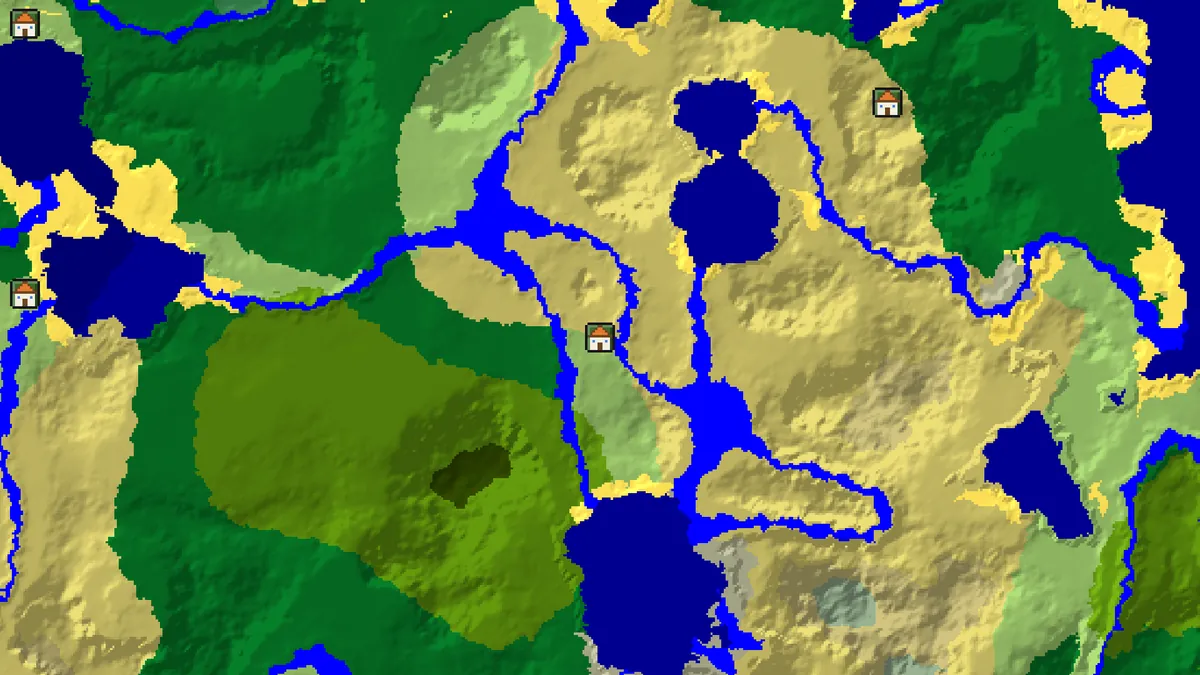
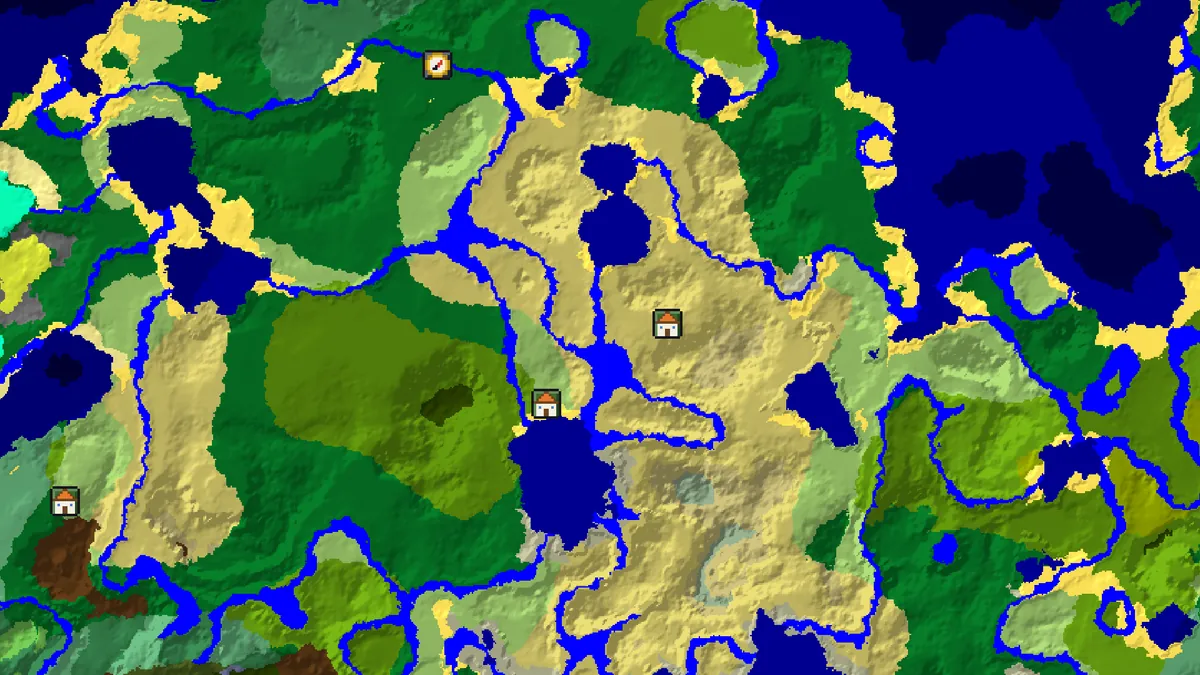
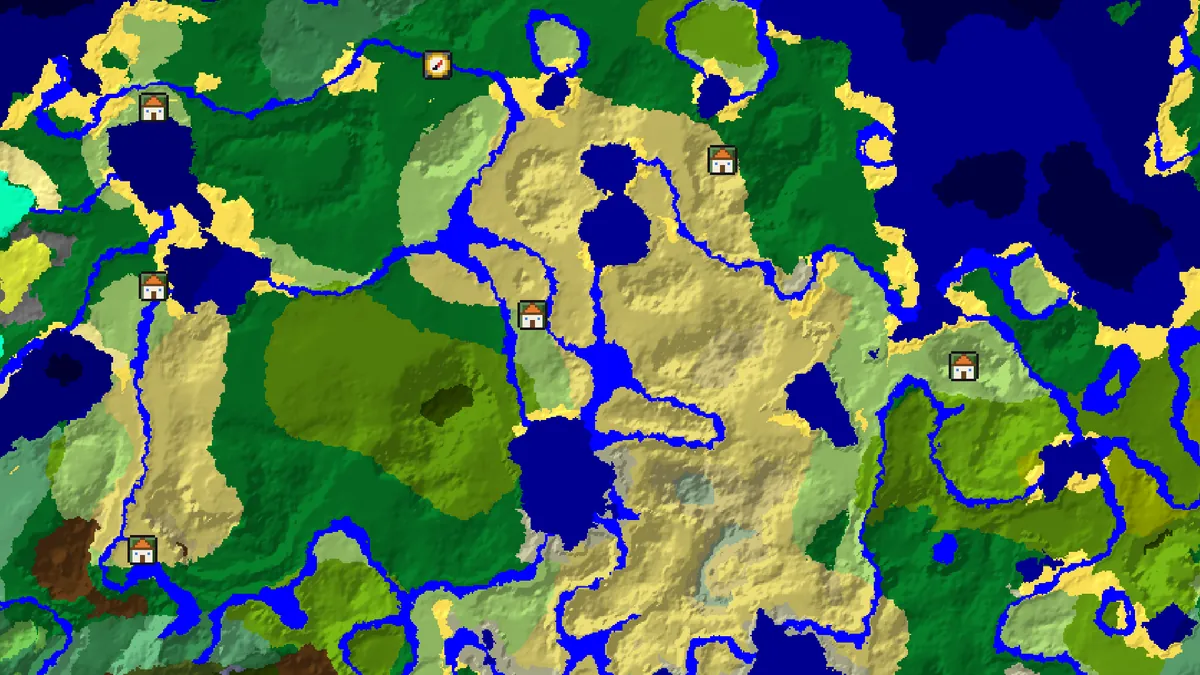
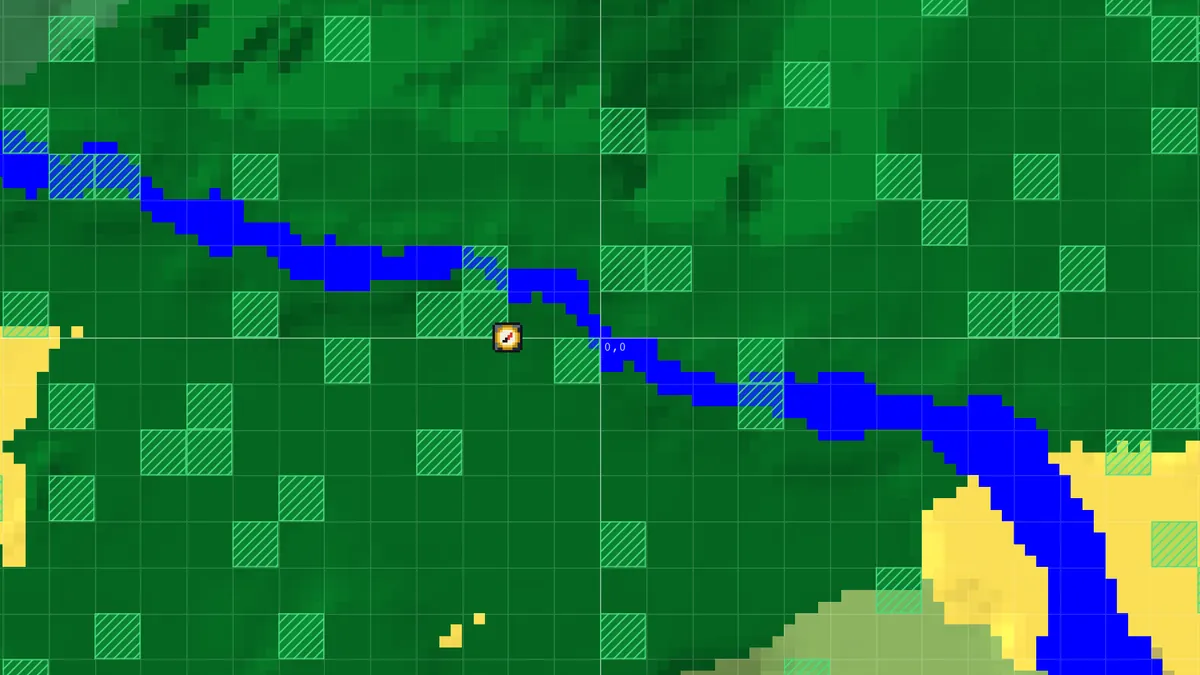
On seed 0, the nearest village to spawn is a savanna village at 608, 720 on Java and a savanna village at 232, 696 on Bedrock. Both are savanna villages because both editions see the same biome map; they are in different places because the dice are different.
Strongholds, slime chunks and the other dimensions
Java places exactly 128 strongholds in rings around the origin, three of them between 1,280 and 2,816 blocks out. Bedrock has no rings. It generates strongholds under some villages and scatters more far away, so the nearest Bedrock stronghold is often several thousand blocks out: on seed 0 the first one the map lists is at -3528, 1896, almost 4,000 blocks from spawn. The map shows the village-linked strongholds for Bedrock; the scattered ones are not shown because their placement could not be confirmed in-game.
Slime chunks are the most extreme case. Java mixes the world seed with the chunk coordinates, so the pattern is unique to the seed. Bedrock seeds its generator with the chunk coordinates alone, so every Bedrock world has the same slime chunks. A Bedrock slime chunk list works in every Bedrock world and in no Java world.
The Nether and the End do not share generation either. Bedrock's Nether biomes differ from Java's, so the map hides the Bedrock Nether biome layer instead of drawing Java's, while fortresses and bastions use Bedrock's own placement and are confirmed in-game. The Bedrock End is laid out differently from Java's, and End cities are marked Java only because an End city attempt from the Java rules is usually not there on Bedrock.

What the map guarantees for Bedrock
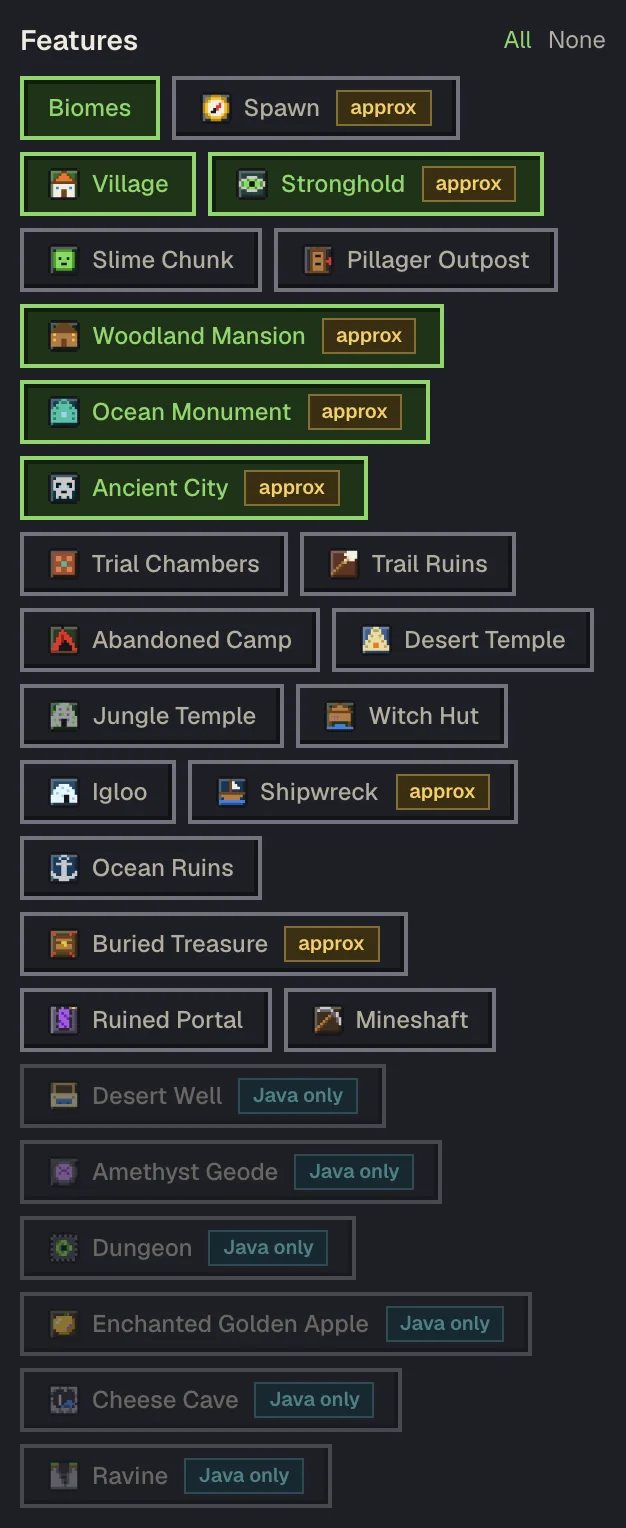
Every structure type carries a Bedrock status in the engine, measured by asking the Bedrock Dedicated Server whether the structure exists at the map's marker. Three groups come out of that.
| Status | Structures | What it means |
|---|---|---|
| Exact | Villages, desert and jungle temples, witch huts, igloos, outposts, ocean ruins, ruined portals, trail ruins, trial chambers, abandoned camps, mineshafts, fortresses, slime chunks | Positions follow Bedrock's algorithm and were confirmed in-game. |
| Approximate | Ocean monuments, woodland mansions, shipwrecks, buried treasure, ancient cities, bastions, strongholds | The marker is where the game attempts the structure; between half and nine in ten are confirmed, and no real structure is missing. |
| Java only | End cities and gateways, geodes, desert wells, dungeons, caves, ravines, ores, enchanted golden apples | No Bedrock algorithm is implemented, so nothing is drawn. A guess would be worse. |
The approximate group admits something many tools hide: on Bedrock, roughly half of the mansion and shipwreck attempts do not generate, because the game's own checks fail after placement. The map still shows them, with an approximate badge, because the ones that do exist are at those coordinates.
Choosing the right edition and version
Set the edition to the game you play, then pick the version band. Bedrock version numbers do not match Java's, so the map lists the Bedrock ranges that use each generator.
| Bedrock version | Generator used by the map |
|---|---|
| 26.50 and later | 26.3 |
| 26.30 – 26.45 | 26.2 |
| 1.21.60 – 26.23 | 26.1 |
| 1.21.50 | 1.21.4 |
| 1.21.0 – 1.21.40 | 1.21.3 |
| 1.20, 1.19, 1.18 | 1.20, 1.19, 1.18 |
Bedrock versions before 1.18 are not supported at all, because their Overworld generator was different from Java's and is not part of the engine. If you play on a console or phone, you are on Bedrock; the Java edition is the desktop version with the launcher.
Questions
Are biomes really identical on Java and Bedrock?
In the Overworld, from 1.18 on, yes: both editions compute biomes from the same noise functions and the same 64-bit seed. The Nether and the End differ, and pre-1.18 Bedrock worlds used a different generator.
Why does a Java seed map show my Bedrock village in the wrong place?
Because Bedrock draws its structure positions from a different random number generator. The village attempt falls in a different chunk of the same region. Set the edition to Bedrock and the map switches algorithms.
Why are some Bedrock structures marked approximate?
Their attempt positions are known, but Bedrock cancels some of them after placement, so between half and nine in ten of the markers exist in-game depending on the type. The map says so instead of pretending.
Why are End cities Java only?
The Bedrock End is shaped differently from Java's, and in tests against the Bedrock Dedicated Server none of the Java-rule End city positions existed. Showing them would send you to empty islands.
Do slime chunks match between editions?
Never. Java slime chunks depend on the seed; Bedrock slime chunks depend only on the chunk position and are the same in every Bedrock world.
Related guides
Finders and tools in this guide
- Seed MapInteractive biome map with every structure, slime chunk and spawn point on one canvas.
- Village FinderLocate villages by biome type — plains, desert, savanna, taiga and snowy.
- Stronghold FinderFind every stronghold ring and the End portal room nearest to spawn.
- Slime FinderHighlight slime chunks for Java and Bedrock — build the perfect slime farm.
- End City FinderEnd cities and ships with elytra and shulker boxes.
- Nether Fortress FinderFortresses with blazes, wither skeletons and nether wart.
- Seed ConverterTurn a text seed into its numeric value (String.hashCode, same on Java and Bedrock).
Written by the Minecraft Tools team from the same world-generation engine that runs the seed map. Coordinates quoted here were computed with it for the stated seed, edition and version, and the engine is tested against the real game.