How to Build an Underground Base in Minecraft
JavaBedrockFrom the surface it's a field with a little stone shrine, an old well and a pond. Eleven steps down there's a pillared hall, a storage room, a workshop, a bedroom and a wheat farm lit through the bottom of the pond. We'll show you every layer, how deep to dig, how to keep mobs out on both editions, and the quick way back up.
Updated · 12 min read · Java & Bedrock up to 26.3
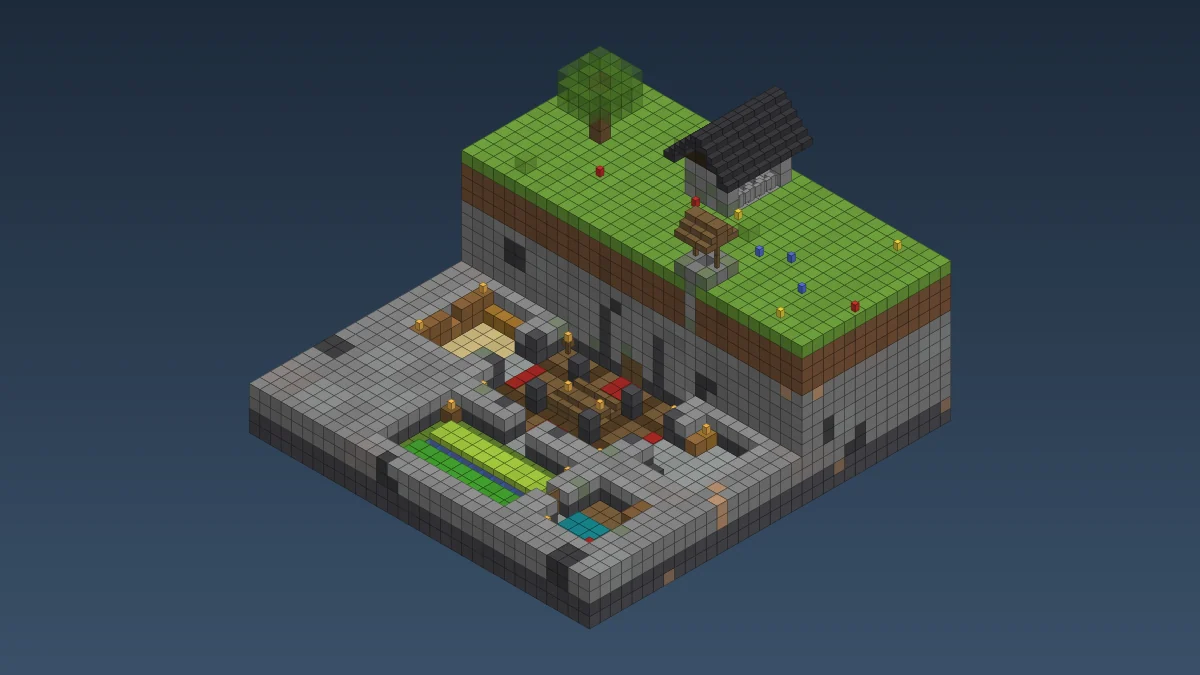
A base nobody knows is there
Most minecraft underground base builds we've seen are a cave with a door on it. Fine for night one. Dig with a plan, though, and you get something better than most surface houses: quiet, creeper-proof once it's lit, and nothing on the skyline for anyone on your server to find.
Ours goes straight down into flat grass. There's no hill to hide in, so the disguise is on top: a small roofed shrine over the stairwell, a stone well, a pond. Walk past and you'd think it was a ruin. The well is actually the fast way home, and the pond is the farm's skylight.
- Size: the dug part is 28 by 31 blocks. The model is a 32 by 34 block of ground, 20 layers tall with the shrine.
- Blocks: 1,672 that you place. The other 7,297 in the model are a shell of the ground round the rooms, plus water and crops.
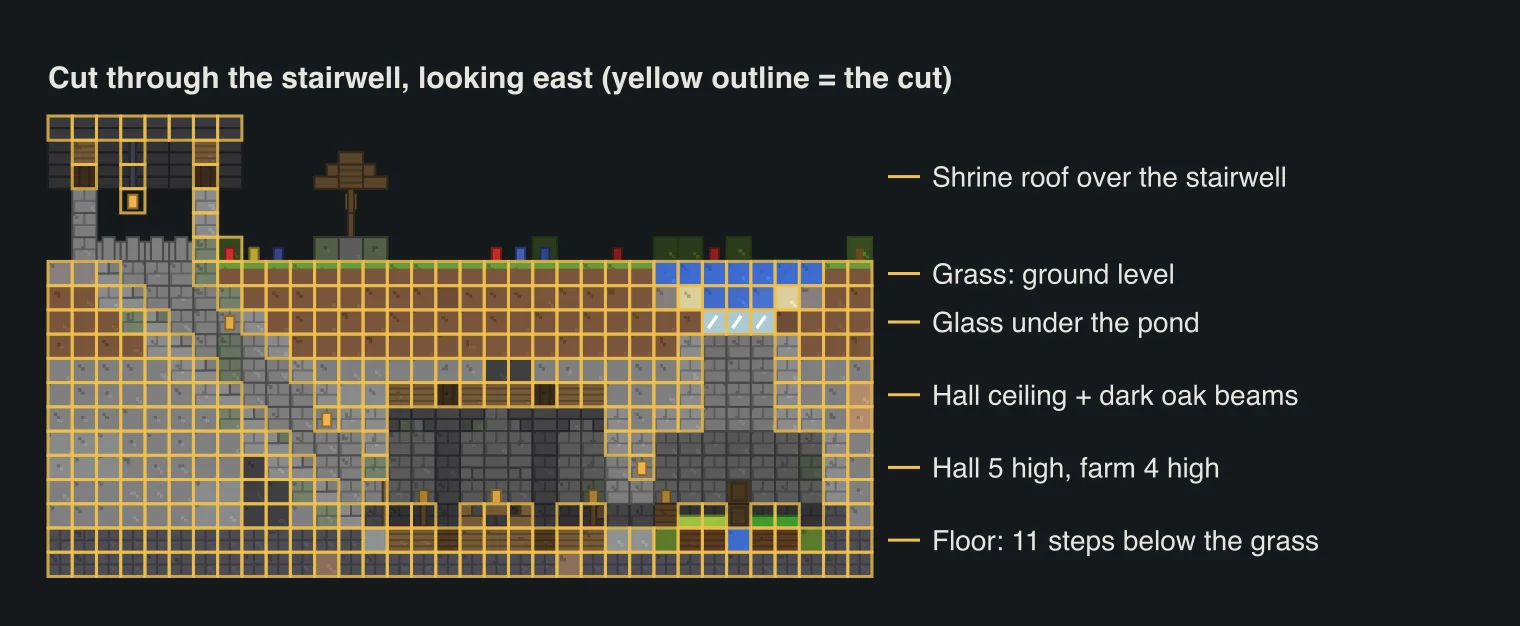
- Depth: floors are 11 steps below the grass. The hall is 5 high, every other room 4.
- Time and difficulty: medium. About four hours in survival, and half of that is digging.
- Main materials: 697 stone bricks (with mossy and cracked mixed in), 262 spruce planks, 174 deepslate bricks, 61 dark oak logs.
The minecraft underground base, layer by layer
Layer 0 is the deepslate under the floors. Floors are on Y+1, the grass is Y+12 and the shrine's ridge tops out at Y+19.
Loading…
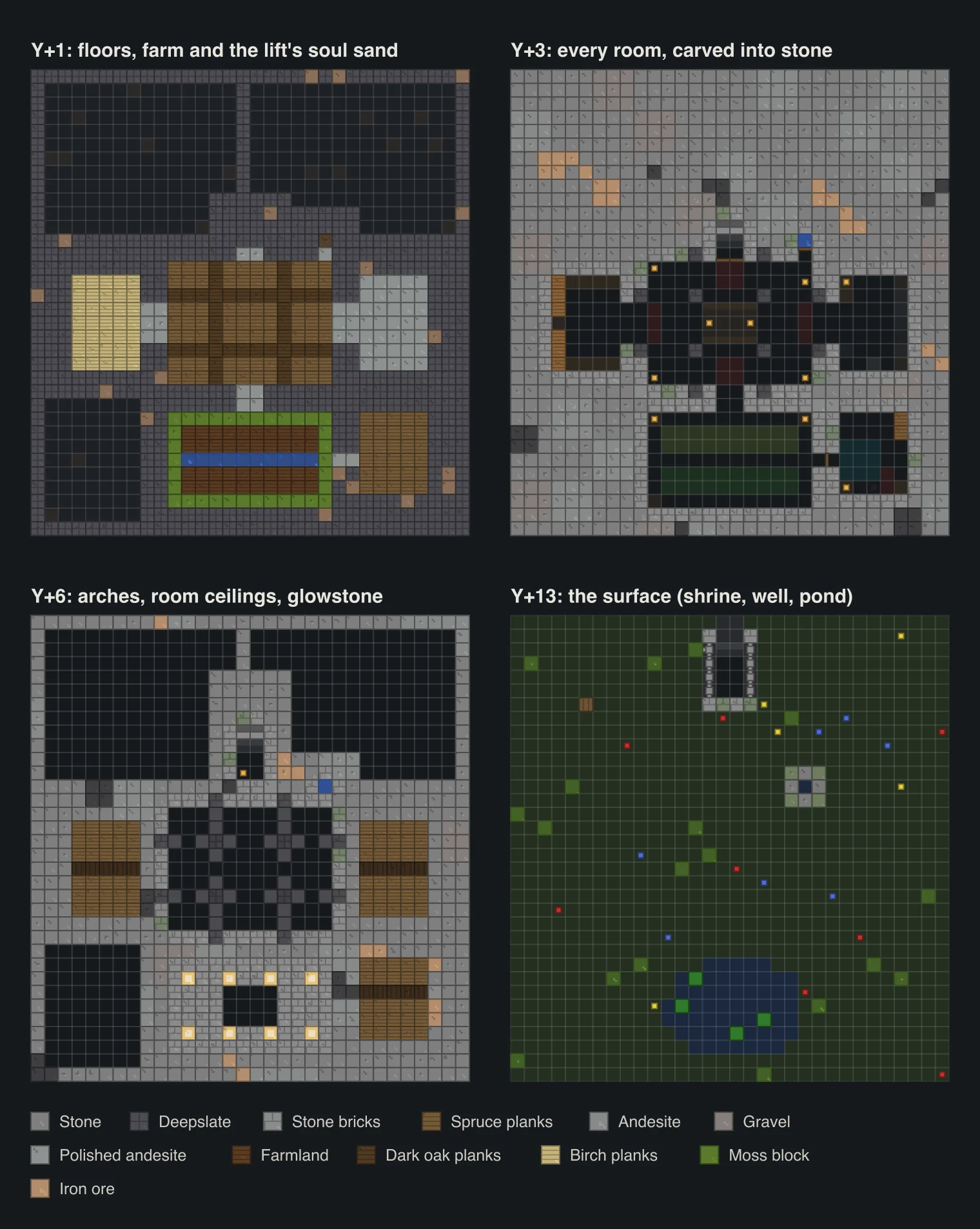
The plan is a cross. Stairs come down from the north into the hall. Storage is through an arch to the west, the workshop through an arch to the east, and a short passage south takes you into the farm. The bedroom hangs off the far side of the farm behind its own door, the quietest spot in the base.
| Block | Count | What it's for |
|---|---|---|
| Stone bricks | 584 | Wall lining, stairwell, farm ceiling, shrine walls |
| Mossy + cracked stone bricks | 58 + 55 | Mixed into the lining at random |
| Deepslate bricks | 174 | Dark course along the bottom of every wall, pillars, pilasters |
| Spruce planks | 262 | Hall and bedroom floors, room ceilings, well roof, shrine gables |
| Dark oak log | 61 | The hall's beam grid, one beam per side room, shrine tie beams |
| Deepslate tile stairs | 48 | Shrine roof |
| Farmland | 40 | Hoe it from the dirt you dig up |
| Polished andesite | 56 | Workshop and passage floors |
| Dark oak planks | 38 | Lines in the hall floor under the beams |
| Birch planks | 35 | Storage floor |
| Moss block | 34 | Path round the farm |
| Stone brick stairs | 35 | 22 for the stairwell, 8 in the arches, 5 for the furnace hood |
| Deepslate brick stairs | 24 | Arches round the pillars and corbels under the beams |
| Small stuff | 17 lanterns, 16 barrels, 14 red carpet, 14 spruce stairs, 12 glass, 10 chests, 8 chiseled deepslate, 8 glowstone, 8 stone brick walls, 7 spruce slabs, 4 bookshelves, 4 cobblestone, 4 mossy cobblestone, 4 gravel, 9 cyan carpet, 8 spruce fences, 4 spruce doors, 3 furnaces, 2 chains, 2 composters, 2 crafting tables, 1 bed, 1 anvil, 1 blast furnace, 1 flower pot, 1 smoker, 1 soul sand, 1 stonecutter |
The nice part: you pull roughly 2,800 blocks of stone and dirt out of the ground on the way, so the bricks pay for themselves. Smelt the cobblestone back into stone and four stone make four stone bricks. Wood's light: about 75 spruce logs, 9 birch logs and around 70 dark oak logs, plus whatever planks your chests and barrels eat.
How deep to dig
We put the floor 11 blocks under the grass. On plains the surface is usually somewhere around Y 63 to 70, so you end up near Y 52 to 59. That's a thick stone roof over the hall, and it keeps you clear of a couple of things that make deeper bases annoying.
- Slimes. In a slime chunk, slimes can spawn below Y 40 no matter how bright it is, on both editions. Stay above Y 40 or check the spot first with the slime chunk finder. Or lean into it and put a slime farm under the base later.
- Caves. Since 1.18 the ground is full of big caves, and breaking into one from your bedroom is a bad night. On Java the cave finder shows the large ones under your site before you start.
And please don't dig straight down. Dig the stairwell first, one step at a time, standing on the step you just cut. You can always see the block in front of you, so lava and caves come at you from the side where you can deal with them. The stairwell is 2 wide with three blocks of headroom over every step, and it's the first thing we'd build.
Dig out and line the rooms
We tried this the lazy way first: dig the rooms, leave raw stone walls. It looked like a mine. What makes it a base is lining every surface. Each block of ground that touches a room gets swapped for a building block, so no raw stone or dirt shows anywhere.
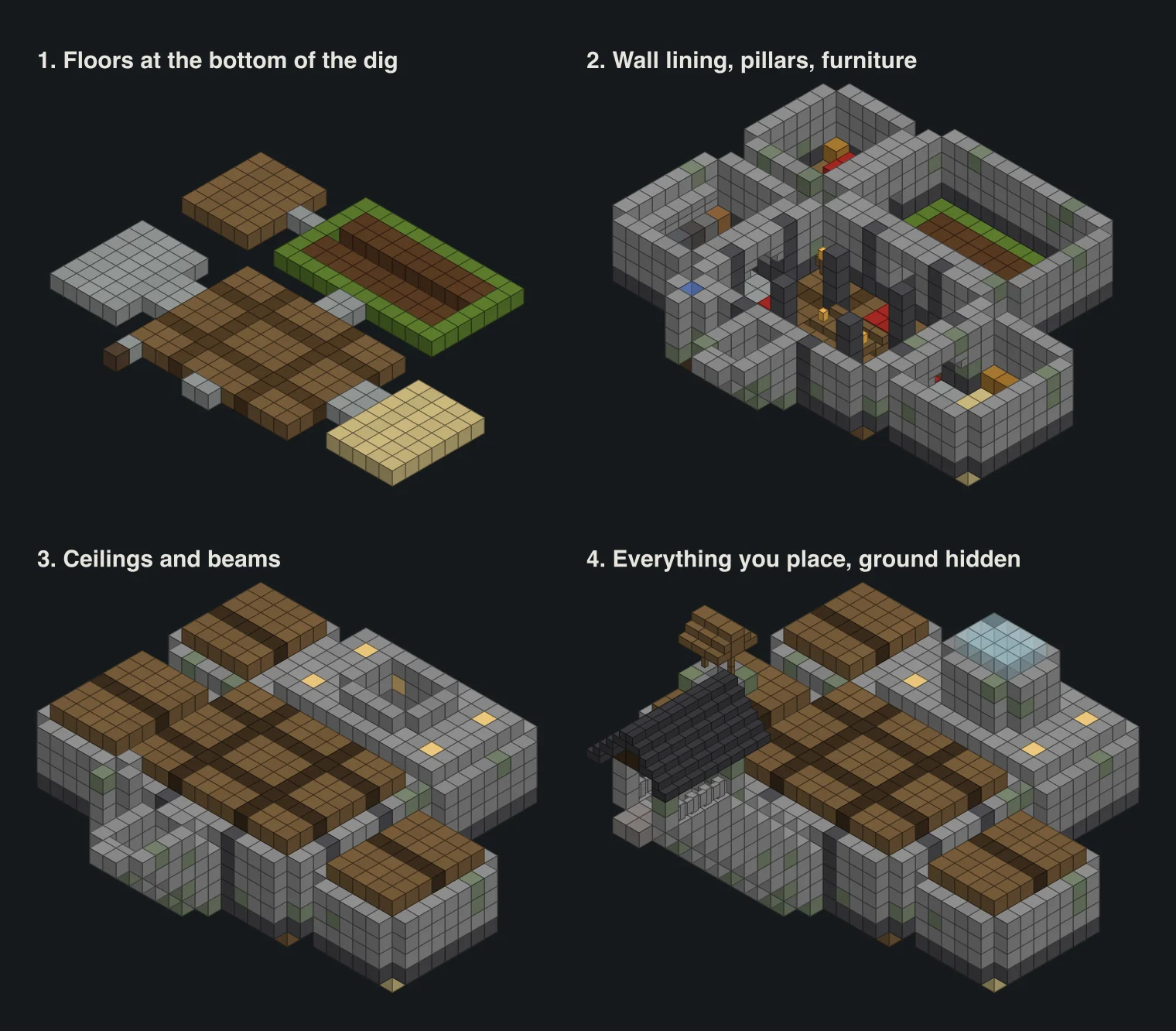
- Y+2 to Y+5, dig. Clear every room 4 high, the hall 5 high (up to Y+6). Dig all of it before you line anything, because you'll trim walls a lot.
- Y+1, floors. A different one per room, so you always know where you are underground: spruce planks with dark oak lines in the hall, birch in storage, polished andesite in the workshop and passages, spruce in the bedroom.
- Y+2, the dark course. Deepslate bricks along the bottom of every room wall. A skirting board, basically.
- Y+3 up, the lining. Stone bricks, with roughly one in eight cracked and one in twelve mossy. Pick from your hotbar at random.
- Ceilings. Spruce planks over the hall, storage, workshop and bedroom. Stone bricks over the farm, the stairwell and the passages.
- Beams. Dark oak logs in a grid across the hall ceiling on Y+7, and one beam across the middle of each side room on Y+6.
The doorways between rooms are 3 wide and 3 high, cut through a 2-block-thick wall. Put an upside-down stone brick stair in both top corners, tall side out, on each face of the wall. That's the whole arch, and it's the difference between a doorway and a hole.
The hall: pillars, arches and a beam grid
The hall is 12 by 9 inside and 5 high. Four freestanding pillars split it into nine bays: chiseled deepslate at the foot and the head, three deepslate bricks in between. On the head layer, Y+6, an upside-down deepslate brick stair goes on all four sides of each pillar, tall side against it. From the floor they read as arches springing off every pillar.
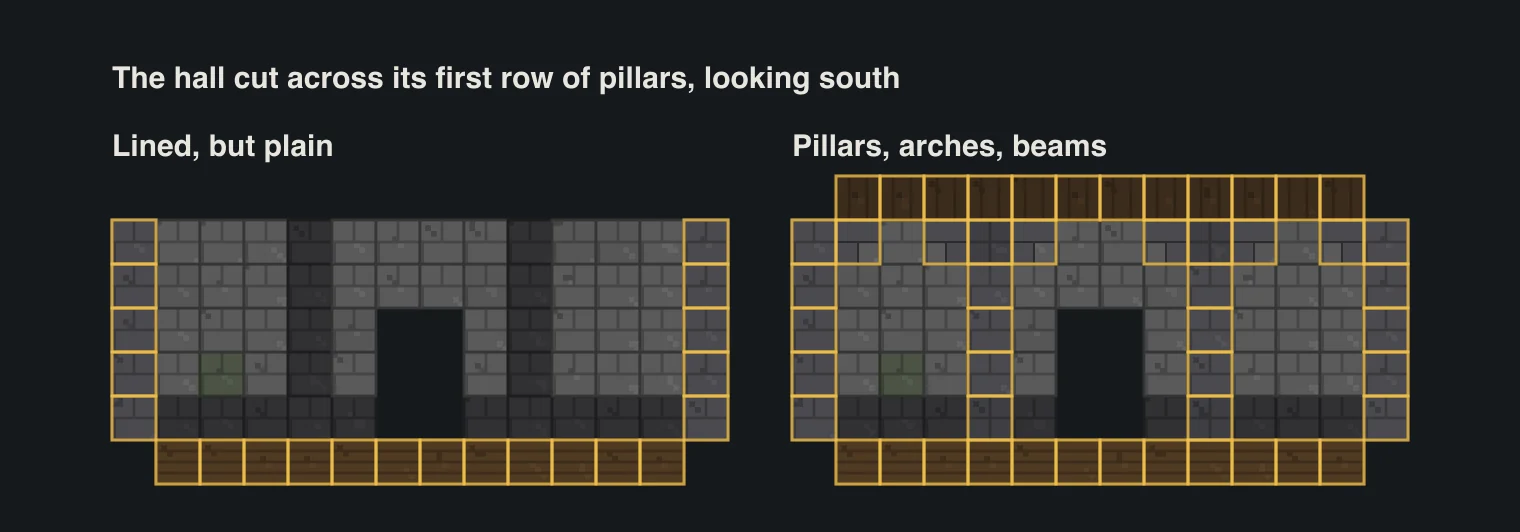
Where a beam line meets a wall we put a pilaster, a strip of deepslate bricks set into the lining from floor to ceiling, with one more upside-down stair under the beam as a corbel. There are eight. Without them the beams just stop at the wall and it looks unfinished.
Our first hall was 4 high like the other rooms, and the arches crowded your head. One more block up fixed it. If you only make one room big, make it this one.
The farm under the pond
Most underground farms we see don't grow, and it's always the light. Crops need light level 9 or more to grow, on both editions.
Ours is 12 by 7 with a moss path all the way round. Inside are two strips of farmland, 10 long and two rows each, with a water channel between them. Water keeps farmland wet for 4 blocks sideways, so every block is covered. Wheat on one side, carrots on the other.
Then the light. Eight glowstone blocks sit in the ceiling, in two rows of four right over the outside rows of crops. Light drops by one for each block it travels, so a glowstone four blocks above a crop gives it 11, and the furthest crop still gets 9. We checked every block.
In the middle of the ceiling a 4 by 3 shaft goes up four blocks to a layer of glass, and the pond sits on that. Honestly, it's for looks. Water dims sky light, and what reaches the crops is weaker than the glowstone. But you get daylight and rain over your wheat.
Mob-proofing with light levels
Here's the rule, and it's the same on Java and Bedrock since 1.18: most hostile mobs only spawn where the block light is 0. Underground there's no sky light, so any block light on a floor keeps zombies, skeletons and creepers out. A lantern or glowstone gives 15, a torch 14, and it drops by one per block.
You need fewer lights than you'd think. The model has 17 lanterns plus the farm glowstone, and every floor block is lit. Most of them stand on things: fence posts in the hall corners, the table, barrel stacks, the composters.
- The stairwell is the weak spot. It's open to the surface, so a mob can just walk down. Keep it lit and keep the doors at the bottom shut.
- Zombies break wooden doors on Hard. If you play on Hard, use an iron door with a button on each side, or a fence gate.
Getting out fast: the well lift
Eleven steps up is fine. Eleven steps up while you're on fire is not. So the well isn't a well. It's the top of a bubble column that starts behind a door in the hall's north-east corner.
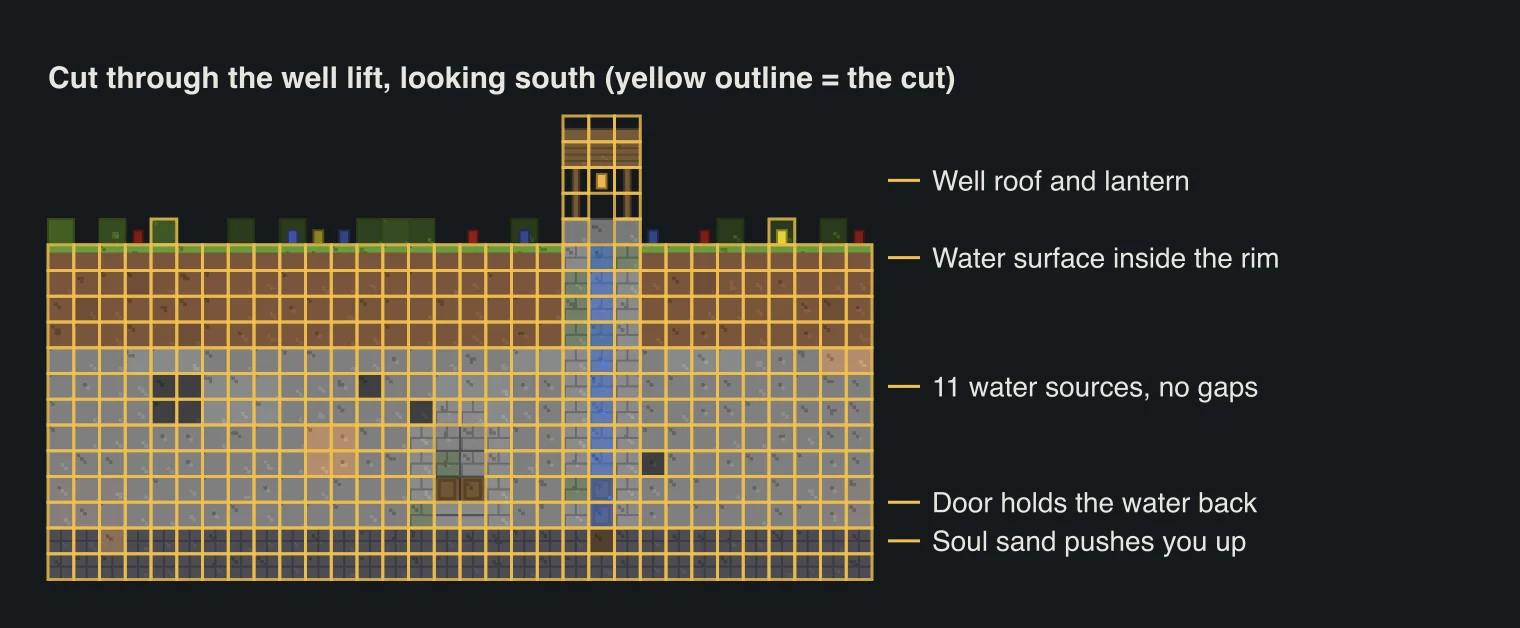
Soul sand on the floor makes an upward bubble column in the water above it. The catch: it only travels through source blocks, so all 11 blocks of the shaft have to be sources or the bubbles stop at the first gap. Easiest way we found: pour water in from the top, then dive down and place kelp on the bottom block and keep placing kelp until it reaches the surface. Kelp turns flowing water into source water. Break the bottom piece, the whole lot drops, and you're left with a full column. Then swap the bottom block for soul sand.
The door at the bottom holds the water back, so the hall stays dry. Step through it and you shoot up, about 11 blocks a second on Java and a little faster on Bedrock, and pop out inside the well. Hop onto the rim and you're out. Going down, use the stairs.
On the surface
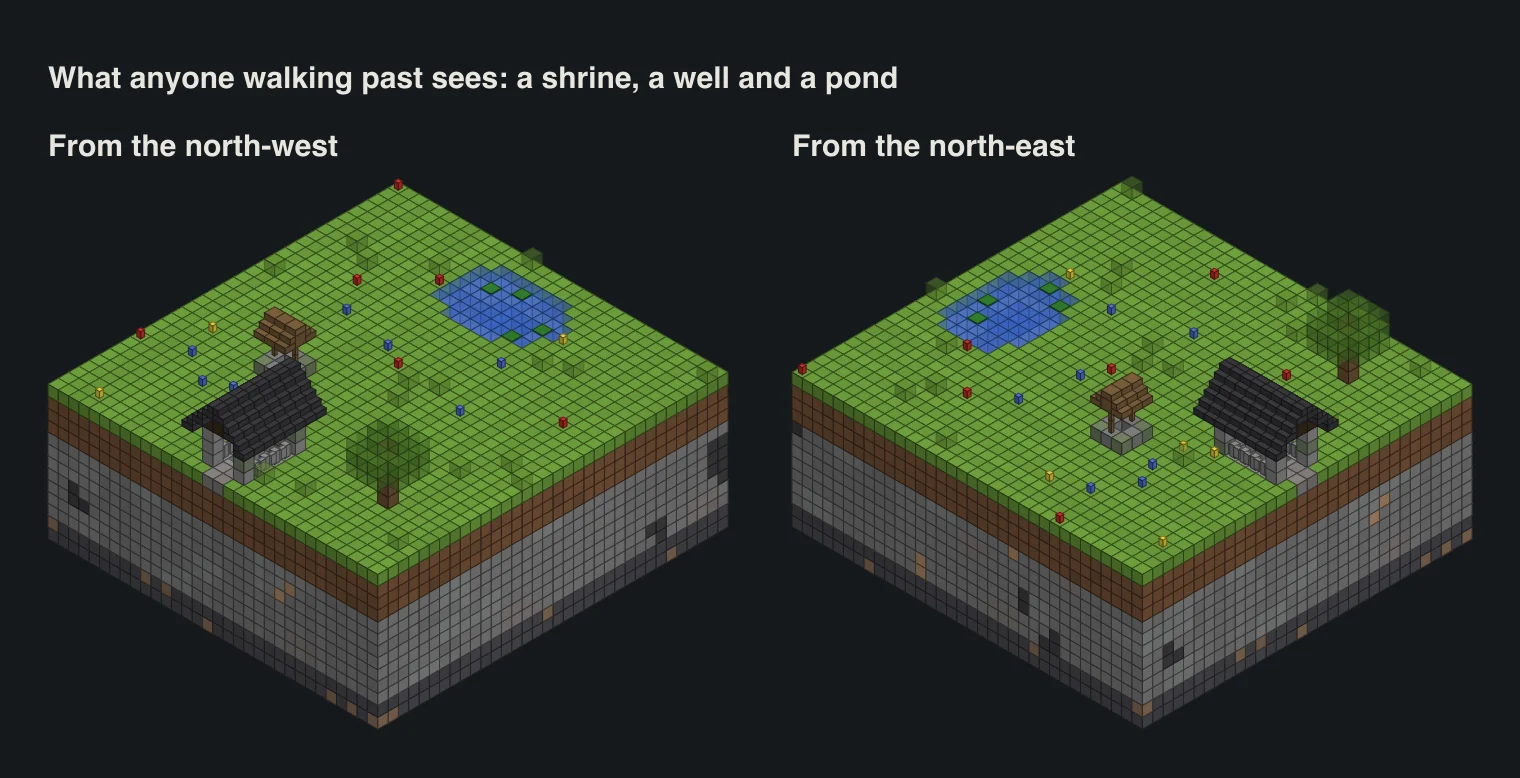
- The shrine: two stone brick posts at the front, a back wall, stone brick wall railings down both sides of the stairwell hole, and a steep gable of deepslate tile stairs from Y+16 up to Y+18. A lantern hangs on two chains over the stairs.
- The well: a 3 by 3 rim of cobblestone and mossy cobblestone with the water one block below it, two spruce fence posts and a tiny spruce roof with a lantern under it. A normal well. Nobody jumps in a well.
- The pond: water one deep with lily pads, two deep over the glass.
- The rest: grass, a few flowers, a couple of azalea bushes and one oak tree. Leave it scruffy.
Room by room
Storage (5 by 7, west). Barrels stacked two high down the far wall with a crafting table in the gap, and four chests along each end wall, with a lantern on each barrel stack. Barrels open with a block on top, chests don't.
Workshop (5 by 7, east). A furnace bank on the east wall: three furnaces, a blast furnace and a smoker, with a hood of upside-down stone brick stairs one block above them. Crafting table, anvil and stonecutter on the other side. The stonecutter turns stone into bricks, stairs and walls one for one, so it earns its spot.
Bedroom (5 by 6, south-east). A red bed against the south wall, a 3 by 3 cyan rug, two bookshelves stacked two high, a chest, a flower pot and a barrel with a lantern on it. Beds work underground just fine, so sleep here and your spawn point is inside the base.
Cheaper palette, bigger or smaller
Early game, you can build the whole thing out of what you dig. Cobblestone instead of stone bricks, plain stone or andesite for the floor, oak instead of spruce and dark oak, torches instead of lanterns, cobblestone stairs for the arches. It looks rougher but the layout carries it, and you swap blocks later room by room.
- Smaller: skip the bedroom and the lift for now. Hall, storage and the farm is a perfectly good first base, and you can cut the rest in later through the walls you've already lined.
- Bigger: every room hangs off a lined wall, so cut a new arch anywhere and keep going. Copy the hall's pillar grid for any room over 8 blocks across.
Where to dig it
Flat, boring ground is perfect: plains, savanna, the edge of a forest. Somewhere that won't turn heads. Use the biome finder to find a plains patch near spawn, check it with the slime chunk page if you plan to go below Y 40, and on Java run the cave finder over the site. Our guide on choosing a base location covers the rest.
If you'd rather live above ground after all, the big layered house is where we'd start, and the starter house is a quick shelter for the nights before the dig's done.
Questions
How deep should an underground base be in Minecraft?
About 11 blocks under the grass, around Y 52 to 59 on plains. Staying above Y 40 also means slimes can't spawn inside, even in a slime chunk.
What light level stops mobs spawning in an underground base?
On both Java and Bedrock, since 1.18, most hostile mobs only spawn at block light 0. Underground there's no sky light, so any light on every floor block keeps them out. Crops need 9 or more, though.
Can crops grow underground in Minecraft?
Yes, with block light 9 or more and water within 4 blocks of the farmland. We use eight glowstone blocks in the farm ceiling.
How do I get out of an underground base quickly?
Build a bubble column: soul sand at the bottom of a 1-wide shaft full of water source blocks, with a door at the bottom so the water stays put.
Does this underground base work on Bedrock?
Yes. Every block is on both editions, and the light rules, crop light and bubble columns work the same.
Related guides
Finders and tools in this guide
- Biome FinderSearch for any biome, from cherry groves to mushroom fields and deep dark.
- Cave FinderJavaHuge cheese caves underground, sized and with the depth to dig to — mining, bases and caving.
- Slime FinderHighlight slime chunks for Java and Bedrock — build the perfect slime farm.
- Slime Chunks ExplainedHow slime chunks work on Java vs Bedrock, and how to farm them.
Written by the Minecraft Tools team from the same world-generation engine that runs the seed map. Coordinates quoted here were computed with it for the stated seed, edition and version, and the engine is tested against the real game.