Amethyst Geodes: Where They Spawn and How Many Are Near You
JavaYou don't need luck to find a geode. On three Java 26.3 seeds we never found a spot more than about 120 blocks from the nearest one, and one seed had two within 64 blocks of spawn. The hard part is knowing which way to dig, so here's how we do it.
Updated · 6 min read · Java up to 26.3
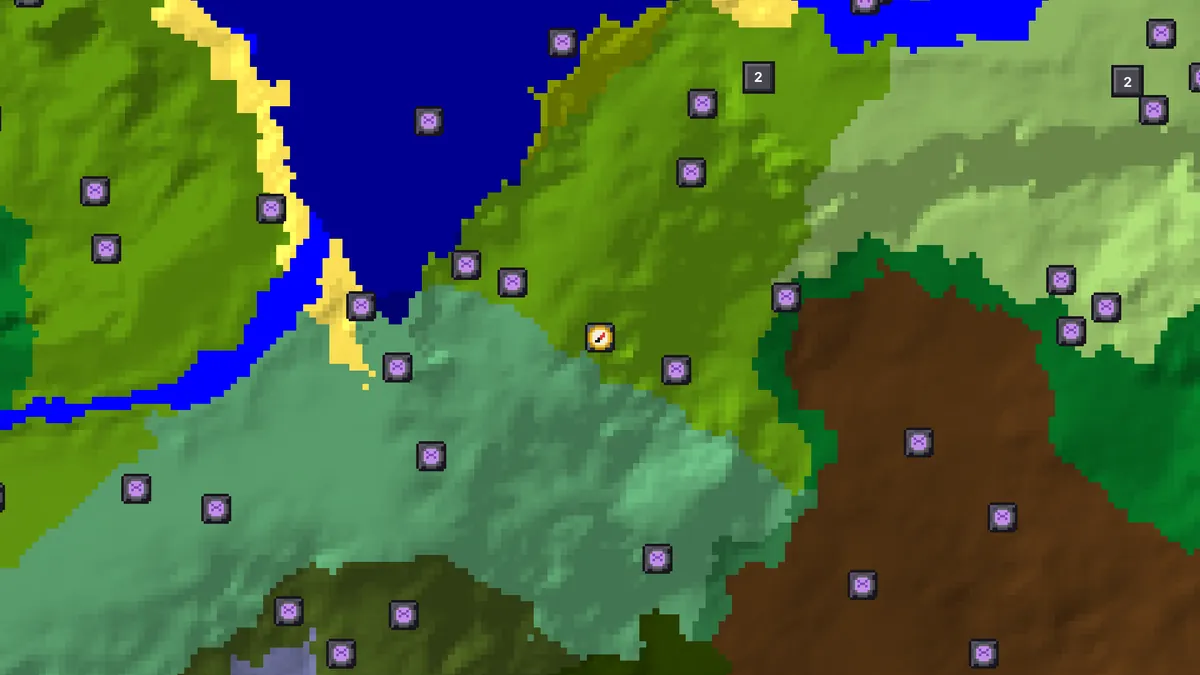
How common geodes really are
The usual line is "one chunk in 24 tries to place a geode". We wanted to see what that looks like in an actual world, so we had the engine list every geode attempt in a 2,048 × 2,048 block square (16,384 chunks) around the origin on three seeds, Java 26.3.
| Seed | Geodes | One per | Within 128 of spawn | Within 256 of spawn |
|---|---|---|---|---|
0 | 663 | 24.7 chunks | 3 | 27 |
123456789 | 668 | 24.5 chunks | 6 | 31 |
8675309123456789 | 664 | 24.7 chunks | 7 | 25 |
So the folk number holds up almost exactly. That works out to roughly 158 geodes per square kilometre, and the three seeds landed within five geodes of each other. Your seed doesn't really decide *how many* geodes you get, only where they are.
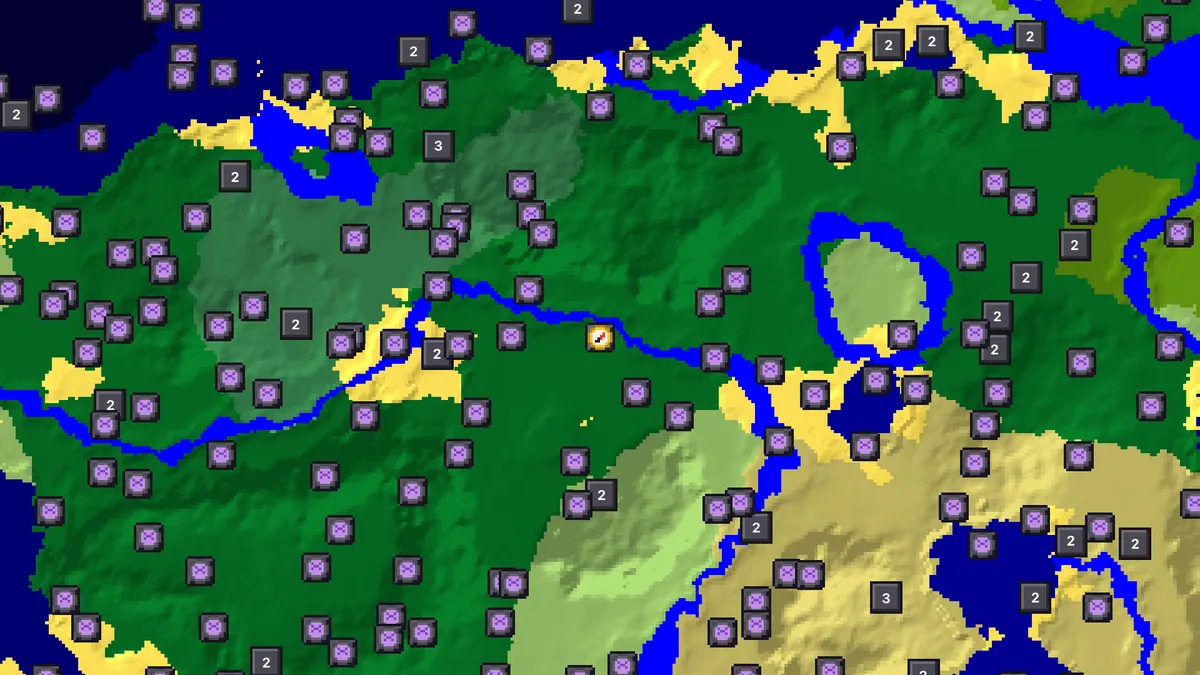
The more useful number for a survival player: we walked a 32-block grid across the middle 1,536 × 1,536 blocks of each seed and measured the distance to the nearest geode from every point. The worst spot on any of the three seeds was 122 blocks away. Wherever you build, there's a geode within a short walk. You just can't see it.
Where in the world they turn up
Geodes sit underground, anywhere from Y −58 up to Y 30, and they don't care about the biome above them. That's mostly a good thing, with one catch: a big share of them end up under water.
- On seed 0, 217 of 663 geodes (33%) sat under an ocean biome. That seed has a lot of coastline near spawn.
- Seed 123456789 is mostly forest and plains, and only 51 of 668 (8%) were under ocean.
- Seed 8675309123456789 was in between, with 121 of 664 (18%).
An ocean geode is still reachable, it's just more annoying: you dig down through the sea floor, fight the water and probably run into an aquifer on the way. Unless you're already doing an underwater base, pick a land geode.
Almost every geode is cracked. Between 95% and 96% of the attempts on all three seeds had the crack flag set, which is the game's default 95% chance. In practice the crack is the thing that gives a geode away in a cave wall: you spot the purple through the gap or hear the chimes before you see anything.
Finding one near spawn
Seed 8675309123456789 is a nice example. World spawn is at 0, 0, and the engine puts geode attempts at 46, 20 (50 blocks from spawn) and −53, −33 (62 blocks), with three more inside 120 blocks: −81, −44, then 55, −100 and 113, −24. Seed 0 is less generous. Its spawn sits at −32, 0 and the closest geode is 80 blocks away at 12, 67, with the next two at −118, −58 and −139, −2, all under forest.
- Open the amethyst geode finder, paste your seed and pick your Java version.
- Click a geode marker. The popup gives you the block X and Z, plus the distance and direction from where you are.
- Walk to that X and Z with F3 open. The finder doesn't give a Y, because the game rolls the height separately for each geode.
- Dig a staircase straight down. You'll usually hit smooth basalt somewhere between Y 30 and the deepslate. Basalt in the middle of stone means you're right on top of it.
- Once you're close, stop digging and listen. Amethyst blocks chime when you walk nearby and when something brushes them.
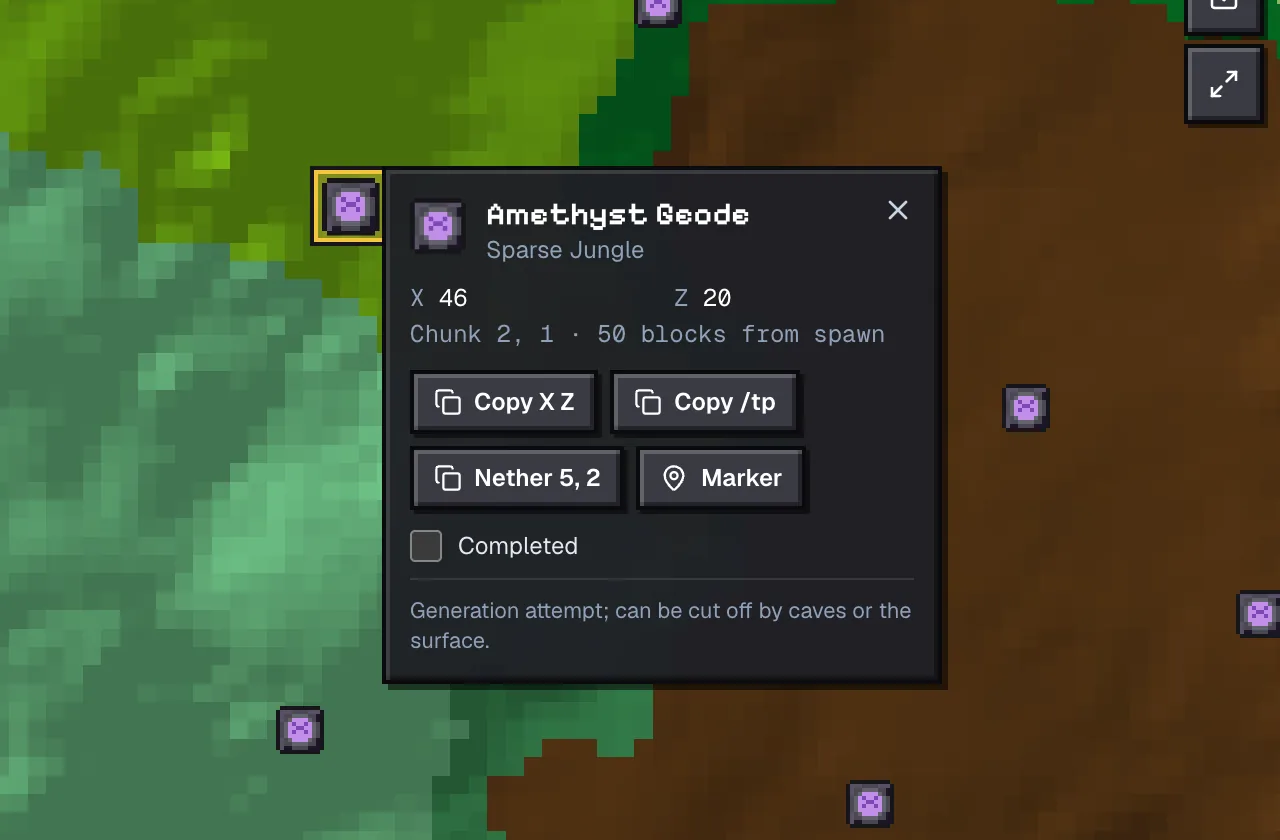
A word on accuracy. The finder shows where the game *tries* to place a geode. A cave, an aquifer or the surface can cut part of it away, and now and then a whole geode never appears. So treat each marker as a very good lead, not a promise. If you dig down at a marker and find nothing but stone by deepslate level, move to the next one.
Turning a geode into a farm
Here's the part that trips people up the first time: budding amethyst can't be moved. Silk Touch doesn't save it. Break it and it's gone. That means the farm gets built where the geode is, so pick your geode with that in mind (a land geode near your base beats a bigger one under the ocean).
- Only budding amethyst grows anything. Small bud, medium bud, large bud, then the full cluster. Breaking a bud early gives you nothing.
- Full clusters drop shards, four normally and more with Fortune. Silk Touch on a cluster gives you the cluster block itself, which looks nice as decoration.
- Clear the plain amethyst blocks around the budding ones to make room. Plain amethyst can be mined and taken home; it never grows anything.
- Leave the outer layers alone if you want, but light the inside up. Mobs love the dark hollow in the middle.
What are the shards for? A spyglass (two shards and a copper ingot), tinted glass (four shards around one glass for two tinted glass), the calibrated sculk sensor, and feeding allays. Tinted glass is the one people underrate: it blocks light completely, which makes it perfect for mob farm windows.
Bedrock and old worlds
The finder is Java only, and on purpose. Bedrock places features like geodes with its own random generator, and we haven't modelled it, so rather than show Bedrock players positions that would be wrong, the map shows nothing for Bedrock. Bedrock geodes do exist and spawn at the same depth range; you'll just have to find them by ear.
Geodes arrived in 1.17. Chunks generated before that have none, and the finder shows nothing if you pick 1.16 or older. If your world started in an older version, only the chunks you first explored after updating can hold geodes, so head out past the edge of your old map. The ore levels page and how ores generate cover what else changed underground in that update.
Questions
How many amethyst geodes are there per chunk?
About one geode per 25 chunks. On three Java 26.3 seeds we counted 663, 668 and 664 geodes in 16,384 chunks, so roughly 158 per square kilometre.
How far is the nearest geode usually?
Close. On every seed we checked, no spot in the middle 1,536 × 1,536 blocks was more than about 122 blocks from a geode attempt.
What Y level are amethyst geodes at?
Anywhere from Y −58 to Y 30. The finder gives you X and Z; dig down at that spot and watch for smooth basalt.
Can you move budding amethyst with Silk Touch?
No. Budding amethyst breaks and drops nothing, even with Silk Touch, so an amethyst farm has to be built around the geode where it generated.
Does the amethyst geode finder work on Bedrock?
No, it's Java only. Bedrock places geodes with a different random generator, so Java coordinates would be wrong in a Bedrock world.
Related guides
Finders and tools in this guide
- Amethyst Geode FinderUnderground geodes full of amethyst clusters and budding blocks.
- Cave FinderJavaHuge cheese caves underground, sized and with the depth to dig to — mining, bases and caving.
- Ore FinderJavaDiamonds, iron, gold, redstone and every other ore, block by block with Y levels.
- Spawn Point FinderSee the exact world spawn and the surrounding spawn chunks.
- Ore LevelsBest Y levels for every ore, before and after the 1.18 world height change.
Written by the Minecraft Tools team from the same world-generation engine that runs the seed map. Coordinates quoted here were computed with it for the stated seed, edition and version, and the engine is tested against the real game.