How to Find a Good Minecraft Seed
JavaBedrockThere is no single best seed, only the best seed for what you plan to do. What follows is the way we pick one: turn the plan into two or three conditions, search for those, and spend a minute reading the candidate before creating the world. Plus the handful of mistakes that make a shared seed look wrong in your own game.
Updated · 8 min read · Java & Bedrock up to 26.3
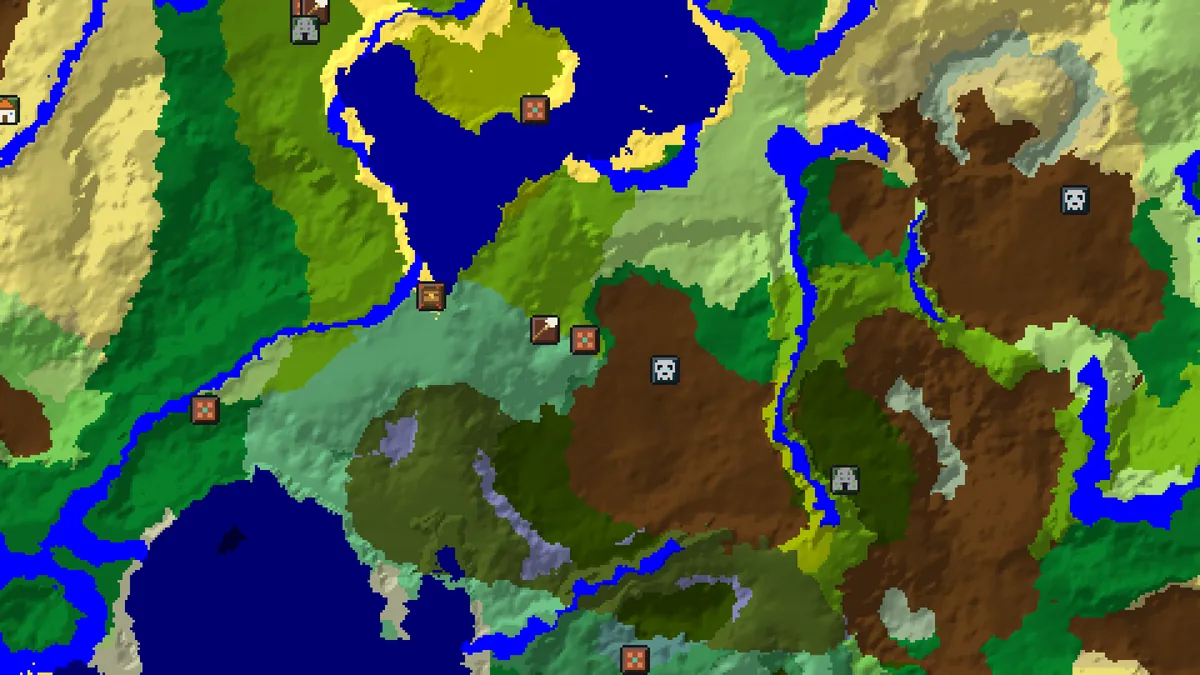
Decide what a good seed means for you
A seed is only a number. The world it produces is good or bad depending on what you want to do in it, so start by writing down the first three things you will need. A survival start wants food, beds and trades, which means a village within a few hundred blocks of spawn. A speedrun wants a bastion and a fortress close to where the portal lands in the Nether and a first-ring stronghold in a direction you can reach fast. A builder wants a specific biome, flat ground and water. A technical player wants slime chunks under the base site and a witch hut or an ocean monument within reach.
Hardcore deserves its own warning, because the things that make a seed exciting make it dangerous with one life. Seed 1340870769, on the best seeds page, has a pillager outpost 16 blocks from spawn: wonderful for a raid farm, a likely death on night one in hardcore. Seed 2441302901 has an ancient city 45 blocks from spawn, so the first strip mine can wake a Warden. Read the map for threats as carefully as for loot.
Each of those is a condition the seed either meets or does not, and every condition is something the seed map can show you before you create the world. That is really all there is to it. Stop judging seeds by screenshots and start judging them by distances.
- Survival start: village within 500 blocks, a ruined portal or lava pool nearby, a stronghold under 2,000 blocks.
- Speedrun: bastion within about 250 blocks of the portal in the Nether, a fortress near it, a stronghold in the first ring on the same side of spawn.
- Base building: the biome you want next to spawn, plus a river or ocean for transport and a mountain or cave for mining.
- Farms: two or more touching slime chunks, a witch hut, a monument or a mansion within a safe travel distance.
- Hardcore: the reverse of a speedrun. A calm spawn biome away from a pillager outpost, a village for beds before the first night, water and trees within sight, and no ancient city under your first mine.
- Building: a biome you like the look of with room around it, such as a cherry grove next to a meadow, a coast for a harbour, or a mountain with flat land below. Structures matter less than shape here.
Search for the conditions instead of scrolling lists
Lists of “top seeds” are usually screenshots of one lucky spawn in one version. The seed finder works the other way round: you describe what you want near spawn, in plain English or with explicit conditions, and it tests seeds with the same world generator the map uses, on your own device, until it has matches. Each match gets a seed score so the ones that satisfy more of your conditions come first, and every result opens on the map.
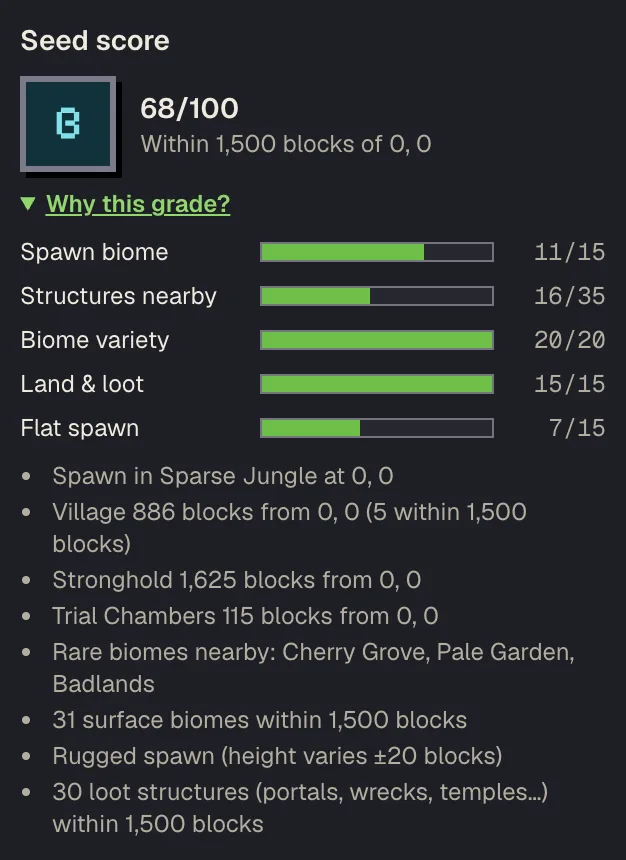
Keep the conditions few and concrete. “Village and stronghold within 1,500 blocks of spawn” finds a seed in seconds; “village, stronghold, mushroom island, mansion and cherry grove within 500 blocks” may never finish, because those things almost never line up. Add conditions one at a time and watch how the hit rate drops.
If what you want is a slime farm, use the dedicated slime seed finder: it tests millions of Java seeds a second for the most slime chunks around a chosen spot, or for an exact slime-chunk pattern.
Read a candidate seed in sixty seconds
Open the candidate on the seed map, check the spawn biome, then use the Nearest list for the four structures that matter most for your plan. This is what that looks like on two seeds we checked against the official Java server, both on 26.3.
Seed 8675309123456789 spawns at 0, 0 in a sparse jungle. The Nearest list shows trail ruins only 58 blocks away at 32, 48, trial chambers 115 blocks away at 96, 64, an ancient city 250 blocks away at 224, 112 and buried treasure at -151, -7. Jungle temples sit at -352, -432 and 512, 288, and the first stronghold is 1,625 blocks south at 132, 1620. That is an unusually dense start, and a screenshot of the spawn would show you a jungle and nothing else.
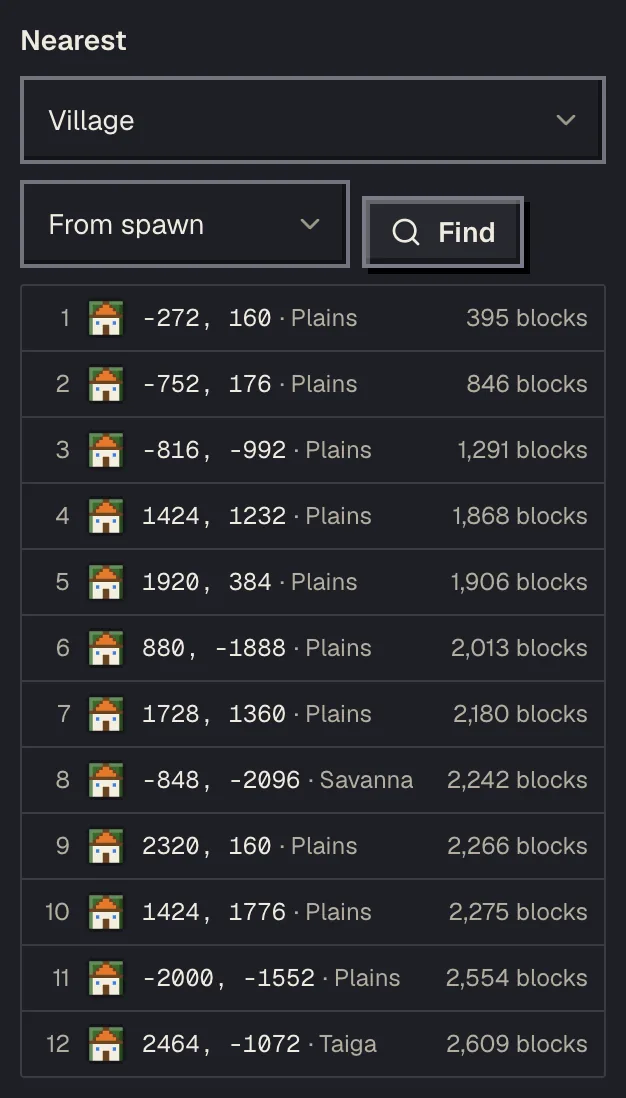
Open seed 8675309123456789 on the mapJava 26.3 · ancient city, trial chambers and trail ruins all within 250 blocks of spawnSeed 123456789 spawns at 64, -48 in a forest. The nearest village is a plains village 395 blocks away at -272, 160, trial chambers are 256 blocks away at 48, 208, the nearest ancient city is 892 blocks away at -688, 432, a woodland mansion stands at 1888, -368 and the closest stronghold is 1,944 blocks away at -908, 1636. A good all-round survival seed, with nothing spectacular but nothing missing either.
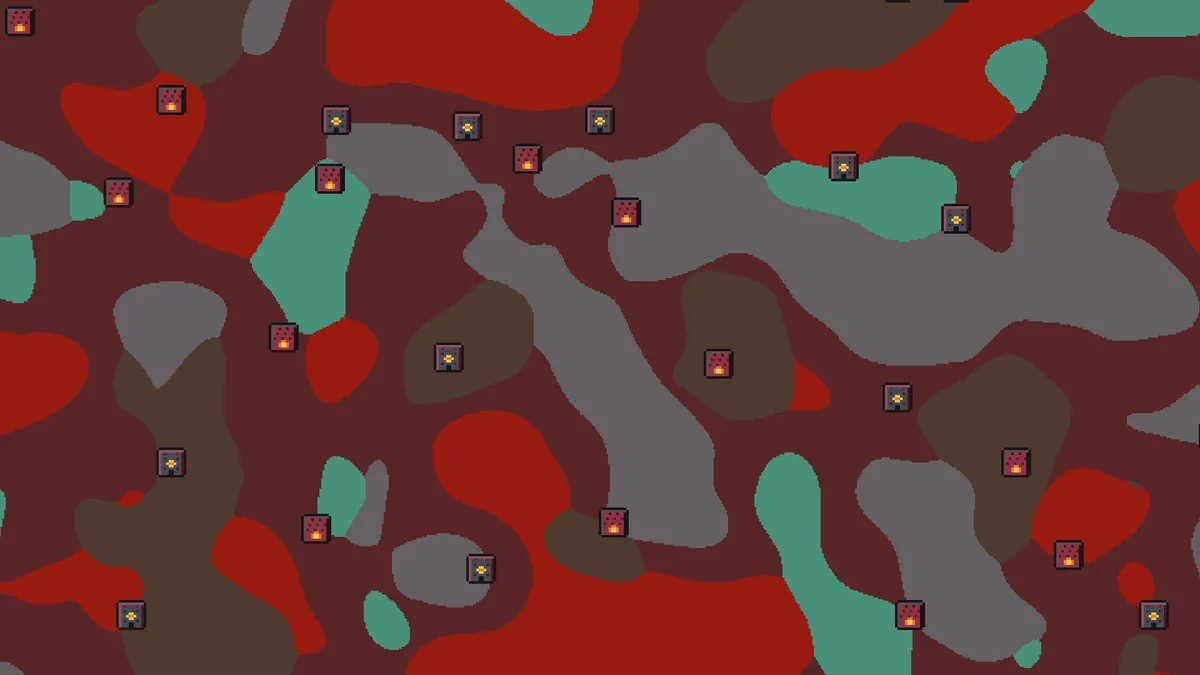
Open seed 123456789 on the mapJava 26.3 · the plains village 395 blocks from spawn, with the rest of the structures one click awaySpend the last twenty seconds on the things that are hard to fix later: is there water near spawn, is the terrain flat enough to build on, and does a Nether portal at spawn land you near a bastion? Switch the map to the Nether and look within 300 blocks of spawn ÷ 8.
A checklist before you commit
- Edition and version set to what you will play, including Large Biomes if you use it.
- Spawn biome and terrain you can live with for the first hour.
- A village or a ruined portal within walking distance, and water for a boat.
- The nearest stronghold under about 2,000 blocks, ideally in the same direction as the village.
- In the Nether view, a bastion or fortress within 300 blocks of spawn ÷ 8.
- For farms: slime chunks, a witch hut or a monument marked on the map and noted down.
- The seed saved to your library with a bookmark on each spot you plan to use.
If the seed fails two of these, keep searching. Seeds are free and the seed finder tests thousands a minute; a world you abandon after a week is the expensive option.
Keep the seed and share the view
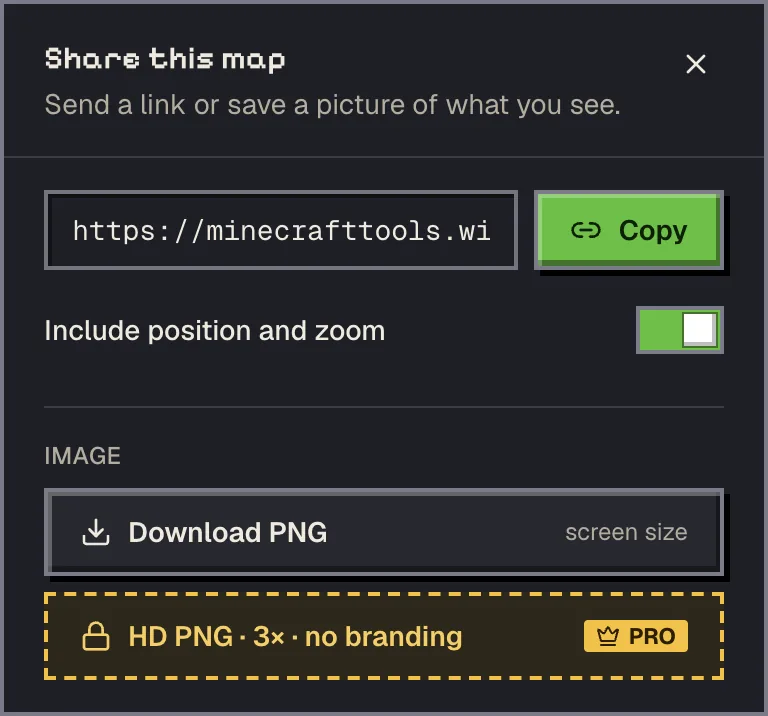
Once you have chosen, copy a link from the map. It carries the seed, edition, version, dimension, position and the layers you switched on, so a friend who opens it sees the same view. Saving the seed to the library keeps your bookmarks and markers with it, and signing in syncs them across devices.
Keep the version in the name of the world or in your notes. In a year, when you want to find the next ancient city in the same world, you will need to know which version the chunks around spawn were generated in.
Questions
What is the best Minecraft seed?
There is no best seed, because every goal needs different things near spawn. The seeds in this guide are good starting points for survival, but a speedrunner or a slime farmer would reject them. Search for your own conditions with the seed finder instead.
Do seeds work across versions?
The number is accepted in every version, but the world only matches if the version matches. Terrain changed in 1.18 and new structures arrived in 1.19, 1.20, 1.21, 1.21.4 and 26.3, so a seed from an older video can look very different in a new world.
Is a text seed different from a number seed?
No. The game converts text to a 32-bit number with Java's String.hashCode, on Java and on Bedrock. “chunkscout” and -1507551055 are the same world. Numbers typed directly can use the full 64-bit range.
Does a Java seed give the same world on Bedrock?
The Overworld biomes match from 1.18 on, but villages, temples, strongholds and every other structure are placed by a different algorithm on Bedrock, and the Nether and End differ. Set the edition on the map to see the right positions.
Can I find a seed with a specific structure at spawn?
Yes. The seed finder accepts conditions such as a village within 200 blocks of spawn, a stronghold within 1,500 blocks or a particular biome at spawn, and ranks the matching seeds by how well they fit.
Related guides
Finders and tools in this guide
- Seed MapInteractive biome map with every structure, slime chunk and spawn point on one canvas.
- Village FinderLocate villages by biome type — plains, desert, savanna, taiga and snowy.
- Stronghold FinderFind every stronghold ring and the End portal room nearest to spawn.
- Trial Chamber FinderCopper-lined trial chambers with spawners, vaults and breeze rods.
- Ancient City FinderDeep dark cities with the warden, sculk and swift sneak books.
- Seed ConverterTurn a text seed into its numeric value (String.hashCode, same on Java and Bedrock).
Written by the Minecraft Tools team from the same world-generation engine that runs the seed map. Coordinates quoted here were computed with it for the stated seed, edition and version, and the engine is tested against the real game.