How to Build a Windmill in Minecraft
JavaBedrockMost Minecraft windmills are a tube with four planks stuck on the front. Ours is a home: a stone storage floor, a mill room with a gallery round it, a bedroom up under a dark oak cap, and a little bakery cottage on the side. The sails are the tricky bit, so we spend a whole section on them. Every layer and every block is below.
Updated · 11 min read · Java & Bedrock up to 26.3
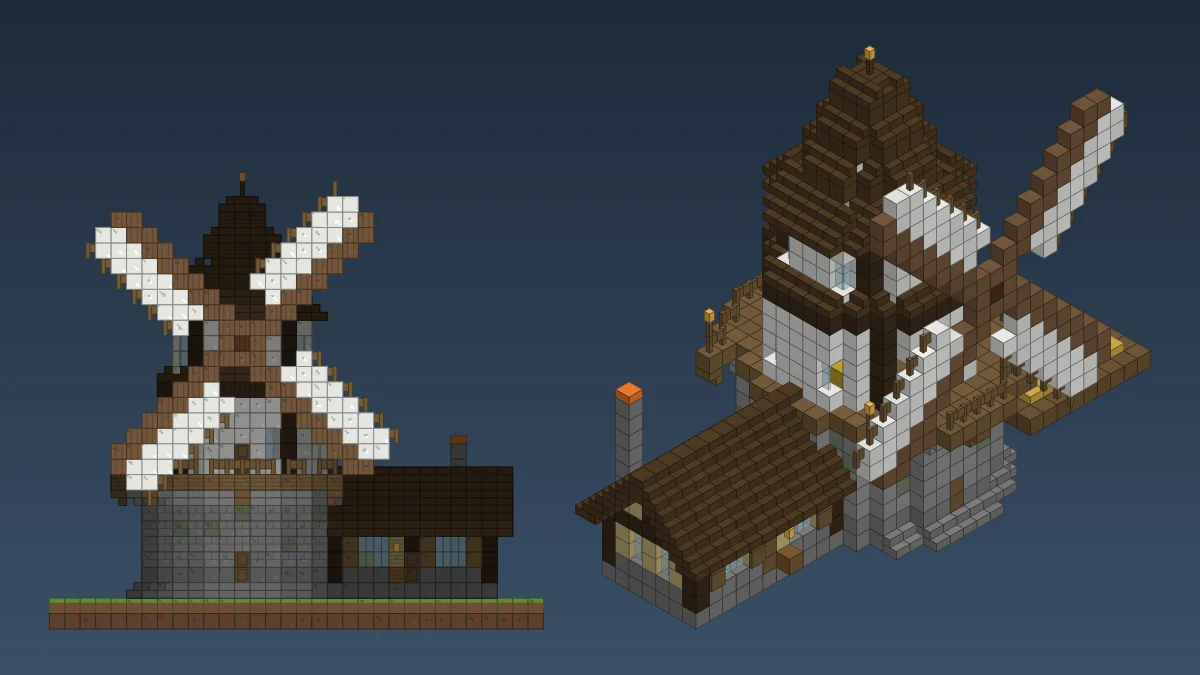
A Minecraft windmill you can actually live in
Search "minecraft windmill" and you'll mostly find the same thing: a skinny cylinder, a cone, and four planks nailed to the front. Walk inside and there's a ladder and nothing else. We wanted a windmill that's a proper base: chests, a mill room, a bed at the top and a kitchen next door.
So this one steps in as it climbs. A wide stone base, a white mill room one block narrower, a bedroom narrower again, then a tall dark oak cap with a lantern on the tip. A wooden gallery wraps the middle like on the old Dutch mills, and a small miller's cottage leans on the east side. Out front, four big sails in an X.
- Size: 28 by 18 blocks with the sails and the cottage, 28 blocks tall to the lantern on the cap. The tower itself is 13 across at the base.
- Blocks: 1,808 items, not counting the optional wheat field.
- Main materials: stone bricks, spruce planks, calcite, dark oak and 72 white wool for the sails.
- Difficulty and time: medium. Round walls are easy once you follow the plans. The sails take longest. Budget a couple of evenings of building once the materials are in the chests.
One thing up front, because people always ask: the sails don't turn. Vanilla has nothing that rotates a build, on Java or Bedrock, so they're decoration made of logs, wool and fences. It's a house that just looks like it grinds your wheat.
Layer by layer: the whole windmill
Y+0 is the ground, where the stone floor and the cottage floor sit. Spin the 3D view whenever a round wall gets confusing.
Loading…
| Block | Count | What it's for |
|---|---|---|
| Spruce planks | 315 | All three floors, the gallery deck, the cottage floor |
| Stone bricks | 285 | 245 plain, 20 cracked, 19 mossy and 1 chiseled: the base wall and floor |
| Dark oak stairs | 222 | The cap, the shoulder ring, the cottage roof |
| Calcite | 205 | Mill room and bedroom walls |
| Cobblestone | 136 | Footing, bottom course, cottage plinth and chimney |
| Stripped spruce logs | 80 | 64 in the sail stocks, the rest for the mill shaft and ladder posts |
| White wool | 72 | Sail cloth, 18 per sail |
| Dark oak planks | 71 | Cap rings |
| Dark oak logs | 69 | Beam ring, corner posts, windshaft |
| Spruce fences | 65 | Gallery rail, lantern posts, sail edges |
| Glass panes | 52 | Windows, about 4 crafts |
| Spruce logs | 46 | Cottage posts and wall plate |
| Stone and spruce stairs | 65 | 29 cobblestone stairs (plinth), 29 stone brick stairs (corbel), 7 spruce stairs (brackets) |
| Birch planks | 28 | Cottage infill and gable |
| Small stuff | 13 barrels, 13 ladders, 12 dark oak slabs, 10 lanterns, 8 smooth stone slabs, 6 chests, 6 hay bales, 6 spruce trapdoors, 5 chains, 4 spruce doors, 2 crafting tables, 2 red carpets, a bed, a bookshelf, a campfire, a composter, a dark oak fence, a furnace, a grindstone, a smoker, a stripped dark oak log |
The grind is dark oak: roughly 170 logs once it's all crafted, so build near a dark forest or plant a few 2 by 2 saplings early. Spruce is about 250 logs once the fences and doors are crafted. The wool is the part that sneaks up on you: 72 blocks is a lot of sheep, so start a little pen before you start the tower.
The stone base and the storage floor
Everything is a circle 13 blocks across, centred on one block. Mark the centre with a torch and lay the Y+0 ring of cobblestone from the plan below. Fill the inside with stone bricks for the floor, then put a ring of cobblestone stairs round the outside, tall side facing in. Leave that ring out on the east where the cottage goes.
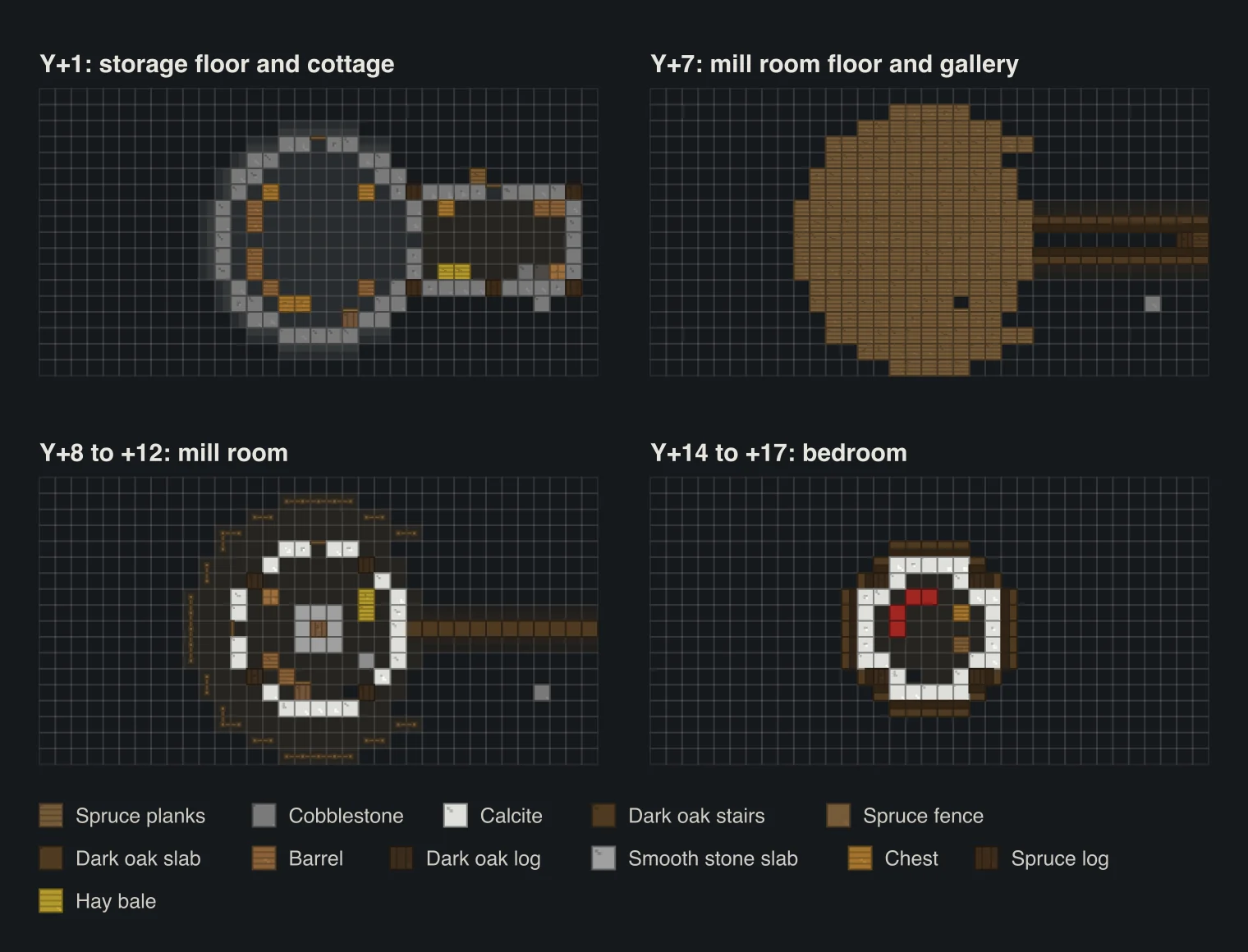
The base wall goes up six layers, Y+1 to Y+6. Bottom course in cobblestone, the rest stone bricks with a cracked or mossy one dropped in at random. No pattern. It should look old.
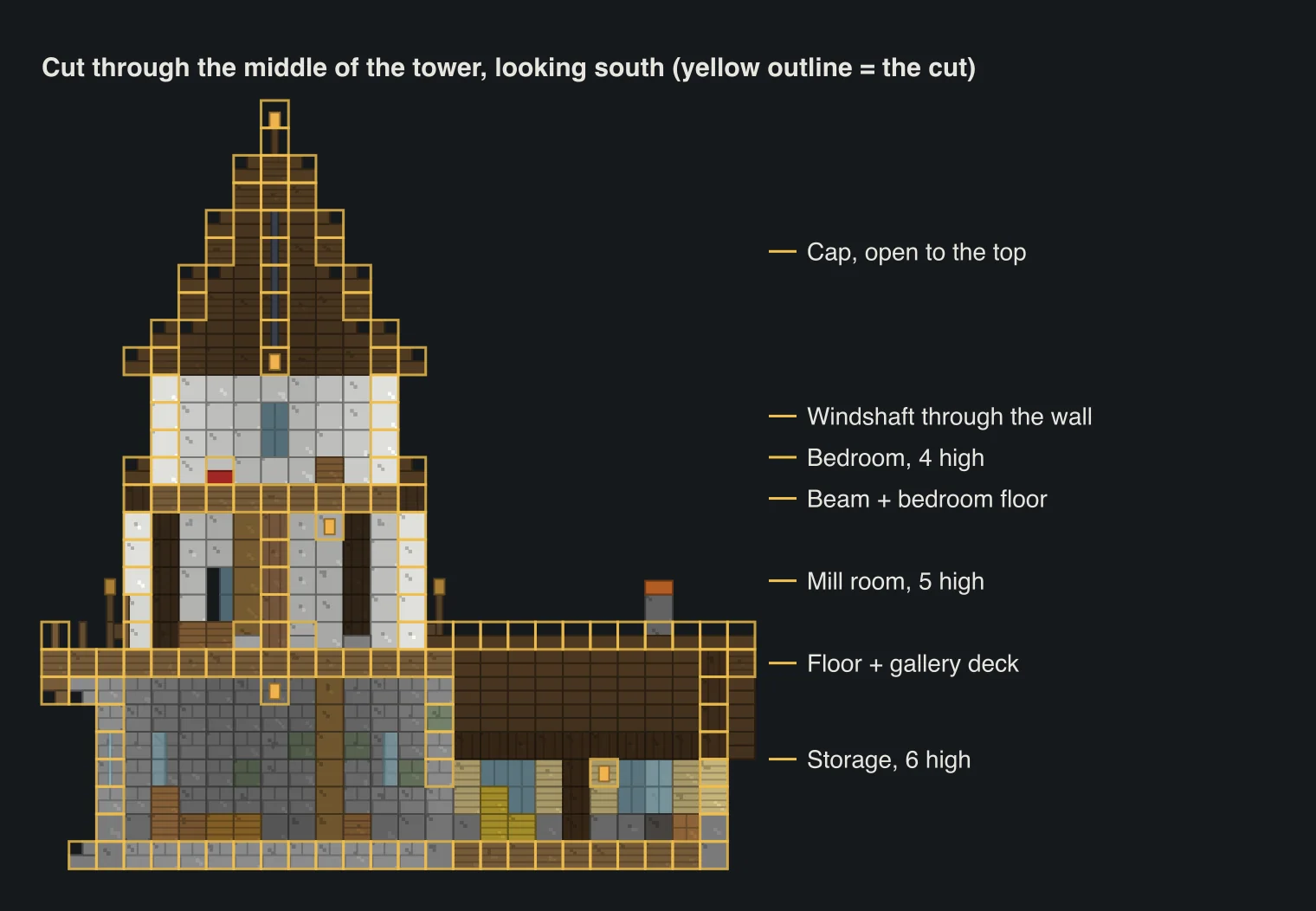
Small windows two panes tall on Y+3 and Y+4, a spruce door facing north with a chiseled stone brick over it, and a 1 by 2 arch on the east side straight through into the cottage. Inside you've got 11 blocks across and 6 high. It's the storeroom: barrels round the walls, a double chest, and the first ladder.
The gallery and the mill room
Y+7 is the big layer. Spruce planks across the whole circle for the mill room floor, leaving the ladder hole, carried on out past the wall to a ring 17 blocks across. That outer part is the gallery deck. A ring of spruce fence goes on its edge at Y+8.
Under the deck, just outside the stone, run upside-down stone brick stairs as a corbel. Then put an upside-down spruce stair at the compass points on the rim as brackets. There are seven, because the cottage roof takes the eighth spot. On the four diagonals add a second fence and a lantern, so the gallery has four lit posts.
The mill room wall starts at Y+8, one block in from the stone, which leaves about two blocks of deck to walk round inside the rail. It's calcite, five layers tall, with dark oak logs on the four diagonals. Glass panes go in pairs on Y+9 and Y+10, and two doors open onto the gallery: one on the north under the sails, one on the west.
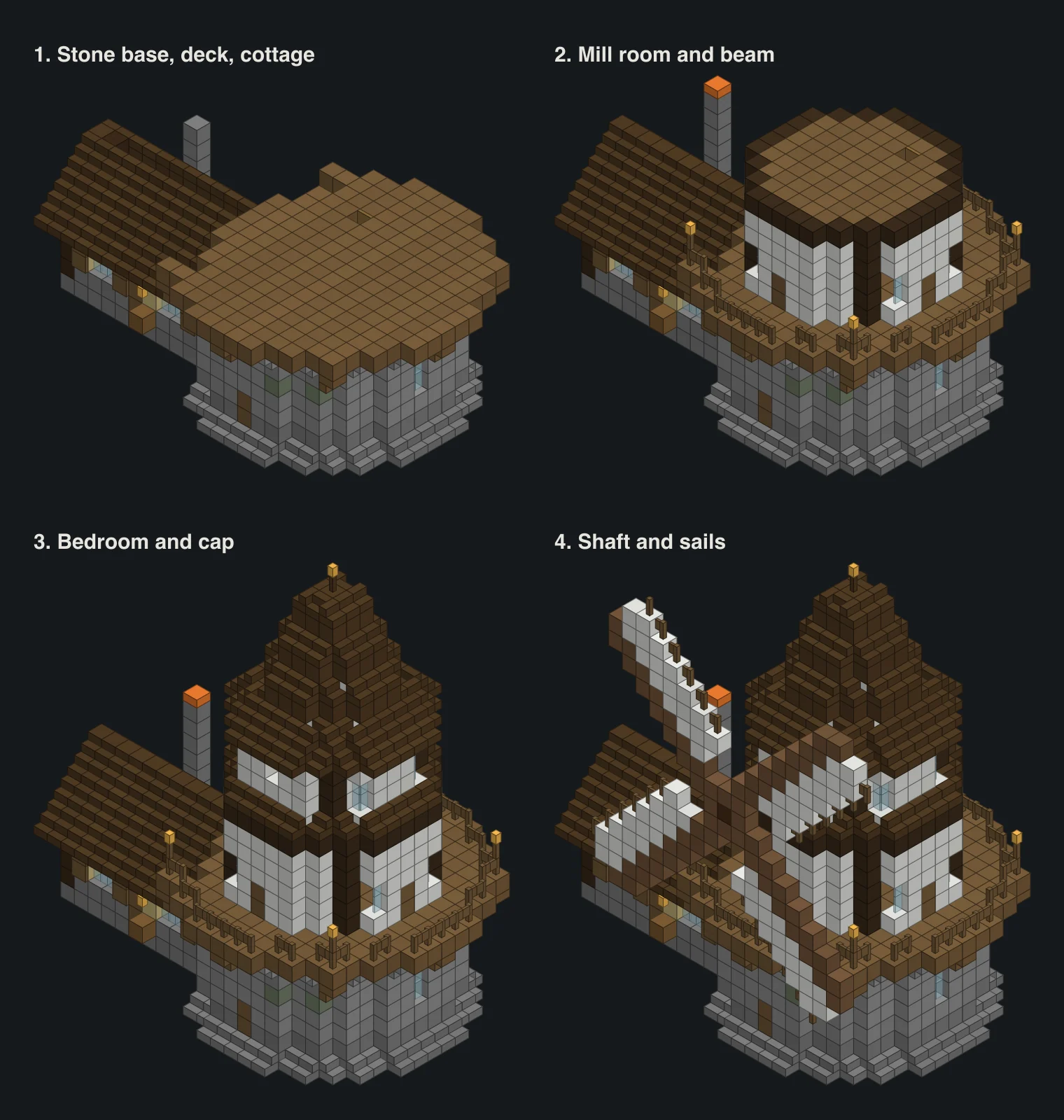
Inside, the mill room is 9 across and 5 high. A stripped spruce log stands in the middle as the upright shaft, with eight smooth stone slabs round its foot for the millstone. Hay, a grindstone, barrels and a crafting table fill the edges.
Bedroom, shoulder and the cap
Y+13 is a ring of dark oak logs on top of the mill room wall with the bedroom floor inside it. On Y+14, right on that ring, place dark oak stairs facing inward. That's the shoulder: a sloped edge instead of a flat ledge, and it looks far more like a real mill.
The bedroom wall is calcite again, one more block in, Y+14 to Y+17. It's only 7 across inside: a bed, a chest, a bookshelf, a bit of carpet. No ceiling. You look straight up into the cap at a lantern on a chain.
The cap is where we changed our minds the most. The first version stepped in one block every layer and came out like a squat dark box on top of the tower. So we went steeper: a brim of stairs that hangs one block over the bedroom wall on Y+18, then two layers per step. A full ring of dark oak planks, a ring of stairs on top of it, then the next ring one block smaller. That gets you a proper point at Y+25, then a fence and a lantern on the tip.
Building the windmill sails
Sails are where most windmills fall apart. Planks stuck straight out make a plus sign, which looks like a weathervane. Angle them into an X and it says windmill, every time.
First the windshaft. A row of dark oak logs sticks out of the north side of the bedroom on Y+16, through the wall and over the gallery, with a dark oak stair on top where it leaves the cap like a little hood. The last block, one past the gallery rail, is the hub: a stripped dark oak log. Every sail sits in that one flat layer of blocks in front of the gallery.
- The stock. From the hub, run a staircase of stripped spruce logs out on a 45° line: two logs side by side, then the next pair one block up and one block out. Twelve blocks along the diagonal is about eight across and eight up.
- The cloth. Starting two steps from the hub, put three white wool next to the stock on each layer, all on the same side.
- The edge. Finish each layer with one spruce fence on the outside of the wool. Fences link up to full blocks next to them, so they read as a wooden frame.
- Repeat, turning. Do the other three arms the same, but keep the cloth on the side that would trail if the sails turned. In the face-on picture the cloth is on the same side of every stock as you go round. That's what makes it look like it's turning.
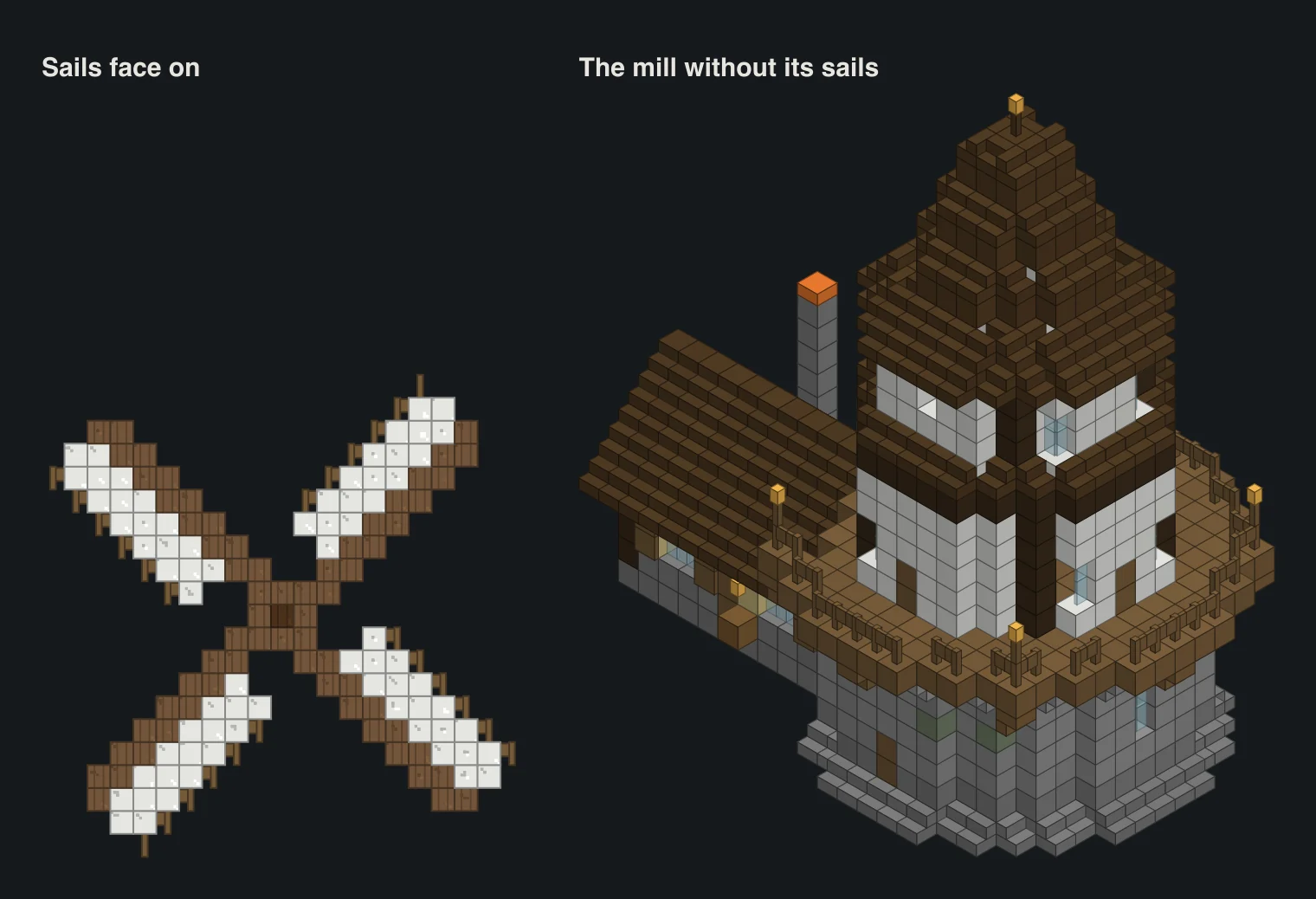
Each sail is 40 blocks: 16 logs, 18 wool and 6 fences. The whole set spans 21 blocks tip to tip, and the lowest sail block sits at Y+6, just under the gallery deck, Stand a scaffolding tower in front of the gallery to work from, and do the bottom two arms first while you still have room to move.
The miller's cottage and a wheat field
The cottage on the east side is 11 by 7 outside, 9 by 5 inside, sitting on a cobblestone plinth. Spruce log posts at the corners and the middle, birch plank infill, glass on Y+2 and Y+3, and a spruce log wall plate all round on Y+4. The front door faces north with trapdoor shutters beside the windows and a lantern by the door.
Its roof is a plain 45° gable of dark oak stairs with a slab ridge on Y+8, running west until it dies into the tower above the gallery. Leave the gallery and the plinth stairs off on this side or they'll clip the roof. A cobblestone chimney stands against the south wall with a campfire on top for smoke.
Inside it's the bakery: a furnace and a smoker on the chimney wall, a crafting table, barrels for flour (well, wheat), a stack of hay bales and a chest. The composter by the front door is a farmer's job block, so an unemployed villager who wanders by will happily take the job.
Now the bit that makes a windmill make sense. West of the tower in our model is a 9 by 9 field: an oak log border, a water channel down the middle and 42 farmland either side. Water keeps farmland wet up to 4 blocks away, so one channel covers the lot. Three wheat makes bread and nine packs into a hay bale. The field is optional and not in the table. For more crops, our modern farmhouse has vegetable beds you can copy.
Cheaper palettes, other sizes, where to build
Early game. Calcite comes from amethyst geodes, the white layer inside the shell. If you haven't found one, the geode finder will. Or use stripped birch logs or birch planks for the walls. Swap dark oak for spruce and the whole thing is one wood. Swap stone bricks for plain cobblestone and you can build it on day two.
Smaller. Skip the bedroom tier and put the cap straight on the beam, then cut each sail to eight blocks along the diagonal. You lose a room and a big chunk of the calcite. Bigger. Add a fourth tier one block narrower again, raise the windshaft with it and stretch the stocks to sixteen. Keep the hub high enough that the bottom tips stay a few blocks off the ground.
Windmills want open ground. Plains, sunflower plains and meadows are perfect, a riverbank even better. The biome finder shows them on your seed. A plains village next door brings farmers and wheat already growing, and the village finder plus our village guide will get you there.
New to round builds? The wizard tower uses the same circle tricks. Never built walls with depth? Start square with the big layered house.
Questions
Can you make a windmill that spins in Minecraft?
Not in vanilla. Neither Java nor Bedrock can rotate a structure, so the sails are decoration. Some Java mods add turning sails, but a survival windmill like this one stays still.
How many blocks do I need for this windmill?
1,808 items without the wheat field. The big ones are 315 spruce planks, 285 stone bricks, 222 dark oak stairs, 205 calcite, 136 cobblestone, 80 stripped spruce logs and 72 white wool.
How do you make windmill sails look right in Minecraft?
Angle them into an X, not a plus. Build each stock as a 45° staircase of logs two wide, put the cloth on the same trailing side of every arm, and edge it with fences. Keep the sails in one flat layer of blocks in front of the tower.
Where's the best place to build a windmill?
Open, flat ground: plains, sunflower plains, a meadow or a riverbank. Somewhere near a village helps, since villages come with farms and farmers. Trees around the base hide the sails, so clear them.
Does it work on Bedrock?
Yes. Every block exists on both editions, ladders and doors place the same way, and the farm works the same. The only version note is the wool slab tip, which needs Java 26.3 or Bedrock 26.50.
Are the pictures screenshots?
No. They're drawn from the same block model as the layer viewer and the material table, so the numbers match what you see.
Related guides
Finders and tools in this guide
Written by the Minecraft Tools team from the same world-generation engine that runs the seed map. Coordinates quoted here were computed with it for the stated seed, edition and version, and the engine is tested against the real game.